You sit down at the NMAT test centre, and before the first question appears, the screen asks you to choose the order of the three sections. You hesitate. You never thought about this in mocks. You pick the default order, start with Language, and the 28-minute timer feels like it's running twice as fast as your reading.
NMAT gives you more control than most MBA exams, and that control only helps if you've planned for it. You choose your section order, each section has its own timer, and the test adapts to how you answer. Once you understand those three features, you can build a pacing plan that fits your strengths instead of fighting the format.
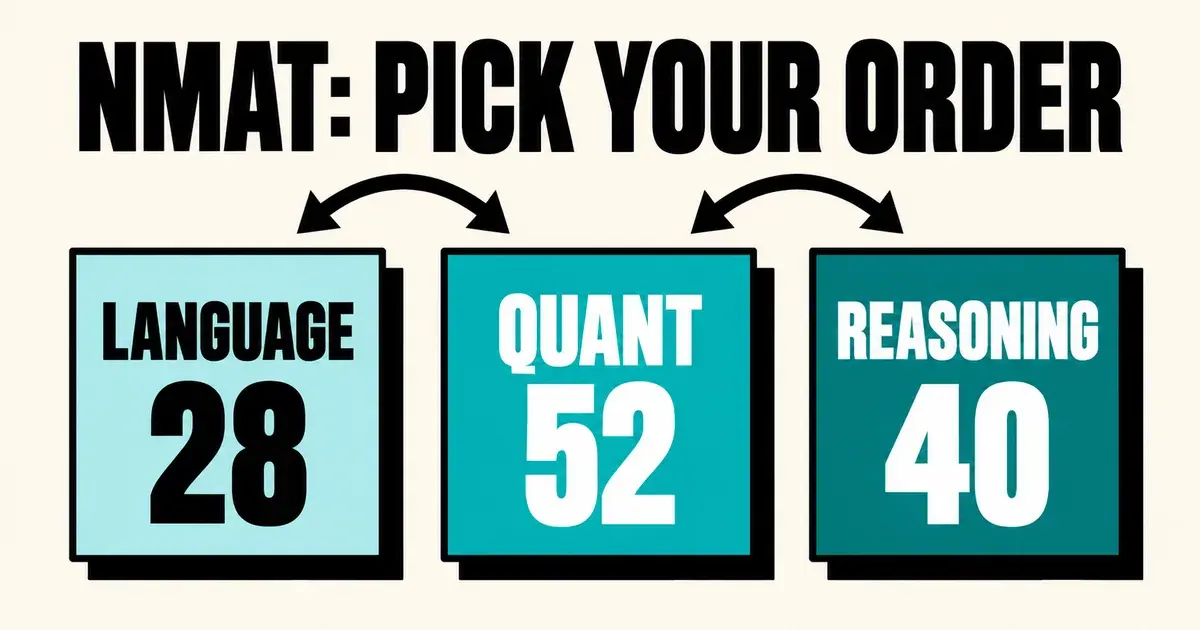
Quick answer: NMAT has three separately timed sections: Language Skills (36 questions, 28 minutes), Quantitative Skills (36, 52 minutes) and Logical Reasoning (36, 40 minutes). You choose the order at the start. Test two or three orders in your first mocks and keep the one that scores best. Most students do well starting with their strongest section.
How NMAT's format works
| Section | Questions | Time | Time per question | Scaled score |
|---|---|---|---|---|
| Language Skills | 36 | 28 min | About 47 s | 12 to 120 |
| Quantitative Skills | 36 | 52 min | About 87 s | 12 to 120 |
| Logical Reasoning | 36 | 40 min | About 67 s | 12 to 120 |
| Total | 108 | 120 min | 36 to 360 |
Source: mba.com NMAT pages (official); Crack NMAT in 60 Days.
Four rules shape every plan:
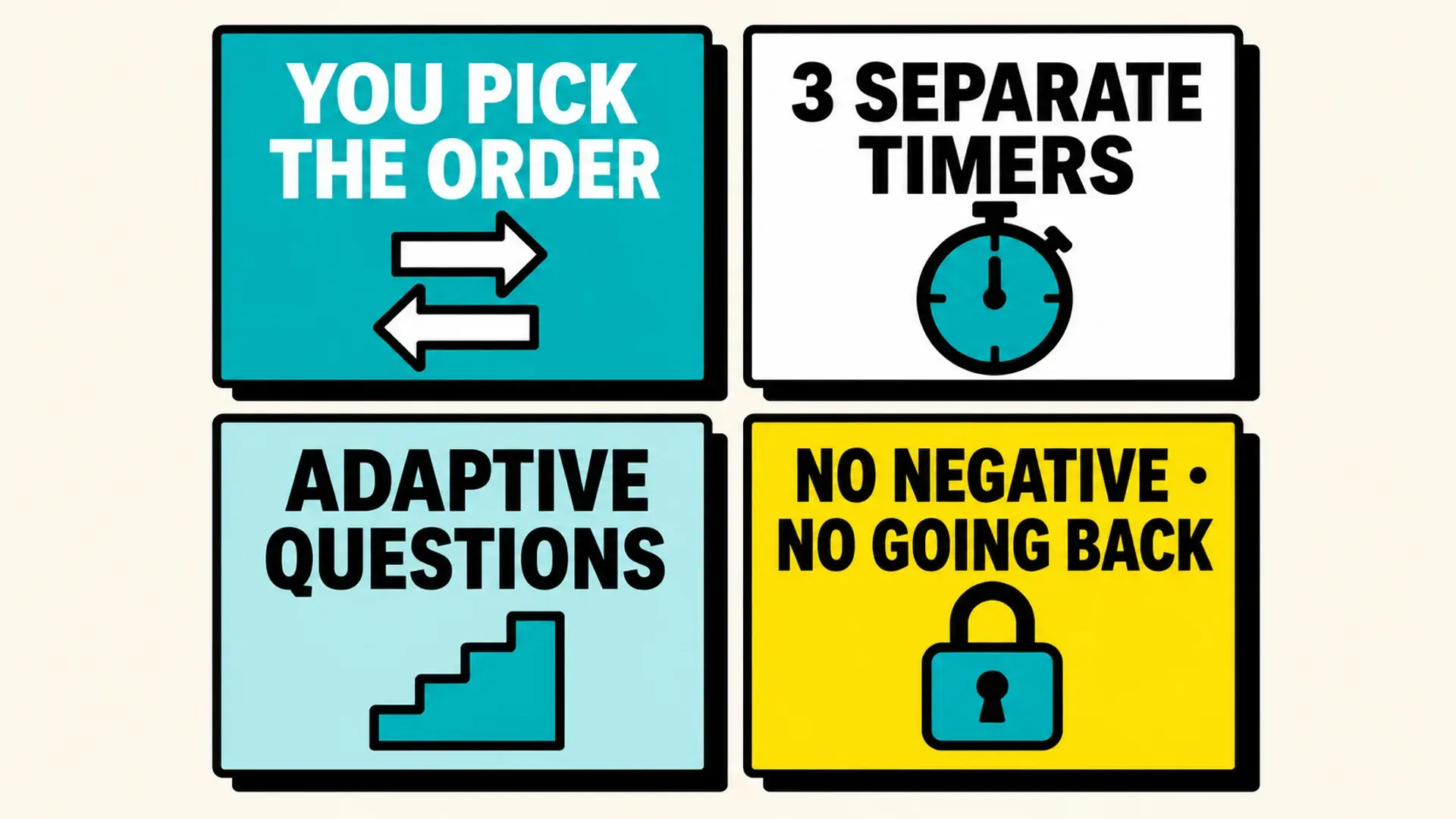
- You choose the section order at the start of the test.
- Each section has its own timer. Time you save in one section does not carry over to the next.
- The test is adaptive. Correct answers lead to harder questions, wrong answers to easier ones. Your score reflects both the level you reach and how many you answer correctly.
- No negative marking, and no going back. GMAC's NMAT FAQ says question review isn't allowed, so treat each answer as final and never leave a question blank.
How to choose your section order
There's no single best order. There's a best order for you, and you find it in mocks.
Step 1: Test three orders in your first mocks.
| Order | Who it often suits |
|---|---|
| Your strongest section first | Most students. A good start calms you down. |
| Quant first | Students who tire out and want the longest section while fresh |
| Language first | Fast readers who want quick marks before the heavy sections |
Step 2: Compare total and sectional scores. Look at which order gave you the best total, and also whether any section dropped sharply when it came later.
Step 3: Lock it in. Fix your order by about Day 40 of your preparation and use it in every mock after that. Don't change it on test day.
Pacing plan: Language Skills (28 minutes)
Language Skills is the fastest section: about 47 seconds per question.
| Minutes | What to do |
|---|---|
| 0 to 10 | Vocabulary, grammar, idioms, prepositions: the quick ones |
| 10 to 24 | Reading passages and para jumbles |
| 24 to 28 | Make sure every question has an answer |
- Know a vocabulary question or guess it in 15 seconds.
- Read the RC questions first, then the passage with a purpose.
- No rereading. There isn't time.
Pacing plan: Quantitative Skills (52 minutes)
Quant gives you the most time per question, and you'll need it. It's usually the toughest NMAT section and calculation-heavy.
| Minutes | What to do |
|---|---|
| 0 to 35 | Arithmetic and algebra at a steady pace |
| 35 to 48 | DI sets and Data Sufficiency |
| 48 to 52 | Best guesses for anything left |
- Keep your rough sheet tidy and write each step. Calculation errors cost more here than anywhere else.
- In Data Sufficiency, decide whether the data is enough. Don't solve fully.
- Approximate in DI when the options are far apart.
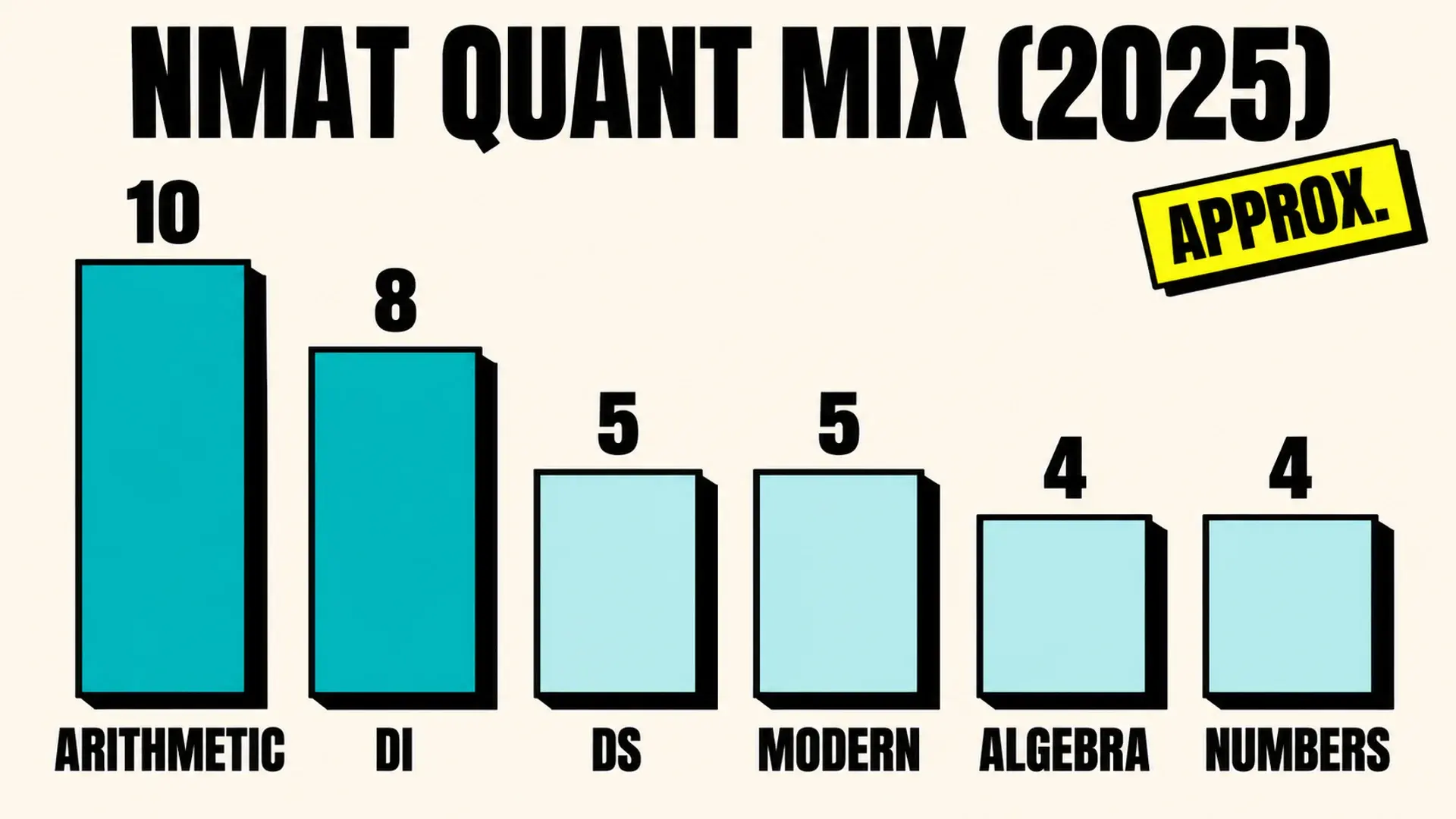
In NMAT 2025, the Quant section had roughly 10 arithmetic questions, 8 DI questions in 2 sets, 5 DS questions, 5 modern maths, 4 algebra and 4 number system questions (paper analysis summarised in Crack NMAT in 60 Days).
Pacing plan: Logical Reasoning (40 minutes)
| Minutes | What to do |
|---|---|
| 0 to 15 | Series, coding, blood relations, direction sense |
| 15 to 30 | Syllogisms, critical reasoning, statements and conclusions |
| 30 to 40 | Arrangements and puzzles |
In recent papers, verbal reasoning (course of action, assumptions, conclusions, critical reasoning) made up about 60 to 70 percent of the section. Practise those types as much as puzzles.
How the adaptive format changes your pacing
Because NMAT adapts to your answers, the early questions in each section shape the difficulty of what follows.
- Don't rush the first 8 to 10 questions of a section. A few careful correct answers early lift the level of later questions, and in an adaptive test, correct answers at a higher level tend to lift your scaled score more.
- Don't panic if questions get harder. That usually means you're doing well.
- Finishing the section matters more than one hard question. If you're stuck for more than about 90 seconds, make your best guess and move on. You can't come back, and a blank earns nothing.
The last minute of every section
Watch the timer. In the final minute, answer every remaining question, even with a quick guess. There's no penalty for a wrong answer, and an unanswered question is a guaranteed zero.
Common timing mistakes
- Rushing the opening questions. Early answers set the level for the rest of the section.
- Leaving blanks when the timer runs out. No negative marking means no reason to leave anything blank.
- Letting one puzzle eat the Reasoning section. Puzzles go last.
- Changing your section order on test day. Use the order you practised.
- Practising without sectional timers. Always mock with 28, 52 and 40-minute limits.
Frequently asked questions
Can I choose the section order in NMAT?
Yes. NMAT asks you to choose the order of the three sections at the start of the test. Once a section ends, you move to the next and can't return. Test different orders in mocks before your real test.
What is the best section order for NMAT?
There is no single best order. Many students do well starting with their strongest section, because a confident start helps the rest of the test. Try two or three orders in your first mocks and keep the one with the best total score.
Can I go back to previous questions in NMAT?
No. GMAC's NMAT FAQ says question review isn't allowed, so each answer is final once you move on. Answer every question before the section timer ends.
Is NMAT an adaptive test?
Yes. NMAT adjusts question difficulty based on your answers: correct answers lead to harder questions and wrong ones to easier questions. Your scaled score reflects both how many you answer correctly and the difficulty level you reach.
Does unused time carry over to the next NMAT section?
No. Each section has its own fixed time. If you finish early, the extra time doesn't move to the next section, so use it to check your remaining answers in the current section where the test allows.
Sources
- NMAT pattern, section timing, adaptive format, review rule and scoring: mba.com NMAT pages and FAQ (official)
- Section time plans, NMAT 2025 paper composition and common mistakes: Crack NMAT in 60 Days by The 99 Percentiler
Related reading: NMAT retake strategy · SNAP vs NMAT · MBA entrance exams compared · Free MBA exam calendar 2026–27 · How to crack 99+ percentile in NMAT
The NMAT playbook has the full 60-day plan, ten topics per section and test-day attack plans.