Your SNAP mocks keep ending the same way. The timer hits zero, you've attempted 41 questions, and you can see six more you could have solved if you'd had another five minutes. The score lands around 36. Not bad, not SIBM.
Most students who stall in the mid-30s know enough to score 45. What they lack is pace and order. SNAP is a one-minute-per-question test with negative marking and no calculator, and the student who reaches the easy questions first wins. This guide gives you a target for each section, a minute-by-minute attack plan, and the drills that build speed.
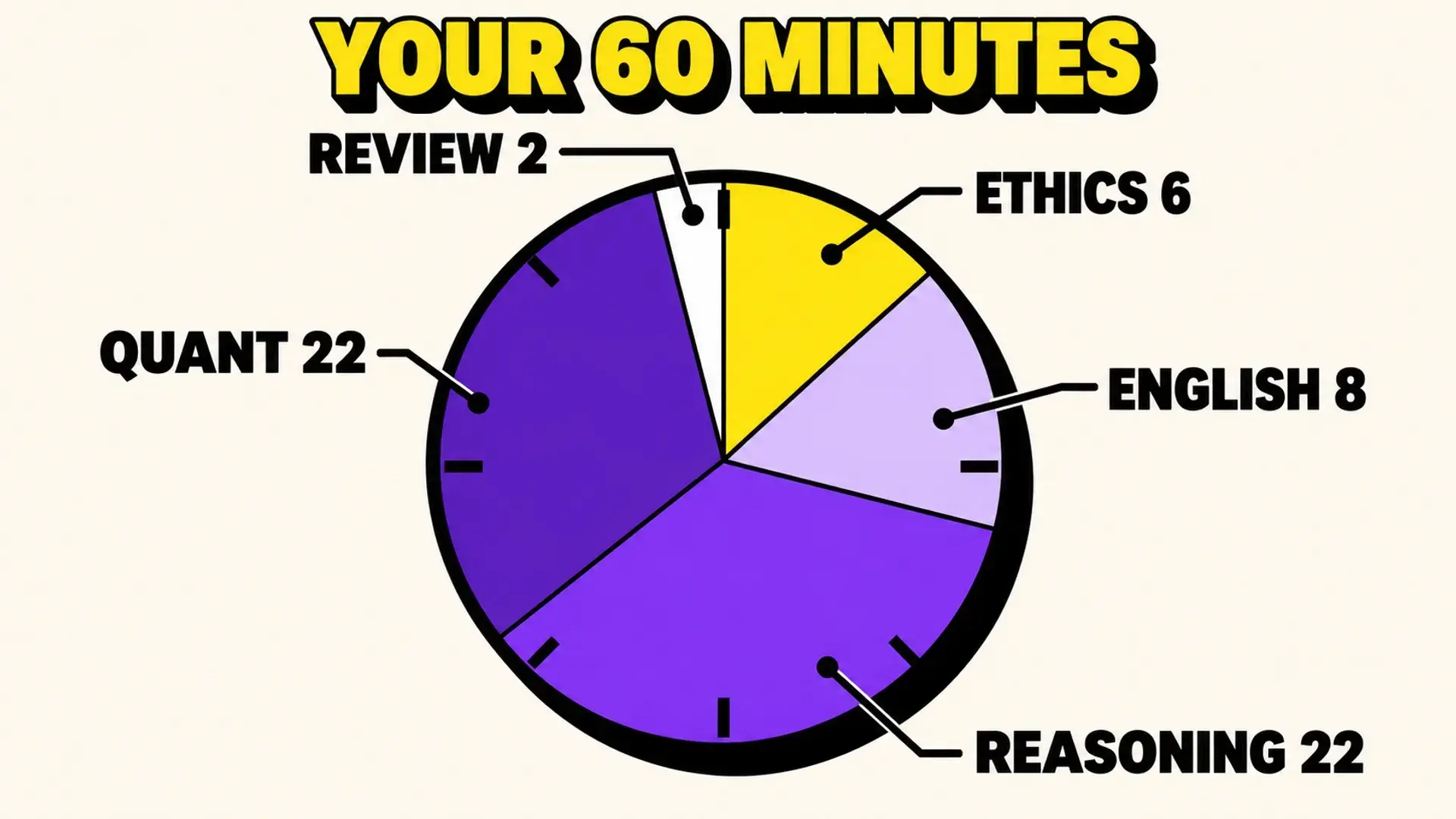
Quick answer: To score 45+ in SNAP, attempt about 50 to 53 questions with around 90 percent accuracy. Start with Ethics and English (about 14 minutes for 20 questions), then Reasoning (22 minutes), then Quant (22 minutes). Solve one-liners first, leave long puzzles for last, and guess only after cutting at least one option.
What 45 out of 60 looks like
SNAP 2026 has 60 questions: General English 10, Analytical and Logical Reasoning 20, Quant/DI/Data Sufficiency 20, and the new Ethics, Morality and Values section 10. A correct answer earns 1 mark and a wrong one costs 0.25.
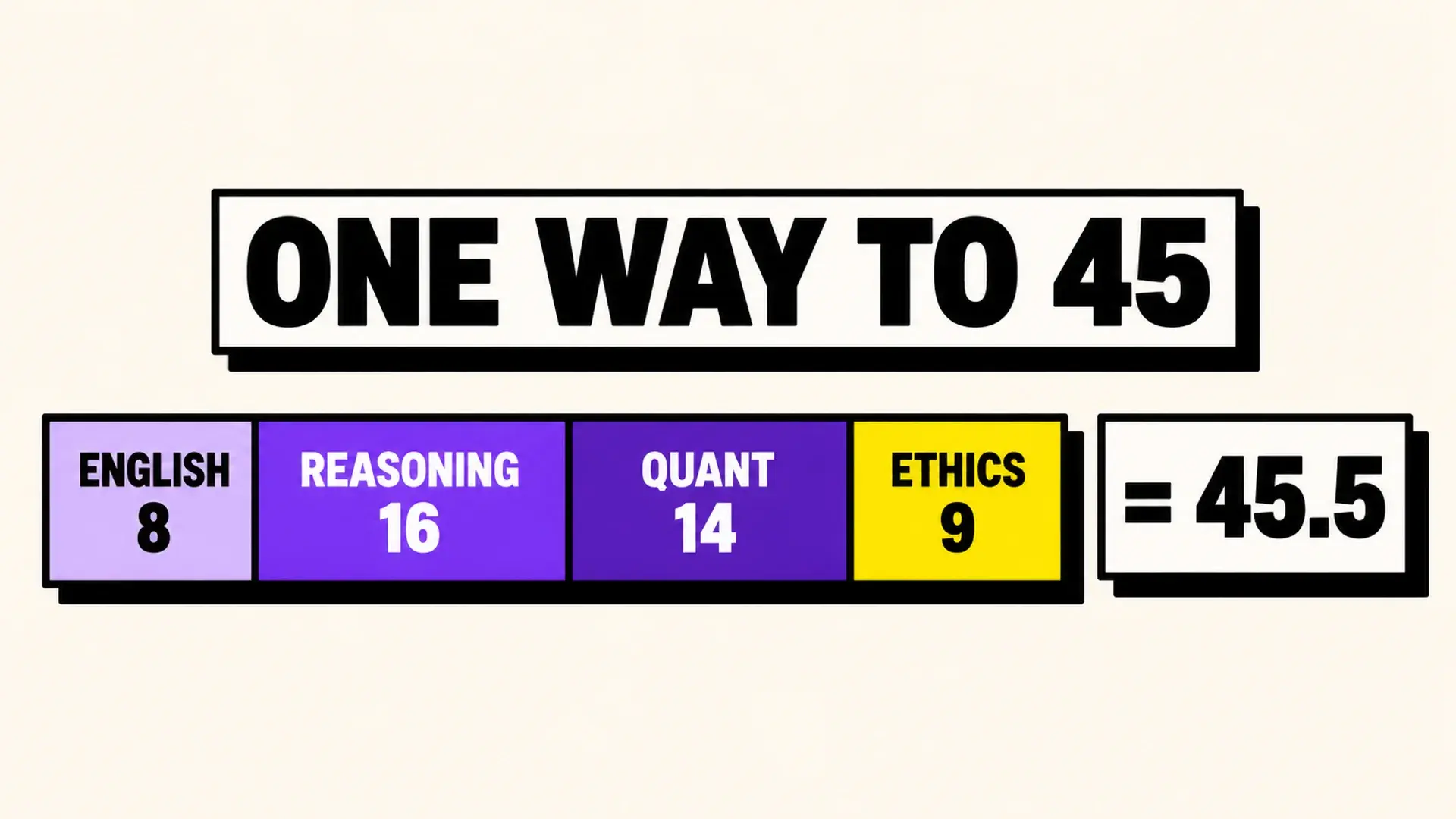
Here is one way to reach 45:
| Section | Attempt | Right | Wrong |
|---|---|---|---|
| General English (10) | 9 | 8 | 1 |
| Reasoning (20) | 18 | 16 | 2 |
| Quant, DI and DS (20) | 16 | 14 | 2 |
| Ethics (10) | 10 | 9 | 1 |
| Total | 53 | 47 | 6 |
Score: 47 − (6 × 0.25) = 45.5. Source: Crack SNAP in 60 Days.
You can skip seven questions and still clear 45. What you can't do is attempt 53 questions at 75 percent accuracy. That gives you about 40 right, 13 wrong and a score near 37.
| Attempts | Right | Wrong | Score | Rough percentile (SNAP 2025) |
|---|---|---|---|---|
| 54 | 51 | 3 | 50.25 | 99.5+ |
| 50 | 46 | 4 | 45 | About 99 |
| 47 | 43 | 4 | 42 | About 95 to 99 |
| 44 | 39 | 5 | 37.75 | About 90 to 95 |
| 40 | 35 | 5 | 33.75 | About 80 |
Source: Crack SNAP in 60 Days. Estimates; the new Ethics section may shift these slightly.
The minute-by-minute attack plan
SNAP has no sectional time limits, so you set the order. This order works for most students because it banks fast marks first and keeps your calm for the harder sections.
| Order | Section | Time | Target |
|---|---|---|---|
| 1 | Ethics, Morality and Values (10) | About 6 minutes | 9 to 10 attempts |
| 2 | General English (10) | About 8 minutes | 8 to 9 attempts |
| 3 | Analytical and Logical Reasoning (20) | 22 minutes | 17 to 18 attempts |
| 4 | Quant, DI and DS (20) | 22 minutes | 15 to 16 attempts |
| Marked questions | 2 minutes | Only those with one option cut |
Source: Crack SNAP in 60 Days.
Test two or three orders in your mocks before you settle. If Quant is your strongest area, putting it second can work too. Fix your order by about 20 days before your first test.
Reasoning: one-liners first, puzzles last
Reasoning is SNAP's biggest scoring area alongside Quant. Solve in order of speed.
| Order | Question type | Time each |
|---|---|---|
| 1 | Series, coding-decoding, analogies | About 30 seconds |
| 2 | Blood relations, direction sense, clocks and calendars | About 45 seconds |
| 3 | Syllogisms, critical reasoning, statement-conclusion | About 60 seconds |
| 4 | Seating arrangements and grid puzzles | Whatever time is left |
If you can't draw a puzzle's grid within two minutes, skip it. A five-question puzzle eats the time of eight one-liners.
Quant: direct arithmetic, then Data Sufficiency
| Order | Question type | Time each |
|---|---|---|
| 1 | Direct arithmetic (percentages, ratio, profit, speed) | About 45 seconds |
| 2 | Data Sufficiency | About 45 seconds |
| 3 | One DI set | About 4 minutes |
| 4 | Algebra and geometry | The rest |
Two rules for SNAP Quant:
- In Data Sufficiency, don't solve fully. You only need to decide whether the statements give enough information.
- There's no calculator, so round numbers in DI when the options are far apart.
English and Ethics: 20 marks in about 14 minutes
General English in SNAP is vocabulary and grammar heavy: synonyms, antonyms, fill in the blanks, error spotting, idioms and short reading passages. If you know a vocabulary question, answer it in 15 seconds. If you don't, skip it unless you can cut an option.
Ethics, Morality and Values is new in 2026, so there are no past SNAP papers for it. The questions describe workplace or social dilemmas. The best answer is usually the one that is legal, honest, fair to everyone involved, and practical. A few patterns from the SNAP playbook:
| Situation | Usually right |
|---|---|
| Conflict of interest | Disclose it and step away from the decision |
| You see fraud | Report it through the official channel |
| A vendor offers a gift | Decline, or declare it as per company policy |
| A harassment complaint | Take it seriously and follow the committee process |
| Hiring or promotion | Same criteria for everyone, based on merit |
Avoid options that hide the problem, favour a friend, go to the media first, or punish someone before an inquiry.
Speed drills that move your score
SNAP speed comes from small things done daily.
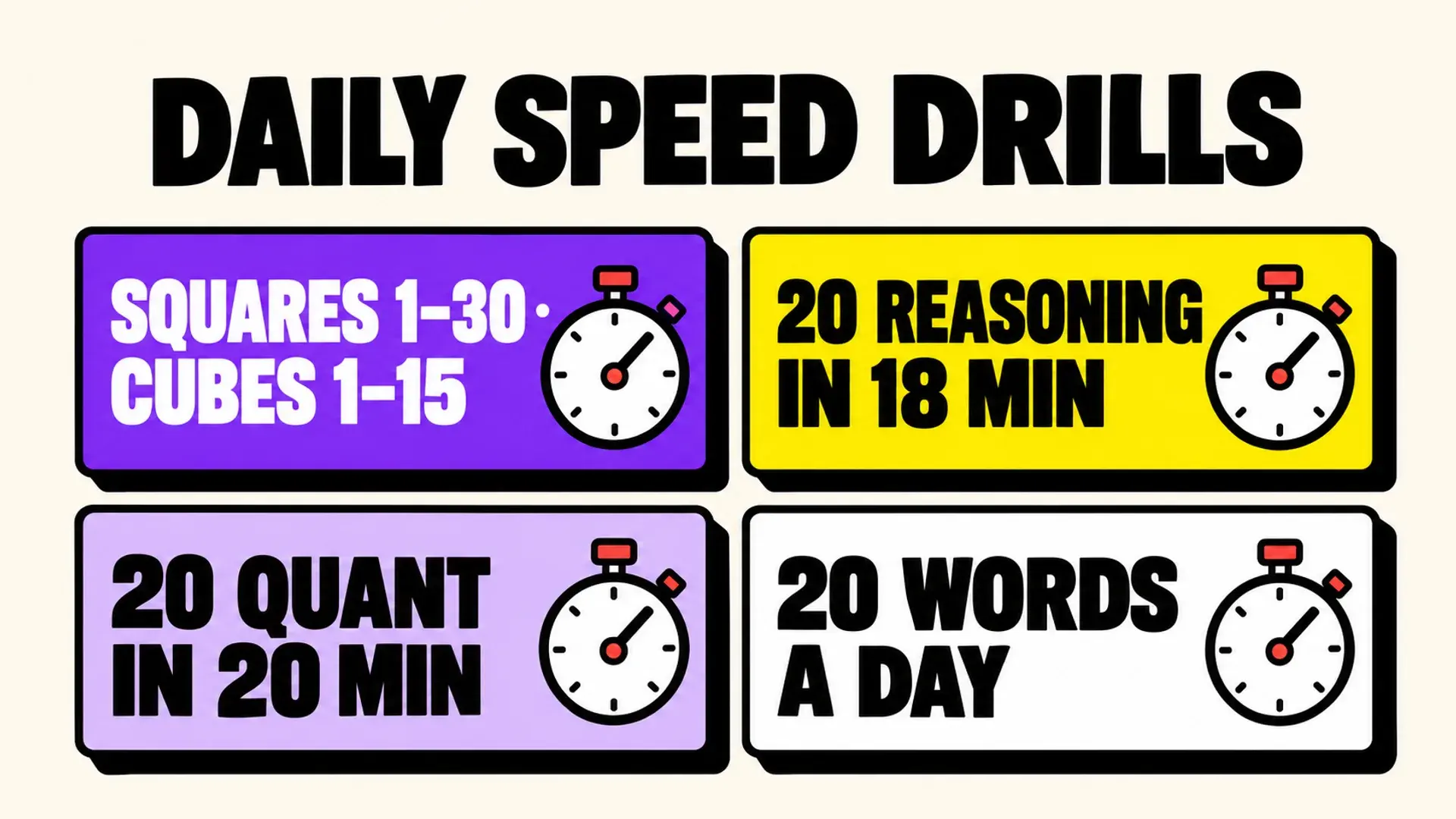
- Mental maths: know squares up to 30, cubes up to 15, and fraction-percentage pairs (1/6 = 16.7%, 1/7 = 14.3%, 1/8 = 12.5%, 1/9 = 11.1%).
- Reasoning sprints: 20 reasoning questions in 18 minutes, three times a week.
- Quant sprints: 20 Quant questions in 20 minutes, three times a week.
- Vocabulary: 20 new words a day, revised every weekend.
- Ethics: five dilemma questions a day for the rules to become automatic.
How many SNAP mocks do you need?
About 15 to 18 SNAP mocks over 60 days. Each mock takes an hour, and its analysis takes about another hour. From Day 31 of your plan, take a mock every second day.
In each mock analysis, track:
- Your score and attempts
- Your accuracy (wrong answers cost 0.25 each)
- How many questions you had left when time ran out
- Your slowest question type
- Three actions for the next mock
Five habits that keep you stuck in the 30s
- Starting with puzzles. They eat your time before you reach the easy questions.
- Blind guessing to raise attempts. Many blind guesses pull your accuracy down.
- Ignoring Ethics. It's 10 marks you can prepare in a week.
- Slow mental maths. Without a calculator, every slow multiplication costs seconds.
- Skipping Data Sufficiency practice. DS questions are fast marks once you know the method.
Frequently asked questions
Is 45 a good score in SNAP?
Yes. In recent years, a score of about 45 or more out of 60 has matched roughly the 99th percentile, which is the range for SIBM Pune. The exact percentile for each score changes slightly every year.
How many questions should I attempt in SNAP?
Aim for about 50 to 53 questions at around 90 percent accuracy. Attempting more questions at lower accuracy usually lowers your score because each wrong answer costs 0.25.
Which section should I attempt first in SNAP?
Many students start with Ethics and General English because they are quick and give fast marks. Then they move to Reasoning and Quant. Test two or three orders in mocks and keep the one that gives you the best score.
How do I prepare for the SNAP Ethics section?
Learn a few decision rules: choose options that are legal, honest, fair to all stakeholders and practical. Practise five dilemma questions a day. Since the section is new in 2026, there are no past SNAP papers for it.
How many mocks should I take for SNAP?
About 15 to 18 full SNAP mocks over two months is enough. Analyse each one for about an hour, focusing on accuracy, unattempted easy questions and your slowest question types.
Sources
- SNAP 2026 pattern and marking: snaptest.org (official); Careers360 and Cracku reports on the 2026 change
- Section targets, attack plan, Ethics rules, score table and drills: Crack SNAP in 60 Days by The 99 Percentiler
Related reading: SNAP three attempts strategy · SNAP vs NMAT · Prepare for all MBA exams together · Free MBA exam calendar 2026–27 · How to crack 99+ percentile in SNAP
The SNAP playbook has the full 60-day plan, a word bank and ten Ethics topics with answer rules.