The timer shows 14 minutes left. You have 22 questions to go, and the last four minutes went to a seating puzzle that still has no answer. In CAT you could afford that. In SNAP it costs you four other questions.
SNAP gives you 60 questions and 60 minutes. The questions are easier than CAT's, which is the reason the cutoffs sit so high: almost everyone can solve them, so the winners are the ones who solve the most without slipping. A 99 percentile here means about 50 marks out of 60.
Quick answer: To crack 99+ percentile in SNAP, you need about 49 to 51 marks out of 60, which means around 54 to 56 attempts with 51 right. Start with Ethics and English, give Reasoning and Quant 22 minutes each, hold a 60-second limit for each question, and book all three tests, since Symbiosis counts your best score.
SNAP at a glance
| Item | Detail |
|---|---|
| Full name | Symbiosis National Aptitude Test |
| Conducted by | Symbiosis International (Deemed University) |
| Usually held | December, on three test dates |
| Questions | 60 |
| Sections | General English, Analytical and Logical Reasoning, Quantitative with DI and DS, Ethics, Morality and Values |
| Time | 60 minutes, with no sectional limit |
| Marking | +1 for a correct answer, −0.25 for a wrong one |
| Attempts | Up to 3 tests in one cycle. Your best score counts |
| Marks for 99 percentile | About 49 to 51 out of 60 in the latest test |
| Accepted by | Symbiosis institutes only, including SIBM Pune and SCMHRD |
| Official site | snaptest.org |
What does a 99+ percentile in SNAP mean?
A 99 percentile means you scored more than 99 out of every 100 SNAP candidates. Only Symbiosis institutes use SNAP, and the top two set their cutoffs close to that line: SIBM Pune shortlists at about 98 percentile and SCMHRD at about 96.
Two features of SNAP work in your favour.
- There are no sectional cutoffs in the test. Your total decides your percentile. You can lean on your strongest sections.
- You get three tries. Symbiosis lets you sit up to three tests and uses the highest score. A bad day doesn't end your season.
SNAP exam pattern and marking scheme
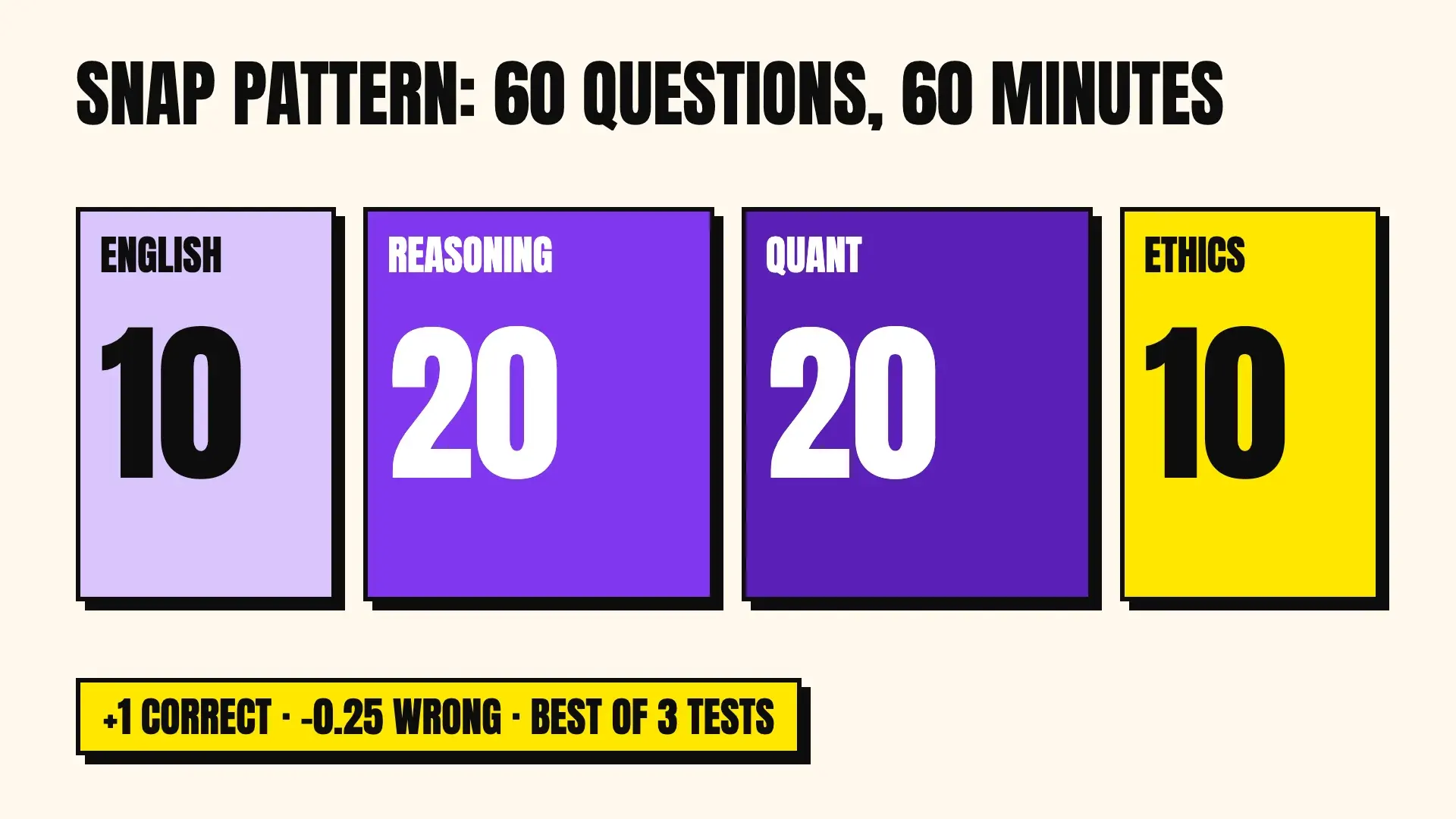
| Section | Questions | Marks |
|---|---|---|
| General English | 10 | 10 |
| Analytical and Logical Reasoning | 20 | 20 |
| Quantitative, Data Interpretation and Data Sufficiency | 20 | 20 |
| Ethics, Morality and Values | 10 | 10 |
| Total | 60 | 60 |
Symbiosis added the Ethics, Morality and Values section in the latest pattern and trimmed English and Reasoning to make room. Check snaptest.org for the bulletin of your cycle, since Symbiosis has changed the section mix more than once.
The rules around the paper:
- 60 minutes for 60 questions, so one minute for each on average.
- No sectional time limit. You choose the order.
- Four options for each question.
- No calculator.
- +1 for a correct answer, −0.25 for a wrong one, 0 for a blank.
Reasoning and Quant make up 40 of the 60 marks. English and Ethics give you 20 marks that you can collect in about 14 minutes.
How many marks do you need for 99 percentile in SNAP?
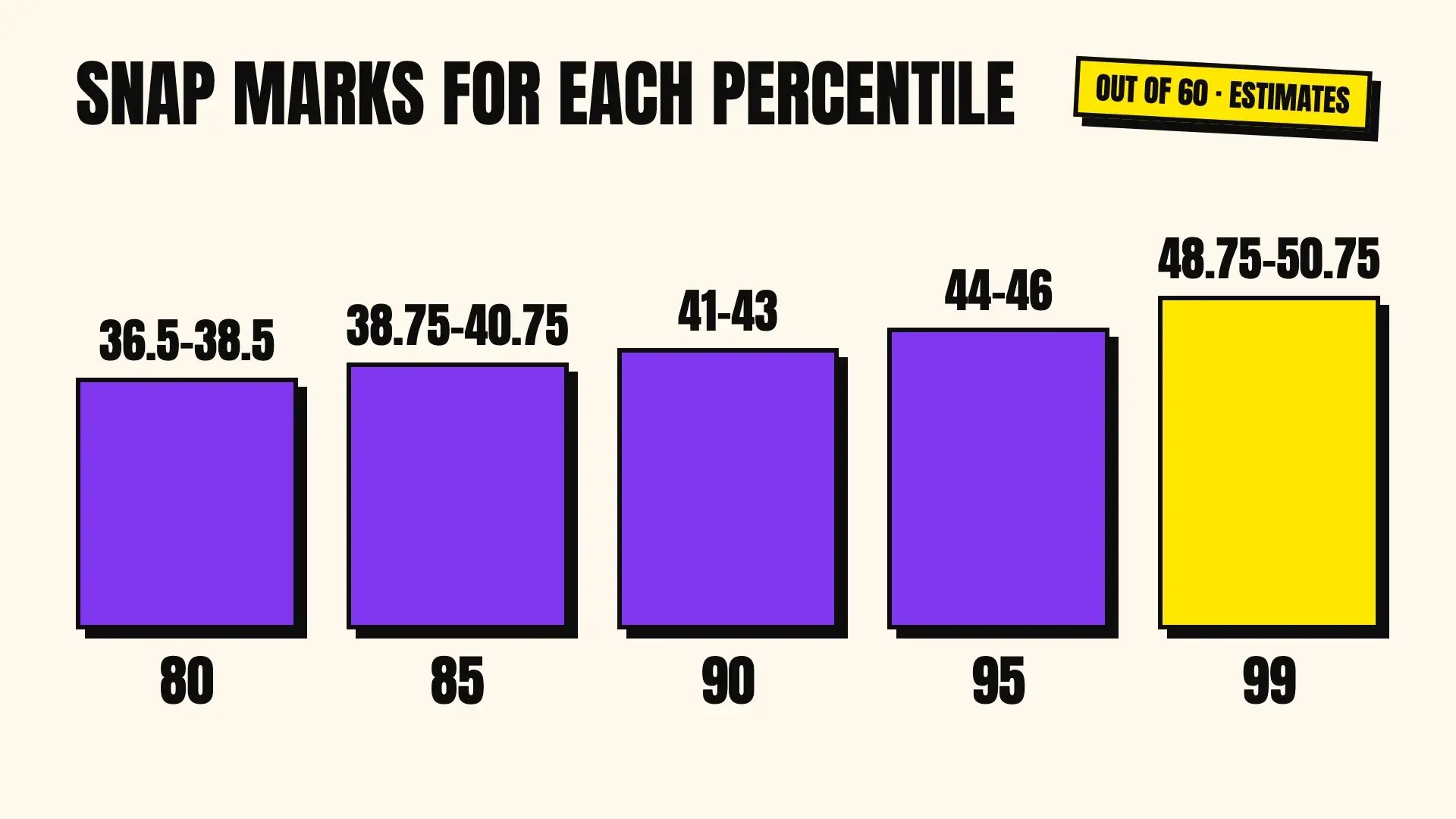
In the latest SNAP, about 49 to 51 marks out of 60 matched the 99th percentile.
| Percentile | Marks out of 60 in the latest SNAP (2025) |
|---|---|
| 99.9 | 52.75 to 54.75 |
| 99.5 | 50.25 to 52.25 |
| 99 | 48.75 to 50.75 |
| 98 | 47.25 to 49.25 |
| 97 | 46 to 48 |
| 95 | 44 to 46 |
| 90 | 41 to 43 |
| 85 | 38.75 to 40.75 |
| 80 | 36.5 to 38.5 |
Score and percentile pairs from candidate scorecards compiled by MBAUniverse and Careers360, with 1 mark of allowance either side.
SNAP marks swing more than any other exam in this group. Compare the two latest cycles.
| Percentile | The year before (2024) | Latest (2025) |
|---|---|---|
| About 99 | About 42 | About 49 to 51 |
| About 98 | About 40 | About 47 to 49 |
| About 94 to 95 | About 36 | About 44 to 46 |
| About 90 | About 34 | About 41 to 43 |
The same 99 percentile needed about 42 marks one year and about 50 the next. An easy paper pushes everyone up, and at this level a jump of 8 marks is the whole game. So plan for the higher figure. If you can hold 50 or more in mocks, an easy paper won't hurt you and a hard one will reward you.
The free SNAP percentile predictor reads your score against both years.
How many questions should you attempt in SNAP for 99 percentile?
Score = right answers − (0.25 × wrong answers). The table shows what that means at each level.
| Attempts | Right | Wrong | Score | Rough percentile in the latest test |
|---|---|---|---|---|
| 56 | 53 | 3 | 52.25 | About 99.5 |
| 54 | 51 | 3 | 50.25 | 99+ |
| 52 | 48 | 4 | 47 | About 97 |
| 50 | 46 | 4 | 45 | About 95 |
| 47 | 43 | 4 | 42 | About 90 |
At 99 percentile you leave almost nothing on the table. You attempt 54 or more questions and get more than 50 right. That is the reason speed drills matter more in SNAP than in any CAT-style exam: you need time to reach the last question.
One way to reach about 50 marks:
| Section | Attempt | Right |
|---|---|---|
| General English (10) | 9 | 9 |
| Reasoning (20) | 19 | 18 |
| Quant, DI and DS (20) | 18 | 15 |
| Ethics, Morality and Values (10) | 10 | 9 |
| Total | 56 | 51 |
Fifty-one right and five wrong gives 49.75.
If your target is SIBM Bengaluru or SIIB and you need about 45 marks, the guide to scoring 45+ in SNAP has a gentler attempt plan.
When should you guess in SNAP?
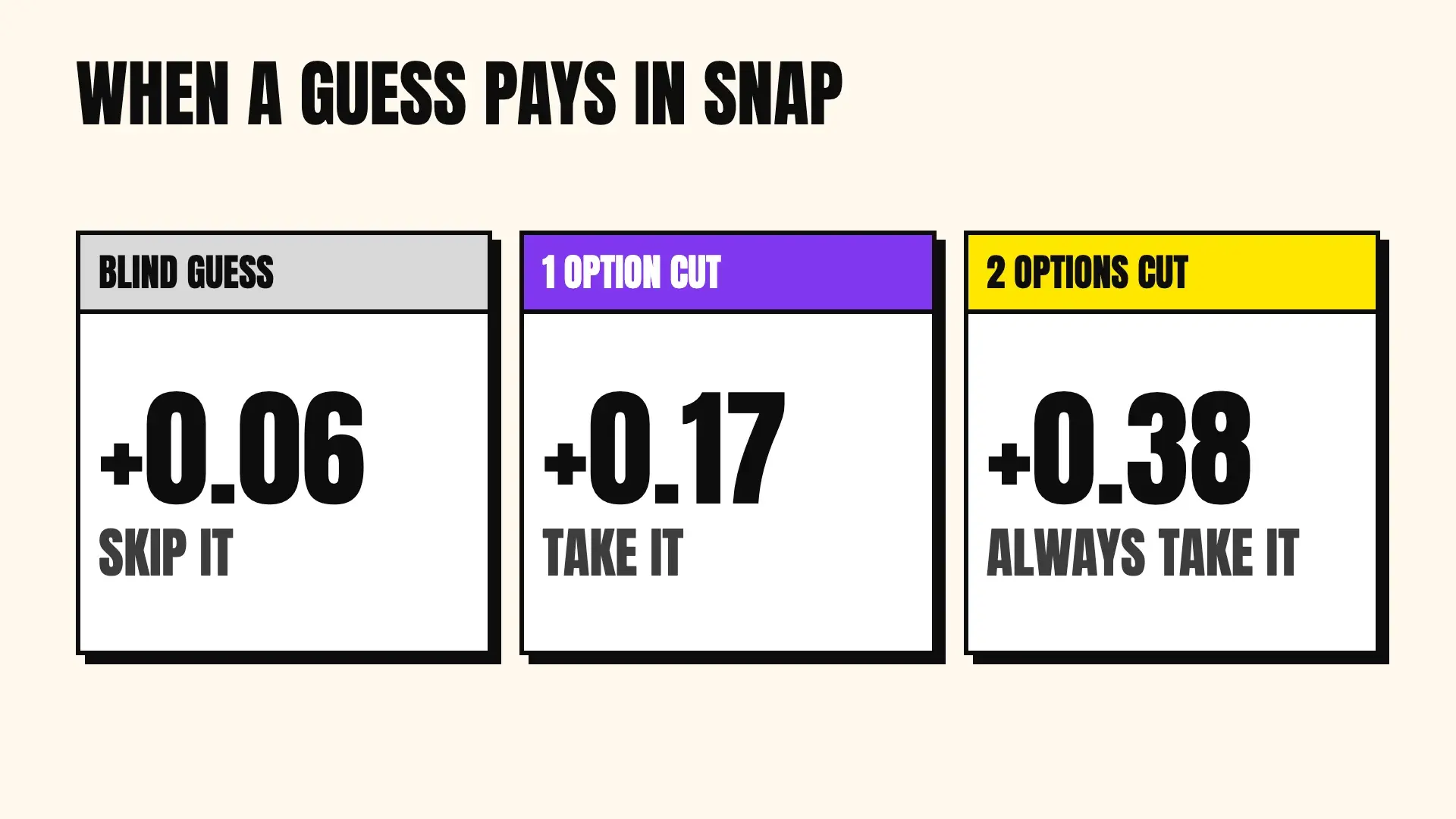
A wrong answer costs a quarter mark. With four options, the maths looks like this.
| Situation | Average marks for each guess |
|---|---|
| Blind guess among four options | +0.06 |
| Guess after cutting one option | +0.17 |
| Guess after cutting two options | +0.38 |
A blind guess gains almost nothing and adds risk to your accuracy. Cut one option and the guess is worth taking. So the rule is: eliminate at least one option, then mark.
SNAP syllabus: the topics that carry the most marks
| Section | Topics to study first |
|---|---|
| Reasoning | Seating arrangement, grid puzzles, coding and decoding, series, blood relations, direction sense, syllogisms, critical reasoning, clocks and calendars, Venn diagrams and analogies |
| Quant, DI and DS | Percentages and profit, ratio and averages, speed and work, number system, equations, data interpretation, data sufficiency, geometry and mensuration, probability, interest and progressions |
| General English | Synonyms and antonyms, fill in the blanks, error spotting, short reading comprehension, para jumbles, idioms |
| Ethics, Morality and Values | Integrity dilemmas, conflict of interest, whistleblowing, workplace fairness, governance and CSR, data privacy |
Arithmetic and DI together make up more than half of the Quant section. In Reasoning, one-line questions such as series, coding and blood relations outnumber long puzzles. The Ethics section is new, so no bank of past questions exists. You prepare for it by learning a few decision rules.
Section-wise strategy to score 99+ percentile in SNAP
Ethics and English: 20 marks in 14 minutes
Start your test here. These two sections are quick, and a clean start settles your nerves.
| Section | Questions | Time | Target right |
|---|---|---|---|
| Ethics, Morality and Values | 10 | About 6 minutes | 9 to 10 |
| General English | 10 | About 8 minutes | 8 to 9 |
For Ethics, the best option is legal, honest, fair and practical. Work through these checks in order.
- Cut any option that breaks the law.
- Prefer the option that discloses the problem over one that hides it.
- Prefer the option that treats everyone by the same rule.
- Avoid extremes: no instant firing, no silent forgiveness.
- Prefer the proper channel: report, inquire, then act.
For English, vocabulary questions are binary. You know the word or you don't. Give each one 15 seconds and move. Learn 20 words and 10 grammar rules a day through your preparation.
Reasoning: one-liners first
| Order | Question types | Time for each |
|---|---|---|
| 1 | Series, coding, analogies | About 30 seconds |
| 2 | Blood relations, direction sense, clocks | About 45 seconds |
| 3 | Syllogisms, critical reasoning, statements | About 60 seconds |
| 4 | Arrangements and puzzles | The rest of your 22 minutes |
If a puzzle gives you no grid in two minutes, leave it. For a 99, aim for 19 of 20 attempted at 90 percent accuracy or better.
Quant, DI and DS: mental maths decides it
| Order | Question types | Time |
|---|---|---|
| 1 | Direct arithmetic | About 45 seconds each |
| 2 | Data sufficiency | About 45 seconds each |
| 3 | One DI set | About 4 minutes |
| 4 | Algebra and geometry | The rest of your 22 minutes |
You get no calculator, so your speed comes from memory. Learn these until they are automatic:
- Squares from 1 to 30 and cubes from 1 to 15.
- Fractions as percentages: 1/6 is 16.7 percent, 1/7 is 14.3, 1/8 is 12.5, 1/9 is 11.1.
- Shortcuts: to multiply by 25, multiply by 100 and divide by 4.
In data sufficiency, decide whether the statements are enough. Don't solve to the final answer. In DI, round the numbers when the options sit far apart.
Your 60-minute attack plan for SNAP
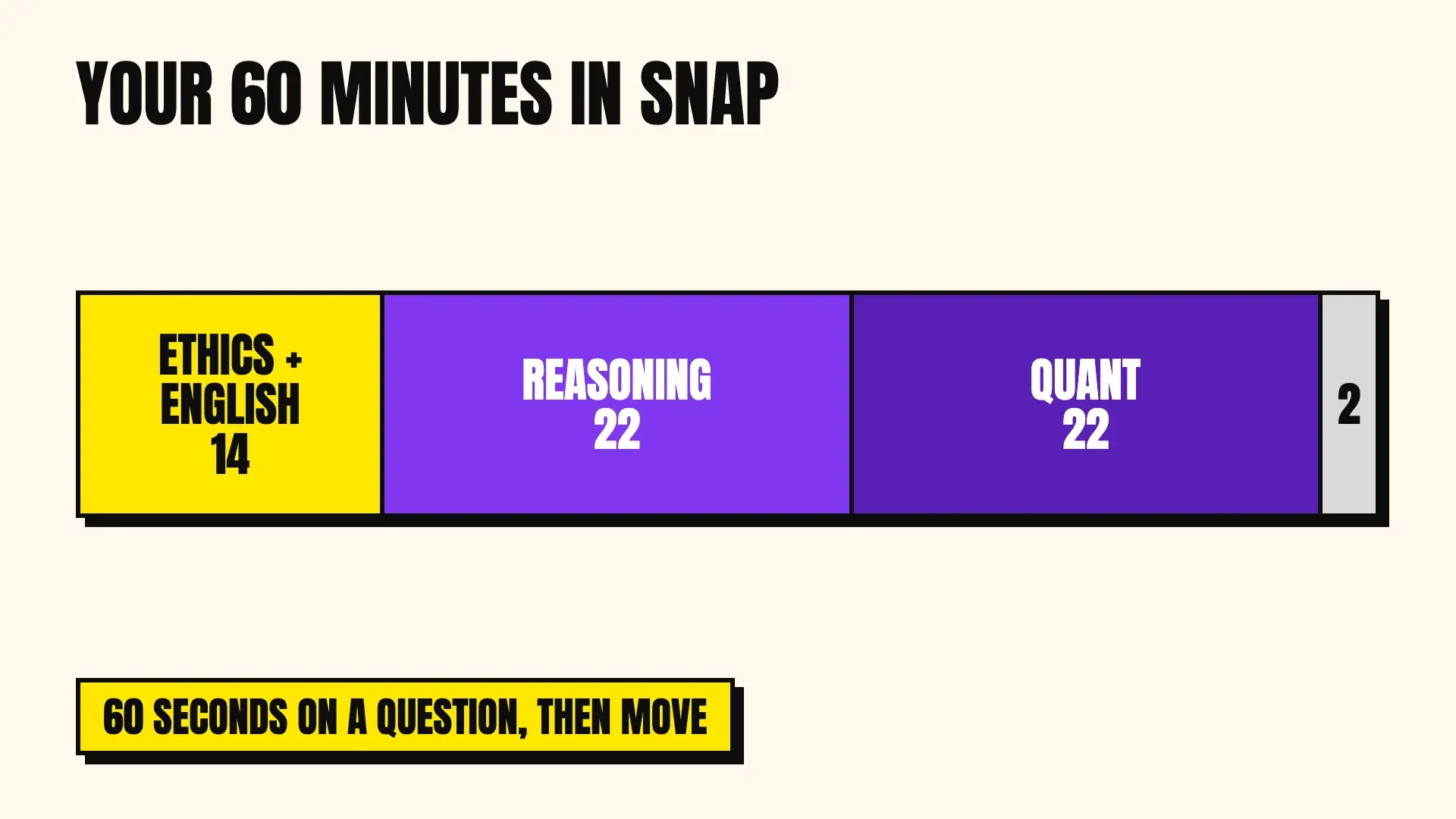
| Order | Section | Minutes |
|---|---|---|
| 1 | Ethics and English (20 questions) | 14 |
| 2 | Reasoning (20 questions) | 22 |
| 3 | Quant, DI and DS (20 questions) | 22 |
| 4 | Marked questions | 2 |
Hold one rule through the test: at 60 seconds on a question, mark it and move. Use the last two minutes on marked questions where you have cut one option.
Test two other orders in mocks before you settle. Reasoning, Quant, English, Ethics suits you if you want your strong sections while you are fresh. Quant first suits you if quant is your best section. Fix your order by the middle of your preparation and keep it on test day.
How to use the three SNAP tests
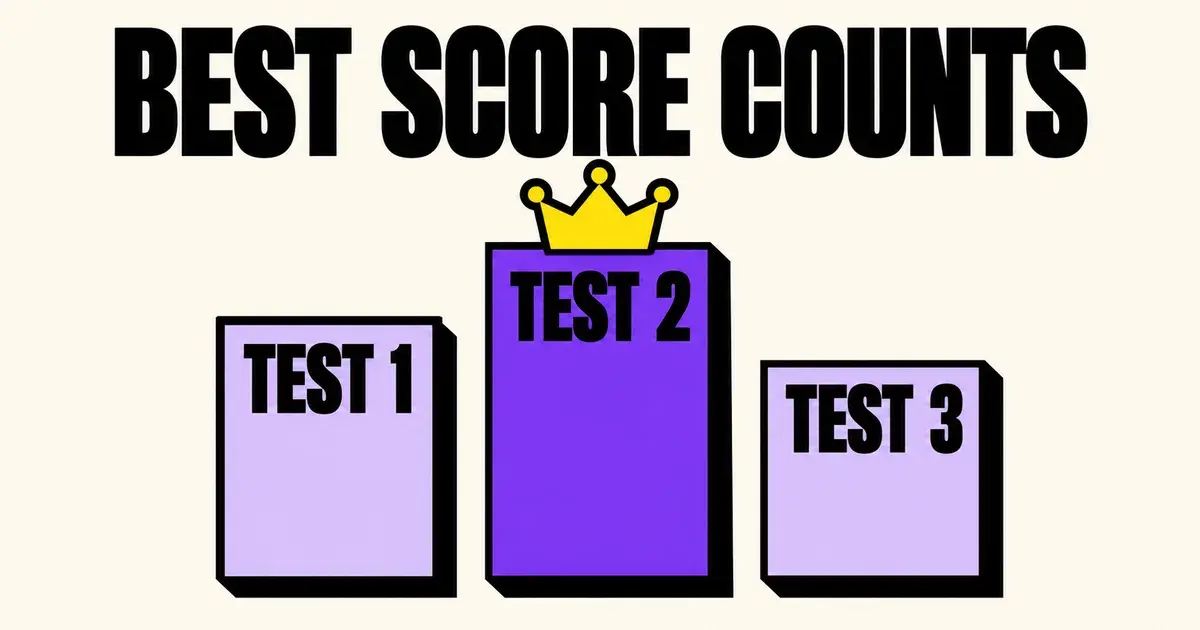
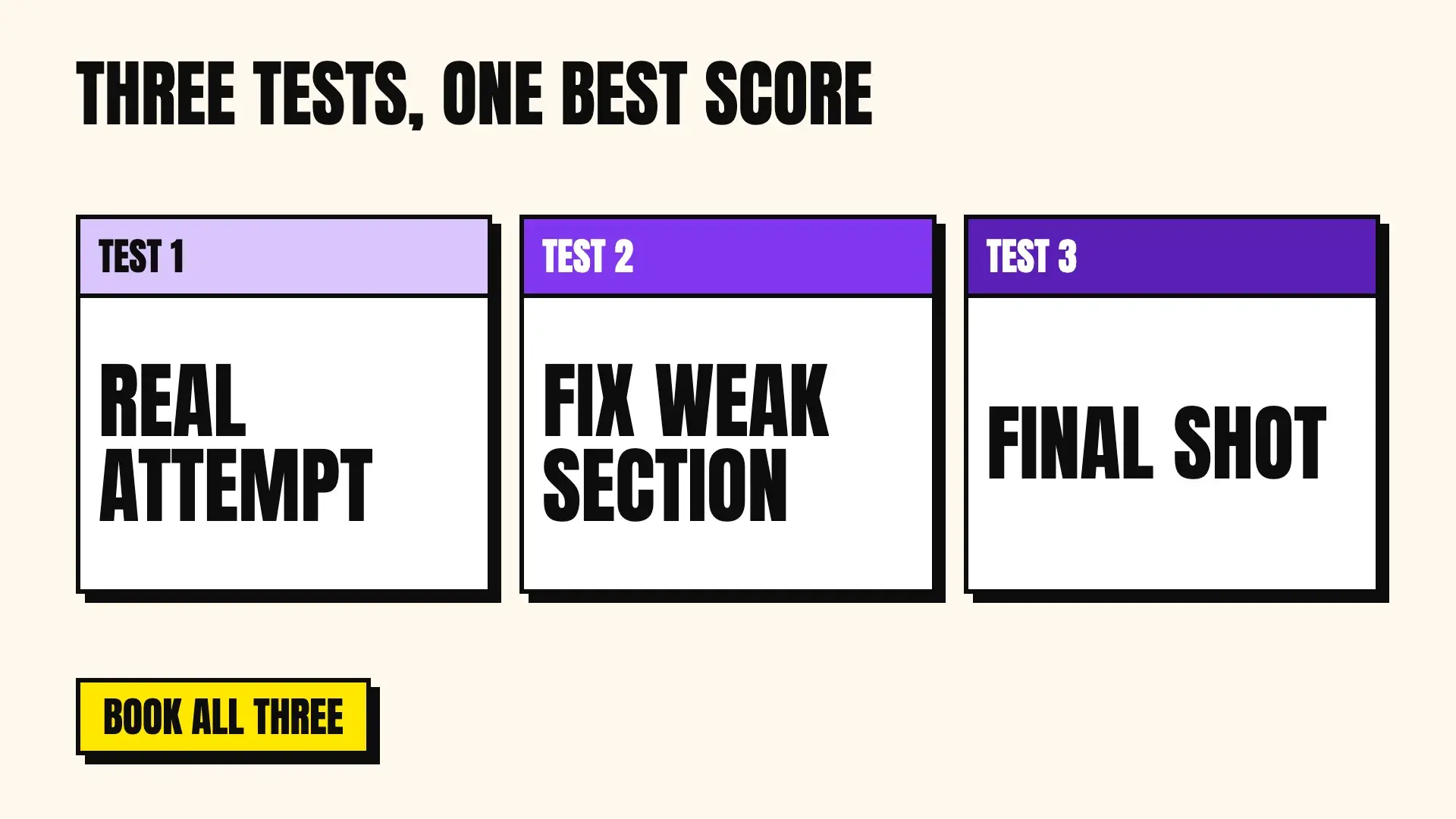
Symbiosis lets you take up to three tests in one cycle and counts your highest score. You choose your tests when you register. Book all three.
| Test | How to use it |
|---|---|
| Test 1 | A real attempt with full preparation. Don't treat it as a trial |
| Test 2 | Fix the weakest section from Test 1, then try for a higher score |
| Test 3 | Your final shot if your best score is still below target |
Between tests, run a short cycle: note your weak section, take two mocks, update your error log, repeat. A weak test does no harm, since Symbiosis ignores it. Skipping Test 1 to "prepare more" throws away a free attempt. The SNAP three attempts guide has a decision table for each gap between tests.
How long does it take to prepare for SNAP?
| Your situation | Time needed | Focus |
|---|---|---|
| You prepared for CAT | 3 to 4 weeks | Speed drills, mental maths, one-line reasoning, vocabulary, ethics rules, 10 or more SNAP mocks |
| You start fresh, with good basics | About 60 days at 4 to 5 hours a day | Arithmetic, reasoning one-liners, a word list, then mocks every two days |
| You start fresh as a beginner | 3 to 4 months at 2 to 3 hours a day | School-level arithmetic and grammar first |
CAT preparation covers the concepts. It doesn't build SNAP speed. Students who walk into SNAP on CAT preparation alone tend to run out of time before the last section. Budget three weeks of 60-minute mocks before your first test. The plan for preparing for all MBA exams together shows where SNAP fits in the season.
A four-phase study plan for SNAP
| Phase | Goal | Main work | Mocks |
|---|---|---|---|
| 1. Build | Fix basics | Arithmetic, one-line reasoning, a daily word list, ethics rules | A diagnostic mock, then two more |
| 2. Strengthen | Add the slower topics | Puzzles, DI, DS, geometry, sectional tests | One every five days |
| 3. Convert | Build speed | Mocks, speed drills, mental maths, a fixed section order | One every two days |
| 4. Perform | Peak for Test 1 | 60-minute mocks at your test time, revision | One every two days, none on the last day |
Speed drills that move your score in phase three:
- 20 reasoning questions in 18 minutes.
- 20 quant questions in 20 minutes.
- English and Ethics together: 20 questions in 14 minutes.
A day for a full-time student:
| Time | Task |
|---|---|
| 7 to 8:30 am | Quant: one concept and 30 questions |
| 9 to 10:30 am | Reasoning: 40 one-liners and one puzzle |
| 11 to 11:45 am | English: 20 words and 10 grammar questions |
| 4 to 4:30 pm | Ethics: five cases |
| 8 to 9 pm | A 60-minute mock or a speed drill |
How many mocks should you take for SNAP?
Take 15 to 18 SNAP mocks. Each is 60 minutes, so a mock and its analysis fit into two hours. In the second half of your preparation, take one every two days.
After each mock, write down:
| Item | Note it for each mock |
|---|---|
| Score out of 60 | |
| Attempts and accuracy | |
| Section scores | English, Reasoning, Quant, Ethics |
| Wrong answers | Each costs 0.25 |
| Questions left at the end | Target: fewer than 5 |
| Slowest question type | |
| Next three actions |
Sort your errors. A concept error needs 20 fresh questions on that topic. A calculation error needs a mental maths drill. A blind guess needs the one-option rule. A time error needs the 60-second rule.
Top colleges you can target with 99+ percentile in SNAP
Only Symbiosis institutes accept SNAP. These are the ten that rank highest.
| Rank | Institute | City | Approximate cutoff percentile |
|---|---|---|---|
| 1 | SIBM Pune | Pune | 98+ |
| 2 | SCMHRD | Pune | 96+ |
| 3 | SIIB | Pune | 92+ |
| 4 | SIBM Bengaluru | Bengaluru | 90+ |
| 5 | SIMS | Pune | 80 to 90 |
| 6 | SIBM Hyderabad | Hyderabad | 80 to 90 |
| 7 | SIOM | Nashik | 80 to 90 |
| 8 | SIDTM | Pune | 80 to 90 |
| 9 | SIBM Nagpur | Nagpur | 80 to 90 |
| 10 | SICSR (MBA IT) | Pune | 80 to 90 |
Approximate general-category cutoffs, as listed in Crack SNAP in 60 Days. Each institute publishes its own cutoff after the result.
You register for SNAP and for each institute's programme separately. Missing the programme registration is a common and costly mistake, so note its deadline when you fill in the SNAP form.
How Symbiosis selects candidates
After the SNAP cutoff, shortlisted candidates go through a Group Exercise and a Personal Interview. SIBM Pune's published weights for a recent cycle were:
| Component | Weight |
|---|---|
| SNAP score | 50 |
| Personal Interview | 40 |
| Group Exercise | 10 |
Your class 10, class 12 and graduation marks don't appear in that formula. If your academics are weak, SNAP is one of the kindest routes to a top-ranked college: the test and the interview decide almost everything. The interview carries 40 percent, so start preparing your profile story the week after your last test. Weights differ a little between institutes; read the selection criteria PDF of each one you apply to.
Seven mistakes that keep you below 99
| # | Mistake | Fix |
|---|---|---|
| 1 | Staying on one puzzle | Two-minute limit, then leave |
| 2 | Guessing blind on many questions | Cut one option first |
| 3 | Ignoring the Ethics section | Learn the five checks; they are worth 10 marks |
| 4 | Slow mental maths | Daily drills on squares, cubes and fractions |
| 5 | Skipping data sufficiency | Practise it every day |
| 6 | Missing programme registration | Register for each institute before its deadline |
| 7 | Booking one test | Book all three |
Frequently asked questions
How many marks are required for 99 percentile in SNAP?
About 49 to 51 marks out of 60 matched the 99th percentile in the latest SNAP. The year before, about 42 marks were enough. The figure moves a lot with the difficulty of the paper, so aim for 50 or more in mocks.
How many questions should I attempt in SNAP to get 99 percentile?
Attempt 54 to 56 of the 60 questions and get about 51 right. Fifty-one correct with five wrong gives 49.75 marks. At this level you can't leave more than a handful of questions, so speed matters as much as accuracy.
What is the SNAP cutoff for SIBM Pune?
SIBM Pune's general-category cutoff has been about 98 percentile or higher. SCMHRD shortlists at about 96 percentile. Each institute publishes its own cutoff after the result, and the final list adds a Group Exercise and a Personal Interview.
Can I crack SNAP in one month?
Yes, if you already prepared for CAT or have sound basics. Spend the month on speed: daily mental maths, one-line reasoning sets, 20 words a day, the ethics rules and a 60-minute mock every two days. Beginners need two to four months.
Is SNAP easier than CAT?
The questions are easier. The cutoffs are higher, since most candidates can solve most questions. CAT rewards choosing the right questions; SNAP rewards solving almost all of them in a minute each. Students who do well in CAT can still fall short in SNAP if they skip speed practice.
How many times can I take SNAP?
You can take up to three tests in one admission cycle, on the dates Symbiosis offers. You choose and pay for your tests during registration. Symbiosis uses your highest score, so a weaker test never counts against you.
Is there negative marking in SNAP?
Yes. Each wrong answer costs 0.25 marks, and a blank costs nothing. With four options, a guess is worth taking once you have cut at least one option.
Does SNAP have sectional cutoffs?
No. The SNAP percentile comes from your total score, and Symbiosis institutes shortlist on that overall percentile. You can score most of your marks in your stronger sections, as long as the total clears your target institute's cutoff.
Do my class 10 and 12 marks matter for Symbiosis admission?
They matter for eligibility, but SIBM Pune's published composite uses the SNAP score, the Group Exercise and the Personal Interview. Academic marks don't appear in that formula. Check the selection criteria of each institute, since the details differ.
How do I prepare for the Ethics section in SNAP?
Learn a short set of checks: cut illegal options, prefer disclosure over concealment, apply the same rule to everyone, avoid extreme responses and use the proper channel. Practise five short cases a day. The section has 10 questions and takes about six minutes.
Sources
- Pattern, marking scheme, attempts and schedule: snaptest.org (official)
- Score vs percentile pairs: MBAUniverse and Careers360
- SIBM Pune selection weights: SIBM Pune admission page, as cited in Crack SNAP in 60 Days
- Section plans, topic lists, guessing maths, colleges and the four-phase plan: Crack SNAP in 60 Days by The 99 Percentiler
Related reading: How to score 45+ in SNAP · SNAP three attempts strategy · SNAP vs NMAT · How to crack 99+ percentile in CAT · How to crack 99+ percentile in MBA entrance exams · Free MBA exam calendar
The SNAP playbook has the topic chapters, the ethics rules, the 60-day calendar and a mock tracker you can print.