
You open a mock result and see 71 marks. The screen says 94 percentile. Your friend in the next seat attempted twelve more questions than you and scored less. You close the laptop and wonder how many more hours it takes to reach 99.
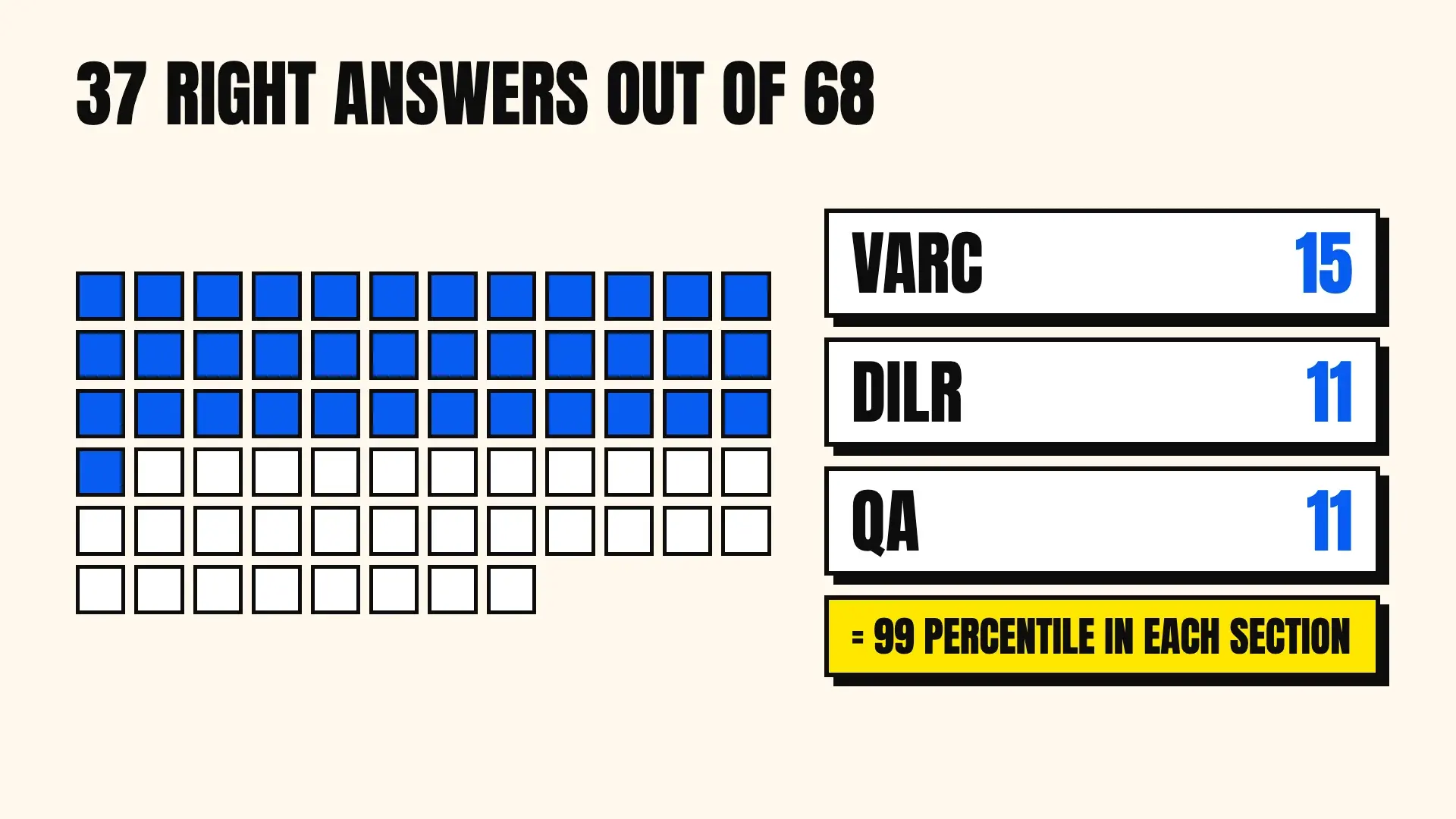
More hours rarely fix it. CAT pays you for the questions you choose and the mistakes you avoid. A 99 percentiler in the latest CAT got about 37 questions right out of 68. That is a little over half the paper. This guide shows you which half to chase, how to prepare for it, and where a 99 takes you.
Quick answer: To crack 99+ percentile in CAT, you need about 81 to 90 marks out of 204, which is 28 to 32 net correct answers out of 68. Build arithmetic, algebra, reading comprehension and DILR set selection first, take 15 to 20 full mocks with a written analysis of each, and keep your accuracy above 85 percent.
CAT at a glance
| Item | Detail |
|---|---|
| Full name | Common Admission Test |
| Conducted by | The IIMs. One IIM runs it each year |
| Usually held | Last Sunday of November, in three slots |
| Questions | 68 in the latest paper |
| Sections | VARC, DILR and QA, in that fixed order |
| Time | 120 minutes, 40 minutes for each section |
| Marking | +3 for a correct answer, −1 for a wrong MCQ, 0 for a wrong TITA |
| Maximum marks | 204 |
| Marks for 99 percentile | About 81 to 90 in the latest paper |
| Accepted by | 21 IIMs, FMS Delhi, MDI, SPJIMR, IIT management schools and over a thousand other colleges |
| Official site | iimcat.ac.in |
What does a 99+ percentile in CAT mean?
A percentile is a rank, written as a percentage. At 99 percentile, you scored more than 99 out of every 100 people who sat the test. More than two lakh candidates take CAT each year, so a 99 puts you inside the top 2,000 to 3,000.
Three numbers appear on your scorecard. Students mix them up, so learn them once.
- Raw score. Your marks from the answer key: 3 for each correct answer, minus 1 for each wrong MCQ.
- Scaled score. The IIMs adjust raw scores across the three slots, so a tougher slot doesn't hurt you.
- Percentile. Your position among all candidates, built from the scaled scores.
You get four percentiles: one overall and one for each section. Most IIMs set a minimum for each section. A 99 overall with a 70 in DILR can still cost you a call from the older IIMs. So "cracking CAT" means a high overall score with no weak section.
CAT exam pattern and marking scheme
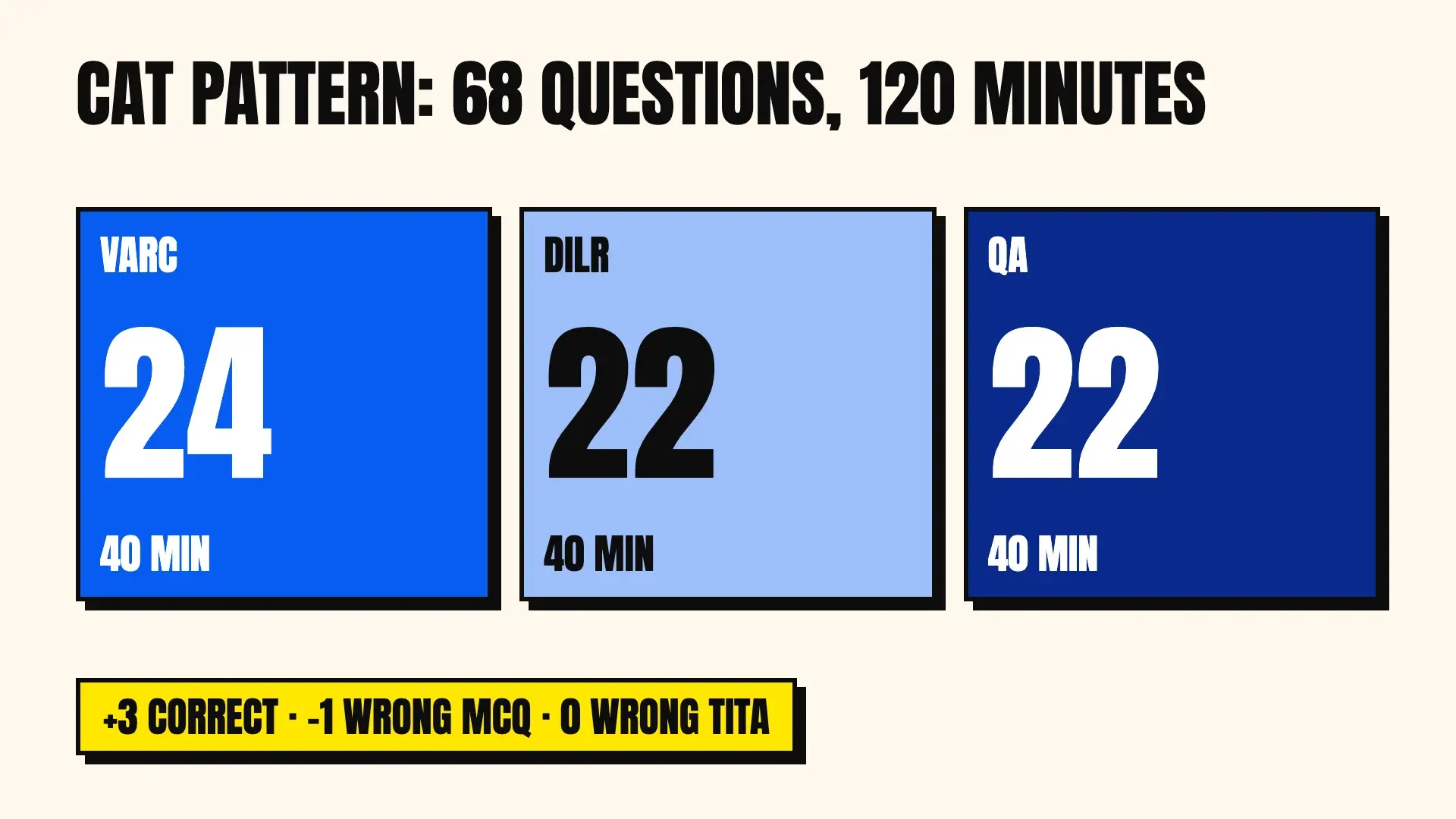
CAT has three sections. You get 40 minutes for each, in a fixed order, and you can't go back to a section once its timer ends.
| Section | Questions | Question types | Time |
|---|---|---|---|
| 1. Verbal Ability and Reading Comprehension (VARC) | 24 | 16 RC questions from 4 passages, 8 verbal ability questions | 40 min |
| 2. Data Interpretation and Logical Reasoning (DILR) | 22 | 5 sets of 4 or 5 questions | 40 min |
| 3. Quantitative Ability (QA) | 22 | About 14 MCQs and 8 TITA questions | 40 min |
| Total | 68 | 120 min |
The IIMs can change the question count from year to year. The paper had 66 questions in some earlier years and 68 in the last two. The structure of three sections and 40 minutes each has stayed the same.
The marking rules decide your strategy.
| Your answer | Marks |
|---|---|
| Correct | +3 |
| Wrong MCQ | −1 |
| Wrong TITA (type in the answer) | 0 |
| Not attempted | 0 |
Two things follow from this table. A wrong MCQ costs you a third of a correct answer, so three bad guesses wipe out one right answer. A wrong TITA costs nothing, so you should type an answer whenever you have a reasonable one.
How many marks do you need for 99 percentile in CAT?
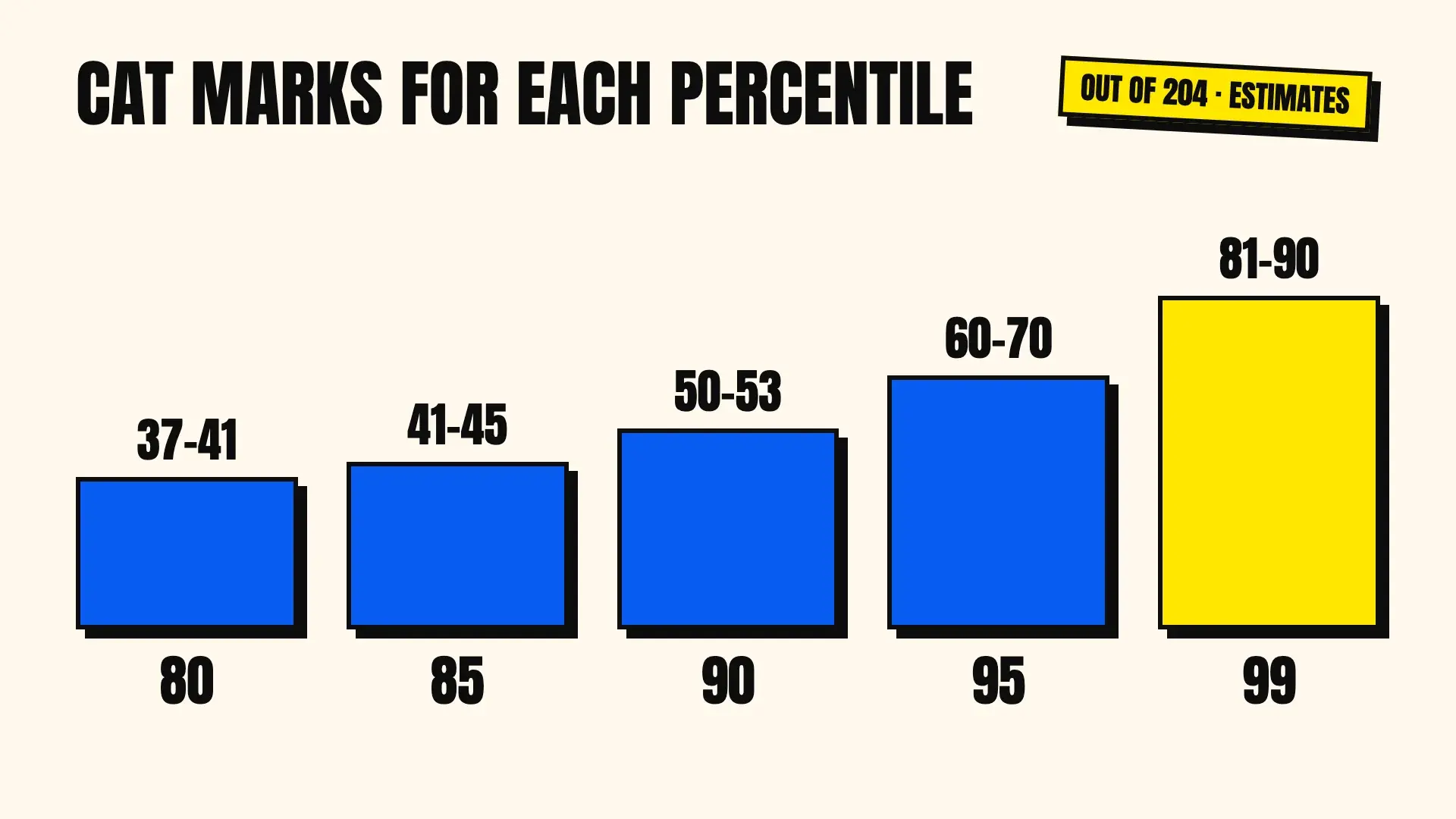
In the latest paper, about 81 to 90 raw marks out of 204 earned a 99 percentile. The range exists because each slot has a different paper and each institute publishes its own estimate.
| Percentile | Marks in the latest CAT (2025) | Marks the year before (2024) |
|---|---|---|
| 99.9 | 107 to 122 | About 127 |
| 99.5 | 93 to 103 | About 104 |
| 99 | 81 to 90 | About 95 |
| 98 | 74 to 81 | No estimate |
| 95 | 60 to 70 | About 70 |
| 90 | 50 to 53 | About 58 |
| 85 | 41 to 45 | About 50 |
| 80 | 37 to 41 | About 44 |
Estimates compiled from Cracku, MBAUniverse and Career Launcher. The IIMs don't publish a conversion table.
Read the two columns side by side. The same 99 percentile needed about 95 marks one year and 81 to 90 the next. A tougher paper pulls everyone's marks down, so fewer marks earn the same rank. You can't control the paper. You can control your margin, so set your mock target at 95 marks or more.
Each section has its own bar too.
| Section | Marks for 99 percentile in the section |
|---|---|
| VARC | About 39 to 42 |
| DILR | About 27 to 34 |
| QA | About 28 to 33 |
To check where your own score stands, enter your right and wrong answers in the free CAT score calculator. The CAT score vs percentile guide has the slot-by-slot numbers.
How many questions should you attempt for 99 percentile?
Marks feel abstract until you turn them into questions. The table below does that, assuming your wrong answers are all MCQs.
| Attempts | Right | Wrong | Score | Rough percentile |
|---|---|---|---|---|
| 36 | 32 | 4 | 92 | 99+ |
| 32 | 29 | 3 | 84 | 98 to 99 |
| 28 | 25 | 3 | 72 | About 96 |
| 22 | 19 | 3 | 54 | About 90 |
| 18 | 15 | 3 | 42 | About 85 |
Source: Crack CAT in 60 Days, based on the latest CAT data.
Thirty-six attempts with four mistakes gets you past 99. That leaves 32 questions untouched. You have more than three minutes for each question you do attempt, which is the reason slow, careful solvers beat fast, careless ones in this exam.
One way to reach 99 percentile in each section:
| Section | Right | Wrong | Marks | Good attempts |
|---|---|---|---|---|
| VARC | 15 | 2 | 43 | 10 to 12 RC questions and 5 to 7 verbal ability questions |
| DILR | 11 | 1 | 32 | 2 to 3 full sets |
| QA | 11 | 2 | 31 | 11 to 14 questions |
| Total | 37 | 5 | 106 |
You can test your own split with the CAT questions-to-attempt planner. Enter a target percentile and it shows the attempts and accuracy you need in each section.
Attempts or accuracy: which matters more?
Accuracy. Look at two students who both attempt 40 questions.
| Student | Attempts | Right | Wrong | Score |
|---|---|---|---|---|
| A, 90 percent accuracy | 40 | 36 | 4 | 104 |
| B, 70 percent accuracy | 40 | 28 | 12 | 72 |
Same effort, a gap of 32 marks. Student B would have scored more by attempting 30 questions and getting 27 right. Keep your overall accuracy above 85 percent in mocks before you try to raise your attempts.
CAT syllabus: the topics that carry the most marks
The IIMs don't publish a syllabus. Past papers show which topics return every year. Study these first.
| Rank | QA | DILR | VARC |
|---|---|---|---|
| 1 | Linear equations and inequalities | Arrangements (linear, circular, grid) | RC: main idea |
| 2 | Geometry (triangles and circles) | Ranking, scoring and ordering | RC: inference |
| 3 | Time, speed and distance | Games and tournaments | RC: tone and purpose |
| 4 | Time and work | Scheduling and timelines | RC: specific detail |
| 5 | Quadratic equations | Selection and distribution | RC: strengthen and weaken |
| 6 | Number system | Mixed DI and LR caselets | RC: "all except" questions |
| 7 | Ratio, proportion and averages | Tables and charts | Para summary |
| 8 | Percentages, profit and interest | Routes and networks | Para jumbles |
| 9 | Progressions and series | Venn diagrams and sets | Odd sentence out |
| 10 | Logs, surds and indices | Quant-based puzzles | Sentence placement |
Source: Crack CAT in 60 Days, from an analysis of recent papers.
In the latest paper, QA had 8 to 10 arithmetic questions and 5 to 9 algebra questions out of 22. Those two areas made up about two thirds of the section. In VARC, reading comprehension gave 16 of the 24 questions. In DILR, logical reasoning sets made up roughly 59 percent of the section.
So the order is clear. Arithmetic and algebra before geometry. RC before verbal ability. Arrangements and games before fancy charts.
Section-wise strategy to score 99+ percentile in CAT
VARC: read every day
RC decides this section. Sixteen of 24 questions come from four passages of about 400 to 450 words each, on topics such as philosophy, economics, sociology, science and history.
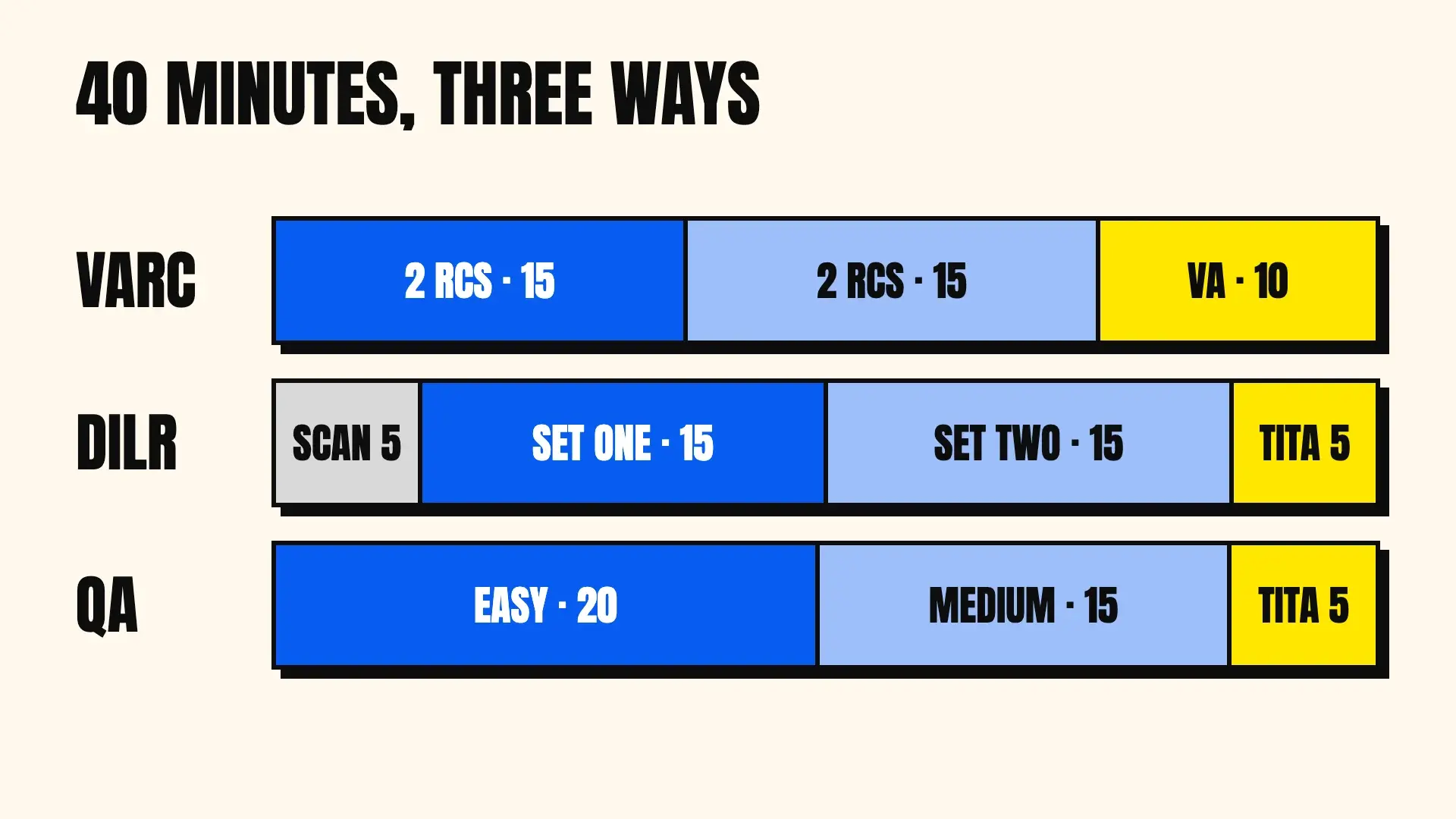
A 40-minute plan that works for most students:
| Minutes | Do this |
|---|---|
| 0 to 15 | Two RC passages |
| 15 to 30 | The other two passages, or the better one of them |
| 30 to 40 | Verbal ability, with TITA questions first |
Rules to follow inside the section:
- Finish a passage in under five minutes. Don't reread single lines.
- Answer an MCQ only after you cut two options.
- Give one question 60 to 90 seconds at most.
- Attempt every TITA para jumble and odd sentence question. A wrong answer costs nothing.
- Check each answer against a line in the passage. An option that is true in real life can still be wrong.
Your target is 80 percent accuracy in RC, which means 12 or 13 correct out of 16. To get there, read two or three passages a day from the first week. Students who do VARC only on weekends stay stuck in the 80s.
DILR: choose two sets and finish them
DILR gives you five sets and 40 minutes. You don't need all five. Ten or eleven correct answers put you near 99 percentile in the section, and that is two full sets plus part of a third.
- Spend the first five minutes reading all five sets. Rank them from easy to hard.
- Start with the easiest set, then the next one.
- Draw the table or grid before you read the questions.
- Use fixed clues first. Treat "either-or" clues as two cases.
- Follow the five-minute rule: if you have no grid after five minutes, leave the set.
Most students lose this section in one place: they pick a hard set, sink 15 minutes into it, and panic. The fix is practice in choosing sets, which is a separate skill from solving them. The CAT DILR set selection guide covers the green and red flags to look for.
QA: three rounds
QA has about 14 MCQs and 8 TITA questions. Eleven correct answers with two mistakes earn roughly 99 percentile in the section, so you can leave eight or nine questions alone.
| Round | Minutes | Do this |
|---|---|---|
| 1 | 0 to 20 | Scan all 22 questions and solve every easy one |
| 2 | 20 to 35 | Solve the medium questions |
| 3 | 35 to 40 | Attempt the leftover TITA questions |
- If you see no approach in 45 seconds, skip the question and return later.
- For MCQs, try the options or plug in simple values.
- Practise TITA questions every day, since eight of them appear in each paper.
- Split your study time as 25 percent concepts and 75 percent solving.
Aim for 11 to 14 attempts at 85 percent accuracy or better.
How long does it take to prepare for CAT?
It depends on your starting point and the hours you can give. Use this table to pick a track.
| Time before CAT | Hours a day | Who it suits | What changes |
|---|---|---|---|
| 9 to 12 months | 2 to 3 | Working professionals, students weak in maths or reading | Slow concept building, a mock every two weeks at first |
| 6 months | 3 to 4 | Most college students | Concepts in three months, mocks every week after that |
| 3 months | 5 to 6 | Students with strong basics | Top 10 topics of each section, two mocks a week |
| 60 days | 8 to 10 full-time, 4 if you work | Repeaters and late starters | Top topics only, a mock every two to five days |
Hours matter less than what you do in them. Eight hours of reading solved examples builds less than four hours of timed solving followed by an hour of error review.
If you have about two months left, follow the 60-day CAT preparation plan. If you have a job, the CAT plan for working professionals fits study blocks around a nine-hour workday. For any other number of days, the CAT study plan tool builds a schedule from your exam date.
A four-phase study plan for CAT
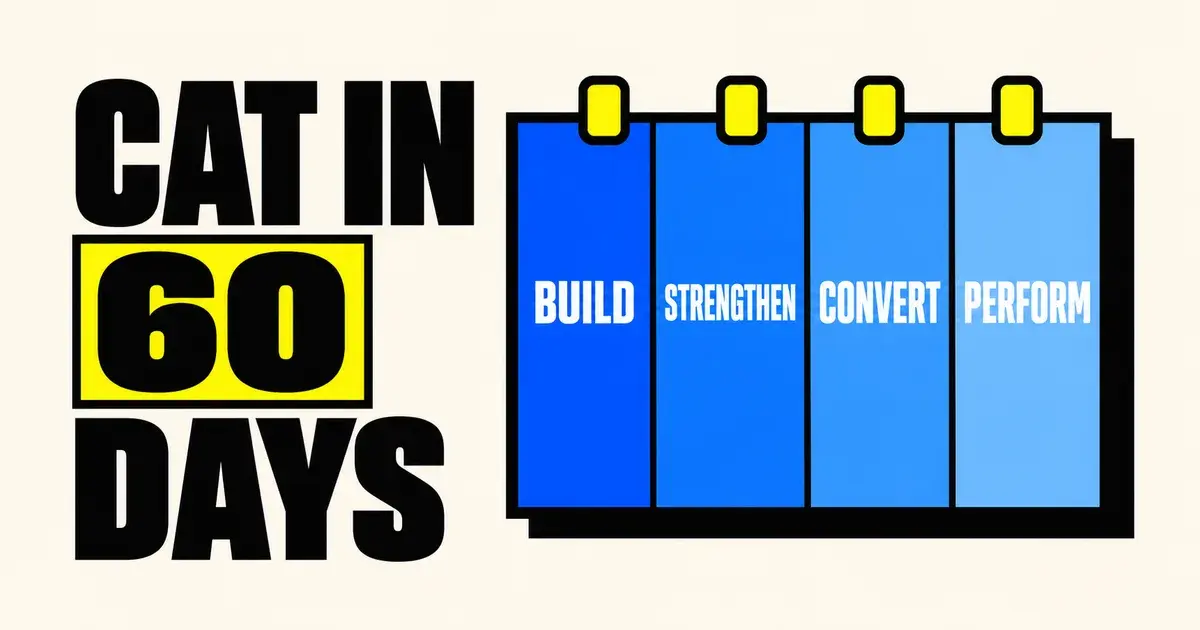
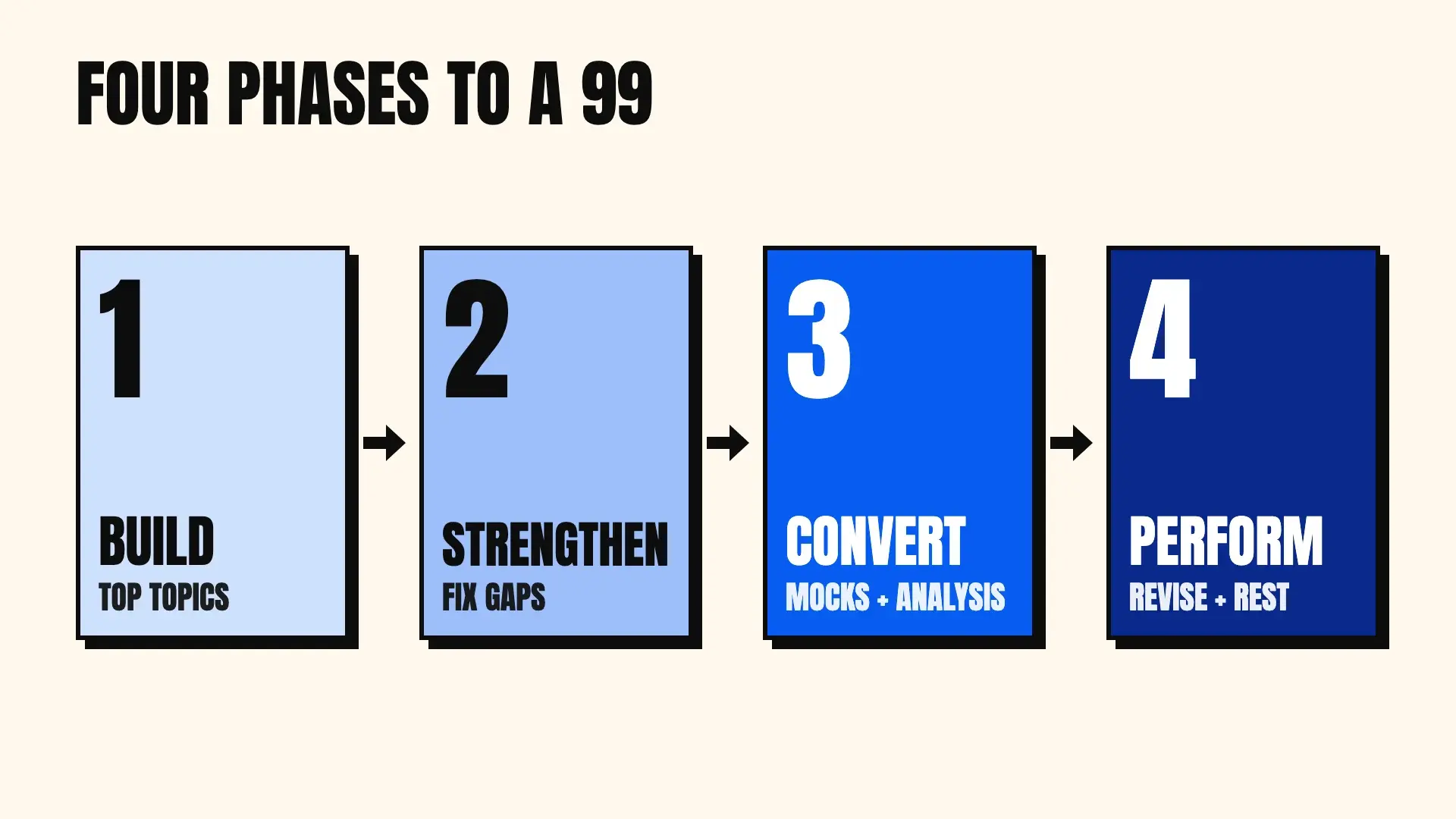
Whatever your timeline, split it into four equal phases. With 60 days, each phase is 15 days. With six months, each is about six weeks.
| Phase | Goal | Main work | Mocks |
|---|---|---|---|
| 1. Build | Cover the topics that carry the most marks | Arithmetic, algebra, arrangements, two RCs a day | A diagnostic mock on day one, then one more |
| 2. Strengthen | Close the gaps your mocks show | Geometry, numbers, harder LR sets, sectional tests | One every five or six days |
| 3. Convert | Turn practice into marks | Mock, analysis, repair of weak topics | One every two days |
| 4. Perform | Peak on exam day | Mocks at your slot time, revision, a fixed sleep routine | Fewer in the last ten days |
A day in phase one, for a full-time student:
| Time | Task |
|---|---|
| 7 to 9 am | QA: one new topic |
| 9:30 to 11 am | QA practice |
| 11:30 am to 1 pm | DILR: two sets |
| 2 to 3 pm | Two RC passages |
| 3 to 4 pm | Verbal ability and vocabulary |
| 5 to 6:30 pm | A sectional test |
| 8 to 9 pm | Revision and error log |
How many mocks should you take for 99 percentile?
Take 15 to 20 full mocks. Fewer than that and you won't have tested your section plans enough. More than 30 and you start skipping the analysis, which is where the marks come from.
- First half of your preparation: one mock every five or six days.
- Third quarter: one mock every two days.
- Last ten days: fewer mocks, more revision.
- After you get your admit card: take mocks at your own slot time.
A mock day should look like this.
| Time | Task |
|---|---|
| 2 hours | Full mock under exam conditions, phone away |
| 30 minutes | Break |
| 1 hour | Solve the wrong and skipped questions again, without a timer |
| 1 hour | Read solutions and fill in your analysis sheet |
| 15 minutes | Write three actions for the next mock |
Sort each mistake into one of five types. The fix differs for each.
| Error type | Fix |
|---|---|
| Concept gap | Relearn the concept, then solve 20 questions on it |
| Calculation or silly error | Find the exact step where it happened and slow down there |
| Practice gap | Add timed questions on that topic |
| Selection error | Improve your one-minute scan at the start of the section |
| Time error | Hold a two-minute limit for any one question |
Your first four or five mock scores will be low. That is normal. Judge your preparation by the average of your last five mocks. Mock percentiles shift from one series to another, so track raw marks. The CAT mock test strategy guide has a printable analysis sheet.
Your exam-day plan for CAT
| Section | First 15 minutes | Next 15 minutes | Last 10 minutes |
|---|---|---|---|
| VARC | Two RC passages | Two more passages | Verbal ability, TITA first |
| DILR | Scan all sets and solve the best one | Second set | Third set or safe TITA questions |
| QA | Round one: sure answers | Round two: medium questions | TITA questions, no blind MCQ guesses |
Carry four rules into the hall.
- Scan the whole section in the first minute.
- If a question holds you for more than two minutes, mark it and move.
- Once a section ends, forget it. The next one starts fresh.
- Return to marked questions only if three or more minutes remain.
The last 10 days before CAT guide covers what to revise, what to skip and what to carry to the centre.
Top colleges you can target with 99+ percentile in CAT
A 99 percentile puts the top colleges in India within reach. These are the ten colleges that rank highest among those accepting CAT.
| Rank | College | City |
|---|---|---|
| 1 | IIM Ahmedabad | Ahmedabad |
| 2 | IIM Bangalore | Bengaluru |
| 3 | IIM Kozhikode | Kozhikode |
| 4 | DMS, IIT Delhi | New Delhi |
| 5 | IIM Lucknow | Lucknow |
| 6 | IIM Mumbai | Mumbai |
| 7 | IIM Calcutta | Kolkata |
| 8 | IIM Indore | Indore |
| 9 | MDI Gurgaon | Gurugram |
| 10 | VGSoM, IIT Kharagpur | Kharagpur |
Order follows the NIRF management ranking for colleges that admit through CAT. FMS Delhi isn't ranked by NIRF, but it sits among the top CAT colleges too.
Calls depend on more than your percentile. For a general-category candidate with an average profile, this is a rough map.
| Percentile band | Colleges where calls are realistic |
|---|---|
| 99+ | IIM Ahmedabad, Bangalore, Calcutta, FMS Delhi, JBIMS (all-India seats) |
| 97 to 99 | IIM Lucknow, Kozhikode, Indore, Mumbai, MDI, IIFT, SJMSOM IIT Bombay |
| 94 to 97 | IIM Shillong, Udaipur, Trichy, Raipur, Ranchi, SPJIMR |
| 90 to 94 | IIM Rohtak, Kashipur, Nagpur, Visakhapatnam, IMT, MICA |
| 85 to 90 | IIM Jammu, Sirmaur, Sambalpur, Amritsar, TAPMI, GIM |
How the IIMs shortlist candidates
Each IIM publishes its own admission policy. Most of them score you on five things:
- CAT score, with a minimum percentile in each section. Many IIMs expect about 70 to 85 in each.
- Academics: your class 10, class 12 and graduation marks.
- Work experience, up to a cap.
- Diversity: gender and academic background.
- Written test and interview at the final stage, which carry close to half the weight at many IIMs.
If your class 10 or 12 marks are weak, aim higher in CAT and apply to colleges where the CAT score drives the shortlist. FMS Delhi, MDI Gurgaon, IIFT and the IIT management schools fall in that group. Read each college's admission policy PDF before you apply, since the weights change every year. The guide to choosing MBA entrance exams maps colleges to the exams they accept.
Seven mistakes that keep you below 99
| # | Mistake | Fix |
|---|---|---|
| 1 | Taking many mocks with no analysis | Spend as long on analysis as on the mock |
| 2 | Starting new topics in the last month | Revise, and stay with the top 10 topics |
| 3 | Staying on one DILR set for 15 minutes or more | Apply the five-minute rule and switch |
| 4 | Answering an RC MCQ without cutting two options | Skip it if you can't eliminate |
| 5 | Leaving TITA questions blank | Attempt them, since a wrong answer costs nothing |
| 6 | Studying VARC only on weekends | Read two or three passages a day |
| 7 | Judging your preparation by one mock | Look at your last five |
Can you crack CAT without coaching?
Yes, if you can hold a routine on your own. Coaching gives you three things: a schedule, a test series and someone to clear doubts. You can replace the schedule with a written plan and the doubt-clearing with solutions and forums. You can't replace the test series, so buy one. Fifteen to twenty mocks from a respected series are the one expense worth paying for.
Working professionals crack CAT each year on four hours a day. They give weekday mornings to QA, the lunch break to one RC passage, the evening to DILR, and the weekend to a full mock with analysis.
Frequently asked questions
How many marks are required for 99 percentile in CAT?
About 81 to 90 raw marks out of 204 earned the 99th percentile in the latest CAT, depending on the slot. The year before, it took about 95. The figure moves with the difficulty of the paper, so aim for 95 or more in mocks.
How many questions should I attempt in CAT to get 99 percentile?
Around 36 attempts with 32 correct answers scores about 92 marks, which has been above the 99th percentile in recent papers. That is roughly 15 correct in VARC, 11 in DILR and 11 in QA. Accuracy above 85 percent matters more than a high attempt count.
Can I crack CAT in 3 months?
Yes, if your basics in arithmetic, algebra and reading are sound. Give five to six hours a day, cover the top 10 topics of each section in the first six weeks, and take two mocks a week after that. Beginners in maths or reading usually need six months or more.
Is 99 percentile enough for IIM Ahmedabad, Bangalore and Calcutta?
A 99 gets you into the range, but it isn't enough alone. These IIMs also score your class 10, class 12 and graduation marks, work experience and diversity, and they set sectional minimums. Many general-category candidates need 99.5 or more for a call.
How many hours should I study for CAT each day?
Full-time aspirants manage 8 to 10 hours, college students 5 to 6, and working professionals about 4 on weekdays with a mock on the weekend. Split the time across all three sections every day. Timed solving and error review count for more than hours spent reading theory.
Which section is the toughest in CAT?
DILR troubles most students, since one wrong choice of set can cost 15 minutes. It is also the section where the marks needed for a 99 percentile are lowest, about 27 to 34 in the latest paper. Two sets solved fully can carry the section.
Is CAT tougher than XAT, SNAP and NMAT?
CAT has the hardest DILR and the widest competition. XAT has tougher quant and a Decision Making section. SNAP and NMAT test speed on easier questions. Preparing for CAT first covers most of the syllabus for the other three.
Can an average student crack CAT?
Yes. CAT tests class 10 level maths, reading and logic, and you need about 37 correct answers out of 68 for a 99 percentile in each section. Students who practise daily, analyse every mock and choose questions carefully reach high percentiles regardless of their college marks.
Do I need to attempt all three sections equally?
You need to clear the sectional cutoff in each one, so you can't ignore any section. Beyond that, most students draw their extra marks from their strongest section. A common split at 99 percentile is about 43 marks in VARC, 32 in DILR and 31 in QA.
How many mocks are enough for CAT?
Fifteen to twenty full mocks, each followed by two to three hours of analysis, are enough for most students. Add sectional tests in between. Solve the last two official CAT papers under timed conditions in the final three weeks.
Sources
- Pattern, marking scheme and exam schedule: iimcat.ac.in (official)
- Score vs percentile estimates: Cracku, MBAUniverse and Career Launcher
- College ranking: NIRF management ranking
- Attempt tables, top 10 topics, section plans and the four-phase plan: Crack CAT in 60 Days by The 99 Percentiler
Related reading: CAT score vs percentile · CAT preparation in 60 days · CAT DILR set selection · CAT vs XAT · How to crack 99+ percentile in MBA entrance exams · Free MBA exam calendar · CAT Quant preparation for beginners
The CAT playbook has the full percentile tables, a chapter for each top topic, the 60-day calendar and a mock tracker you can print.