
Forty minutes, five sets, twenty-two questions. You open the first set, it looks fine, and you start drawing a table. Twelve minutes later you have three possible cases, no answers, and a growing feeling in your stomach. You switch to set two. Then the section ends.
That story ends in a 40 percentile DILR score for thousands of CAT students every year, and most of them could have solved two other sets in the same paper. DILR rewards the student who chooses well more than the student who solves fast. You can learn to choose well, and it takes less time than learning a new topic.
Quick answer: In CAT DILR, spend the first 4 to 5 minutes reading all the sets without solving. Rank them by how many variables and conditions they have, how clearly the data is laid out, and whether the clues are direct. Solve the two easiest sets fully. If you can't build a table within five minutes, leave the set.
How many DILR sets do you need for a good percentile?
Fewer than you think. CAT 2025 DILR had 22 questions in five sets: three sets of four questions and two sets of five.
| Target | What it takes (CAT 2025, approx.) |
|---|---|
| 99 percentile in DILR | About 10 to 11 correct answers, roughly 30 to 34 marks |
| 95 percentile | Two full sets plus one or two extra answers |
| 90 percentile | About 7 to 8 correct answers |
Sources: IMS India CAT 2025 analysis (99%ile DILR marks by slot: 34, 30, 32); Crack CAT in 60 Days. Estimates.
Two clean sets with near-perfect accuracy gets you close to the 95th percentile in DILR. Two and a half sets puts you near 99. You don't need to touch the other two sets at all.
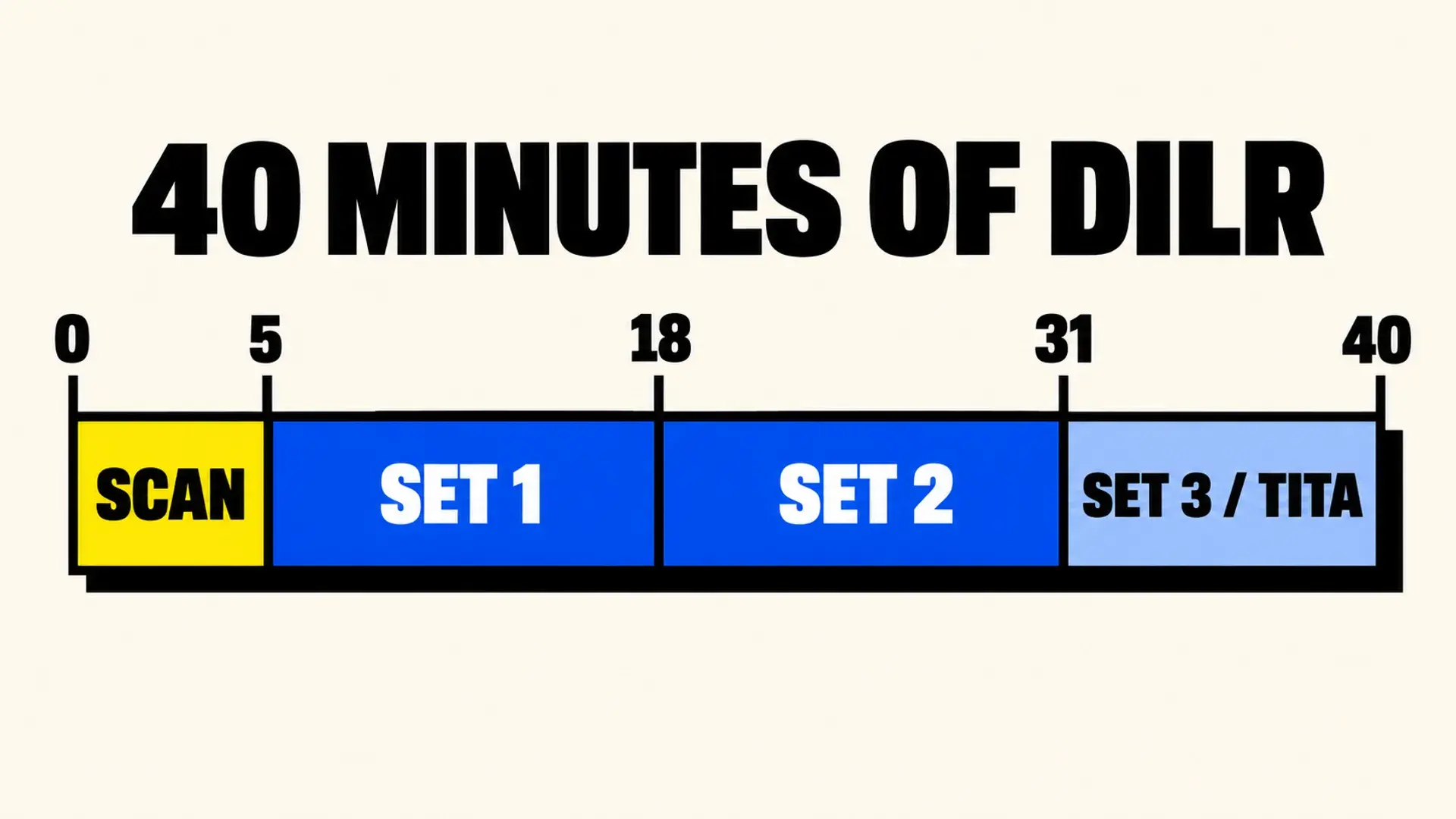
The 40-minute DILR plan
| Time | What you do |
|---|---|
| 0 to 5 min | Read every set. No solving. Rank them easy to hard. |
| 5 to 18 min | Solve the easiest set completely |
| 18 to 31 min | Solve the second set |
| 31 to 40 min | Third set, or pick off the direct questions and TITAs from it |
Remember that wrong TITA answers carry no penalty in CAT. If a set has two TITA questions you can solve from the first two clues, take them even if you skip the rest of the set.
What to look for in the first five minutes
You get about one minute per set. Read the setup paragraph, glance at the table or chart, and read the question stems. Don't start solving.
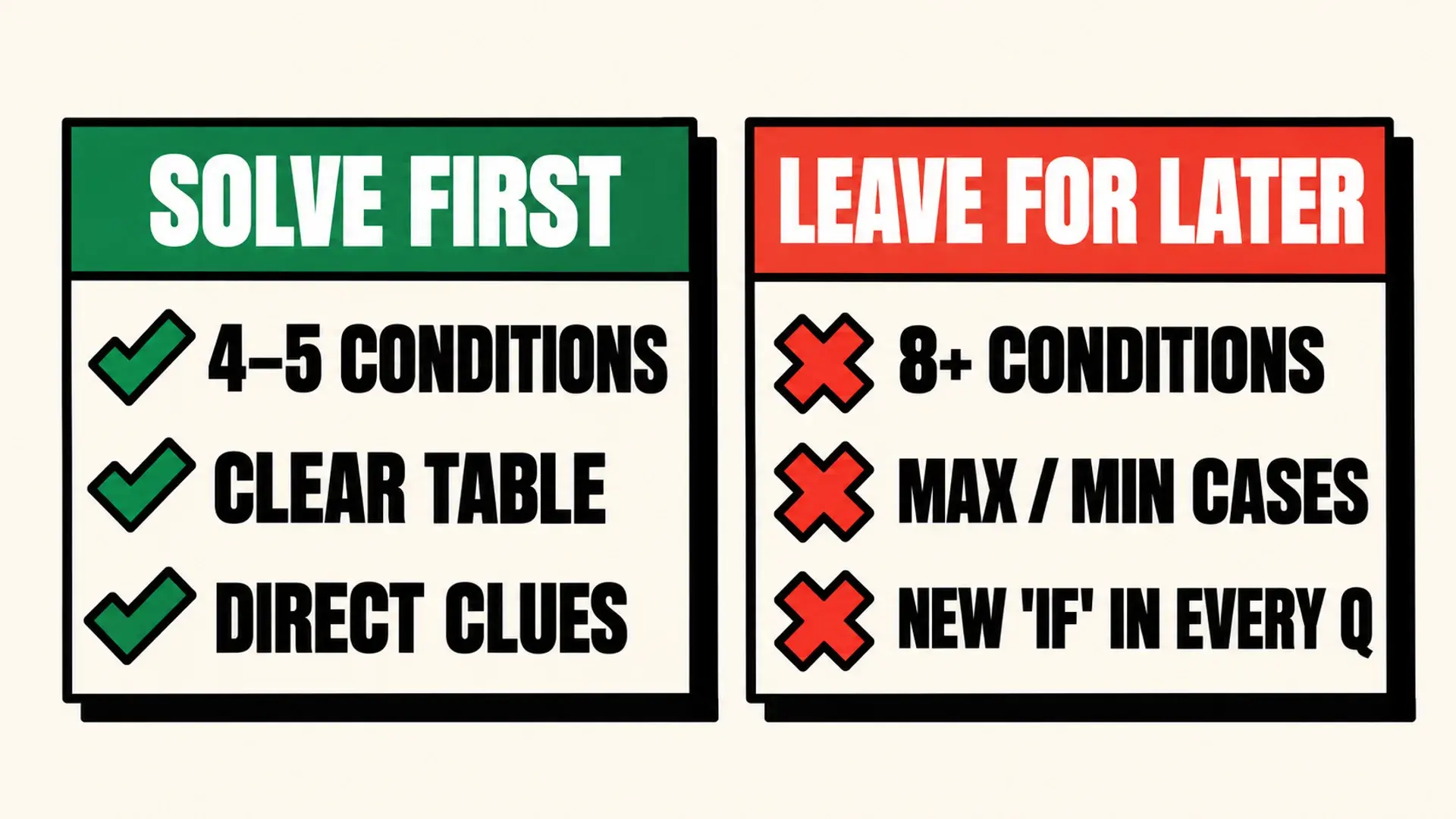
Green flags: solve these first
- Four or five manageable conditions. You can hold them in your head after one read.
- Data in a clear table or chart. You can plug numbers in at once.
- Direct clues. "P sits second from the left" is easier than "If P is not next to Q, then R...".
- A structure you've practised. Linear arrangement, ranking, scheduling or a simple distribution.
- Calculator-friendly DI. Percentages and totals that the on-screen calculator handles in seconds.
- Five questions instead of four. Same setup time, one more question of value.
Red flags: leave these for later
- Eight or more conditions in a long paragraph.
- "Maximum" or "minimum" questions that need you to test many cases.
- Questions that each add a new condition ("If X is true, which of the following...?"). Each one is almost a new set.
- An unfamiliar structure you have never seen in practice.
- Heavy "at least" or "at most" logic across many people or items.
A set with one red flag can still be worth doing. A set with three is a trap.
The five-minute rule
Once you start a set, give it five minutes to "open". If you can't build a table, grid or diagram that holds the main information within five minutes, stop and move to your next set. Mark it and come back only if you have time at the end.
This rule feels painful the first few times, because you hate leaving work half done. But think about what the extra ten minutes buy you on a stuck set: maybe one answer. The same ten minutes on a clean set usually buy four.
Which DILR set types are usually easier?
Difficulty depends on the specific set, but some types open up faster for most students.
| Usually quicker to open | Usually slower |
|---|---|
| Linear arrangement | Circular arrangement with directions |
| Ranking and ordering | Games and tournaments with points |
| Tables and bar charts (DI) | Routes and networks |
| Simple selection with 3 to 4 rules | Binary logic (truth-tellers and liars) |
| Scheduling with fixed slots | Quant-based puzzles with many unknowns |
In CAT 2025, Logical Reasoning made up about 59 percent of DILR, mixed DI and LR caselets about 23 percent, and pure DI about 18 percent (Cracku analysis). So most of your practice should be on LR-heavy sets.
How to solve a set once you've picked it
- Draw the structure first. A table, grid or seating diagram. Do this before reading the questions.
- Place the fixed clues. "C is in the middle" goes in immediately.
- Handle "either-or" clues as two cases. Draw two small grids side by side.
- Strike out cases that break any clue. Most sets collapse to one or two cases quickly.
- Now read the questions. Many questions need only part of the table.
- Use "cannot be determined" only after checking every case.
Build your selection skill in practice
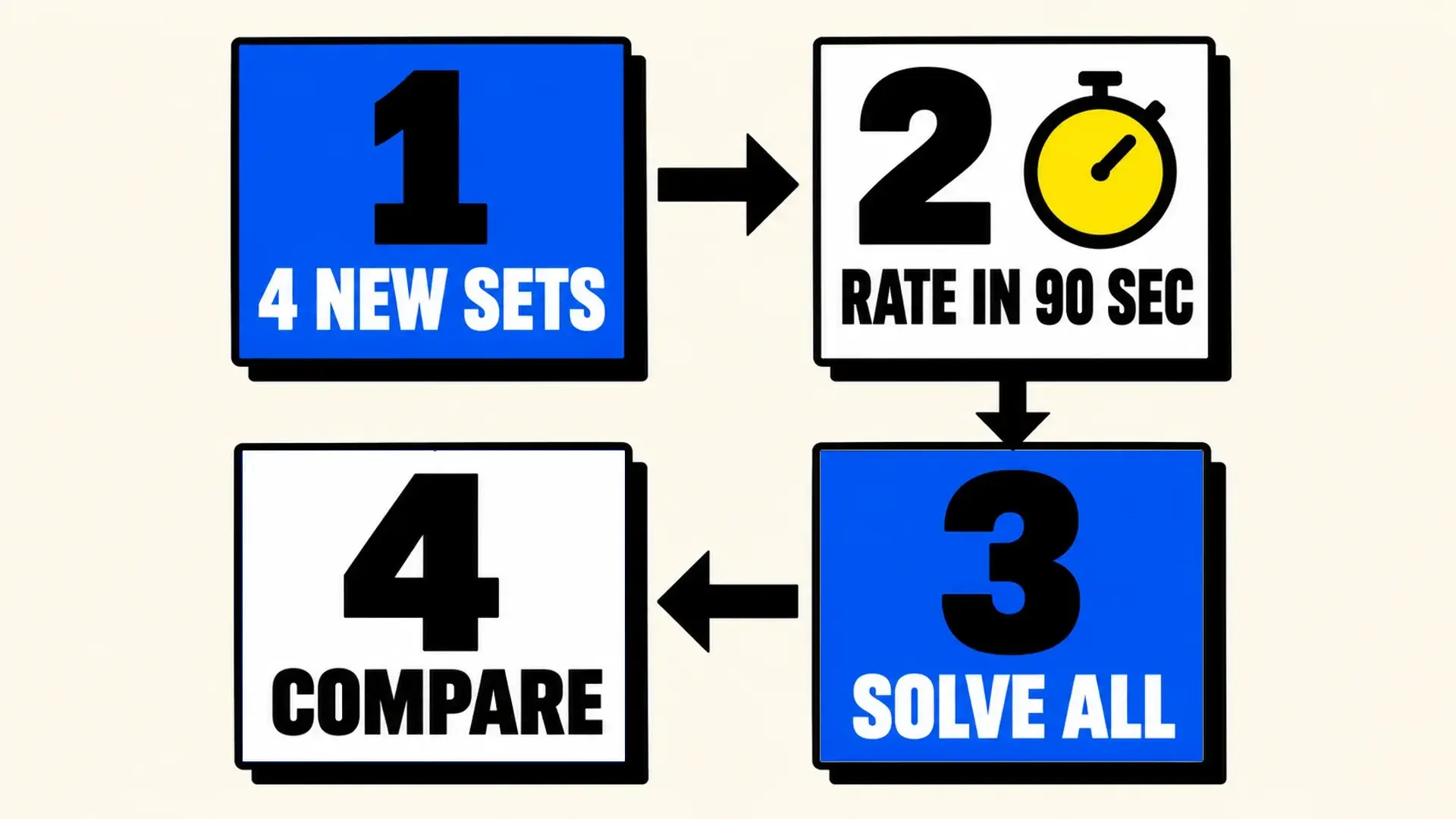
Set selection is a skill, and you can train it on its own. Try this drill three times a week:
- Take four DILR sets you haven't seen.
- Give yourself 90 seconds per set to read and rate it from 1 (easy) to 5 (hard). Write the rating down.
- Now solve all four sets without a time limit, and note how long each took.
- Compare your ratings with reality. Which signals fooled you?
After two weeks of this, your first-glance ratings will be right most of the time. That is worth more marks than another month of grinding hard sets.
Common DILR mistakes
- Starting with set 1 because it's first. The first set is often not the easiest. Scan before you start.
- Reading the questions before drawing the table. You end up solving each question from scratch.
- Solving one set for 15 minutes. Use the five-minute rule.
- Guessing MCQs in a set you didn't solve. Each wrong MCQ costs a mark. TITAs are free to try; MCQs are not.
- Looking at the solution too early in practice. Struggle for at least 15 minutes before you check. The struggle builds the skill.
Frequently asked questions
How many DILR sets should I attempt in CAT?
Aim to fully solve two sets with near-perfect accuracy and pick up a few questions from a third. In CAT 2025, about 10 to 11 correct DILR answers put you near the 99th percentile in the section.
How long should I spend choosing DILR sets?
Spend the first 4 to 5 minutes of the section reading every set without solving. One minute per set is enough to judge the number of conditions, the data format and whether the clues are direct.
What should I do if all the DILR sets look hard?
Pick the set with the fewest conditions and the clearest data, and solve it carefully. Then take the direct questions and TITA questions from the next easiest set. In a hard paper, most students in your slot struggle too, and the marks needed for a good percentile drop.
Is it better to solve one set fully or half of two sets?
One full set is usually better. Most of your setup time goes into building the table, and the last questions in a set are fast once the table exists. Half-solving two sets doubles the setup time for the same number of answers.
How do I practise DILR in the last month before CAT?
Solve two sets a day under a 15-minute limit each, and do a selection drill three times a week. Take DILR sectionals between full mocks, and log every set you abandoned and why.
Sources
- CAT 2025 DILR structure and topic share: Cracku CAT 2025 DILR analysis
- 99 percentile DILR marks by slot: IMS India CAT 2025 score vs percentile analysis
- 40-minute plan, five-minute rule and solving steps: Crack CAT in 60 Days by The 99 Percentiler
- Pattern and TITA marking: iimcat.ac.in (official)
Related reading: CAT mock analysis method · CAT score vs percentile · How to prepare for CAT in 60 days · How to crack 99+ percentile in CAT
Ten DILR set types with worked examples are in the CAT playbook.