
You open the calendar, count the Sundays, and land on a number you don't like: about eight weeks to CAT. You haven't finished geometry. Your last mock felt like a bad dream. And every second video on YouTube says you needed to start in January.
Sixty days is enough to move your percentile a long way, if you spend them on the right things in the right order. Students who jump from 85 to 97 in the last two months rarely learn much new syllabus. They pick the topics that carry marks, take mocks on a fixed rhythm, and fix the same mistakes until they stop making them. The plan below follows that order, one 15-day phase at a time.
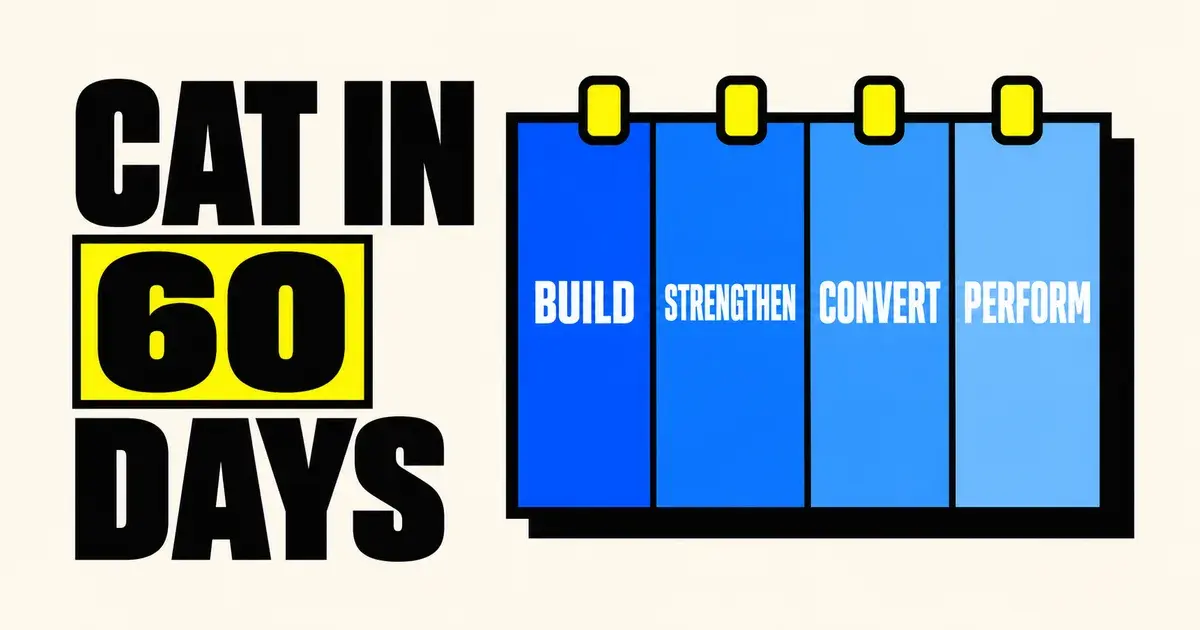
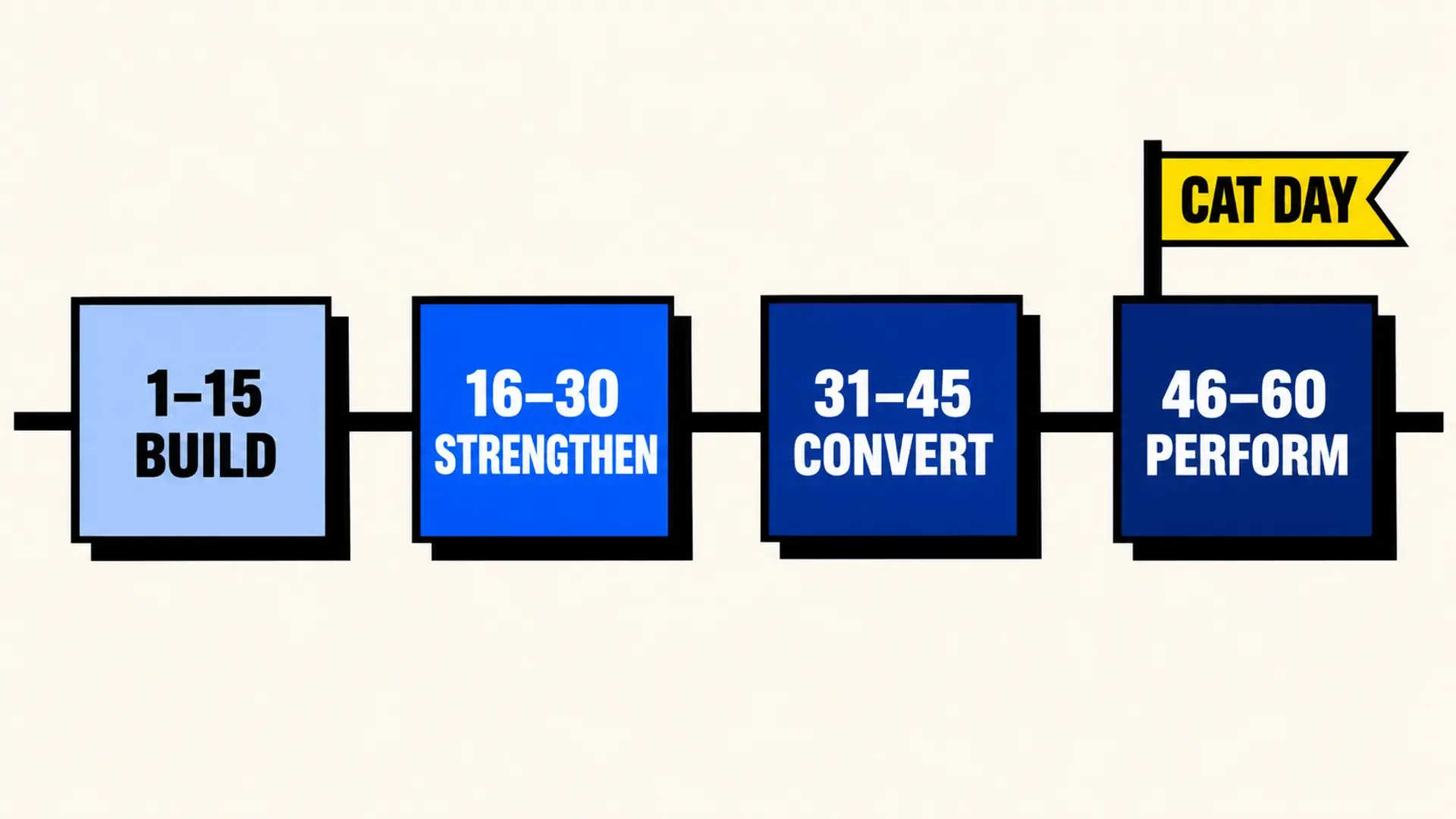
Quick answer: To prepare for CAT in 60 days, split the time into four 15-day phases. Days 1 to 15 build arithmetic, algebra and arrangement sets. Days 16 to 30 add geometry, number system and sectional tests. Days 31 to 45 run a full mock every two days with deep analysis. Days 46 to 60 are for exam-slot mocks, revision and sleep routine.
Is 60 days enough for CAT?
Yes, for most students who already know school-level maths and can read English comfortably. Two months won't make you an expert in every chapter. They can make you very good at the 60 to 70 percent of the paper that repeats every year.
The numbers back this up. In CAT 2025, arithmetic and algebra together made up roughly two-thirds of the Quant section, and Logical Reasoning sets made up about 59 percent of DILR (paper analyses by Careers360 and Cracku). Reading comprehension carries 16 of the 24 VARC questions. If you get those three areas right, you have most of your score.
Two months do have a limit. If you are starting from zero, with no maths since Class 10 and no reading habit, 60 days can get you a respectable score, and a 99 is a long shot. Set your target from your first mock, then aim 10 to 15 percentile points above it.
The CAT pattern you are planning around
Every part of this plan comes from the pattern. Learn it once and the timetable will make sense.
| Section | Questions | Time | What it tests |
|---|---|---|---|
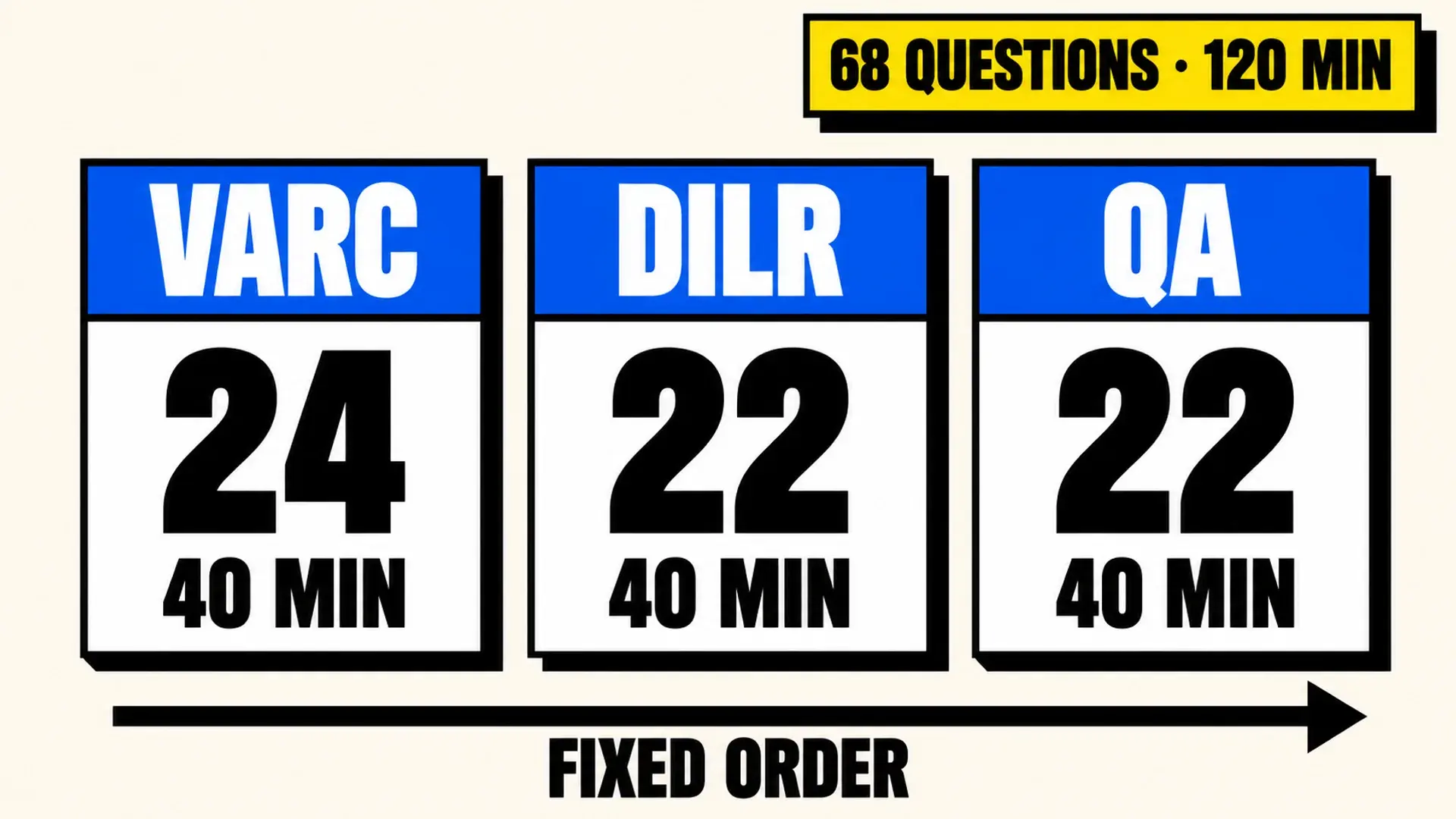
| VARC | 24 (16 RC + 8 VA) | 40 min | Reading speed and choosing the right option |
| DILR | 22 (usually 5 sets) | 40 min | Picking solvable sets and building grids |
| QA | 22 (about 14 MCQ + 8 TITA) | 40 min | Arithmetic and algebra under time pressure |
| Total | 68 | 120 min | Fixed order, no switching between sections |
Marking: +3 for a correct answer, −1 for a wrong MCQ, and no penalty for a wrong TITA (type-in-the-answer) question. The pattern has stayed the same since CAT 2024, so the 40-minute plans below should still hold. Check iimcat.ac.in for the official notice each year.
The 60-day plan at a glance
Think of the two months as four blocks of 15 days. Each block has one job.
| Phase | Days | Your job | Mocks |
|---|---|---|---|
| Build | 1 to 15 | Arithmetic, algebra, basic arrangements, daily RCs | 1 diagnostic + 1 more |
| Strengthen | 16 to 30 | Geometry, number system, hard LR sets, sectionals | 1 every 5 days |
| Convert | 31 to 45 | Mock every second day, repair weak topics | 5 |
| Perform | 46 to 60 | Mocks at your slot time, revision, sleep routine | 4 to 5 |
By Day 60 you will have taken about 15 full mocks, plus the CAT 2024 and CAT 2025 papers under timed conditions. That is enough. Students who take 40 mocks in two months usually skip the analysis, and the analysis is where the marks come from.
How many hours a day do you need?
Your hours depend on your situation. Pick the row that matches your life and stop feeling guilty about the others.
| Your situation | Hours a day | Suggested split |
|---|---|---|
| Full-time preparation | 8 to 10 | QA 3 · DILR 2.5 · VARC 2.5 · revision 1 |
| College student | 5 to 6 | QA 2 · DILR 1.5 · VARC 1.5 |
| Working full-time | About 4 on weekdays | Mornings for QA, evenings for DILR, full mock on the weekend |
If you work full-time, the CAT plan for working professionals breaks the 4 hours down hour by hour.
Days 1 to 15: build the base
Start with a full diagnostic mock on Day 1. Take it in exam conditions, phone in another room. The score will probably hurt. That's fine. You need it to see where you stand, and you will compare every later mock against it.
For the next two weeks, cover the topics that appear in every paper:
- QA: percentages, profit and loss, simple and compound interest, ratio, averages, mixtures, time and work, time-speed-distance. Then linear equations, inequalities, quadratics and progressions.
- DILR: linear, circular and grid arrangements, ranking, scheduling, selection with conditions, games and tournaments. Solve two sets a day without looking at the solution for the first 15 minutes.
- VARC: two to three RCs every day, plus a few para jumbles and summaries. Daily reading matters more than any trick.
A typical Build day looks like this: "Time and work · ranking sets · 2 RCs plus one para summary". Take your second full mock on Day 14. Spend Day 15 on algebra past-year questions and your error log.
Keep the study split at about 25 percent concepts and 75 percent solving. Watching a two-hour lecture on a topic you half-know feels productive. Solving 30 questions on it is productive.
Days 16 to 30: strengthen the middle
Now add the topics that cost students marks when they skip them:
- QA: triangles, circles, polygons, mensuration, coordinate geometry, then number system, remainders, HCF and LCM, and a little permutations and probability.
- DILR: mixed DI and LR caselets, harder arrangements and games, special charts like spider and scatter plots.
- VARC: three RCs a day. Keep VA questions in the mix.
Take a full mock roughly every five days (Days 20, 25 and 28 in this plan) and one QA plus one DILR sectional in between. Day 30 is a revision day: your formula sheet and every line in your error log.
Geometry deserves a calm word. CAT 2025 had about 3 to 5 geometry questions per slot. Learn the core results (triangle areas, similar triangles, circle theorems, tangent rules). Skip the rare exotic theorems. You won't miss them.

Days 31 to 45: convert practice into marks
This is the phase most students get wrong. They keep learning new chapters when they should be turning what they know into marks.
From Day 31, take a full mock every second day: Days 31, 34, 37, 40 and 44 in this plan, with the CAT 2024 paper on Day 42. The day after each mock is for analysis and repair:
- Re-solve every wrong and skipped question without a timer.
- Write each mistake in your error log with its type: concept gap, calculation slip, poor selection, or time sink.
- Pick the three biggest leaks and fix only those before the next mock.
Analysis should take at least as long as the mock itself, around 2 to 3 hours. The CAT mock test strategy guide shows the exact sheet to use.
A useful rule for this phase: if a topic has cost you marks in three mocks, it gets 45 minutes of focused practice the next morning. If it hasn't cost you anything, leave it alone.
Days 46 to 60: perform on the day
Once the admit card is out, you know your slot. Shift your mocks to that exact time of day. Your brain gets used to doing DILR at 1 p.m. or 5 p.m., and the real exam stops feeling strange.
The last 15 days look like this:
- Mocks on Days 46, 50, 52, 54 and 56, with the CAT 2025 paper on Day 48. Day 56 is your last full mock.
- No new big chapter. If you haven't touched probability by now, skip it.
- Formula sheet, shortcut sheet and error log every day.
- Fixed sleep and wake times that match your slot.
The final days are easy and medium practice only: one RC, one DILR set and ten QA questions on Day 59. The day before CAT, no mock and no new topic. The last 10 days before CAT guide covers those days in detail.
Section plans you'll use in every mock
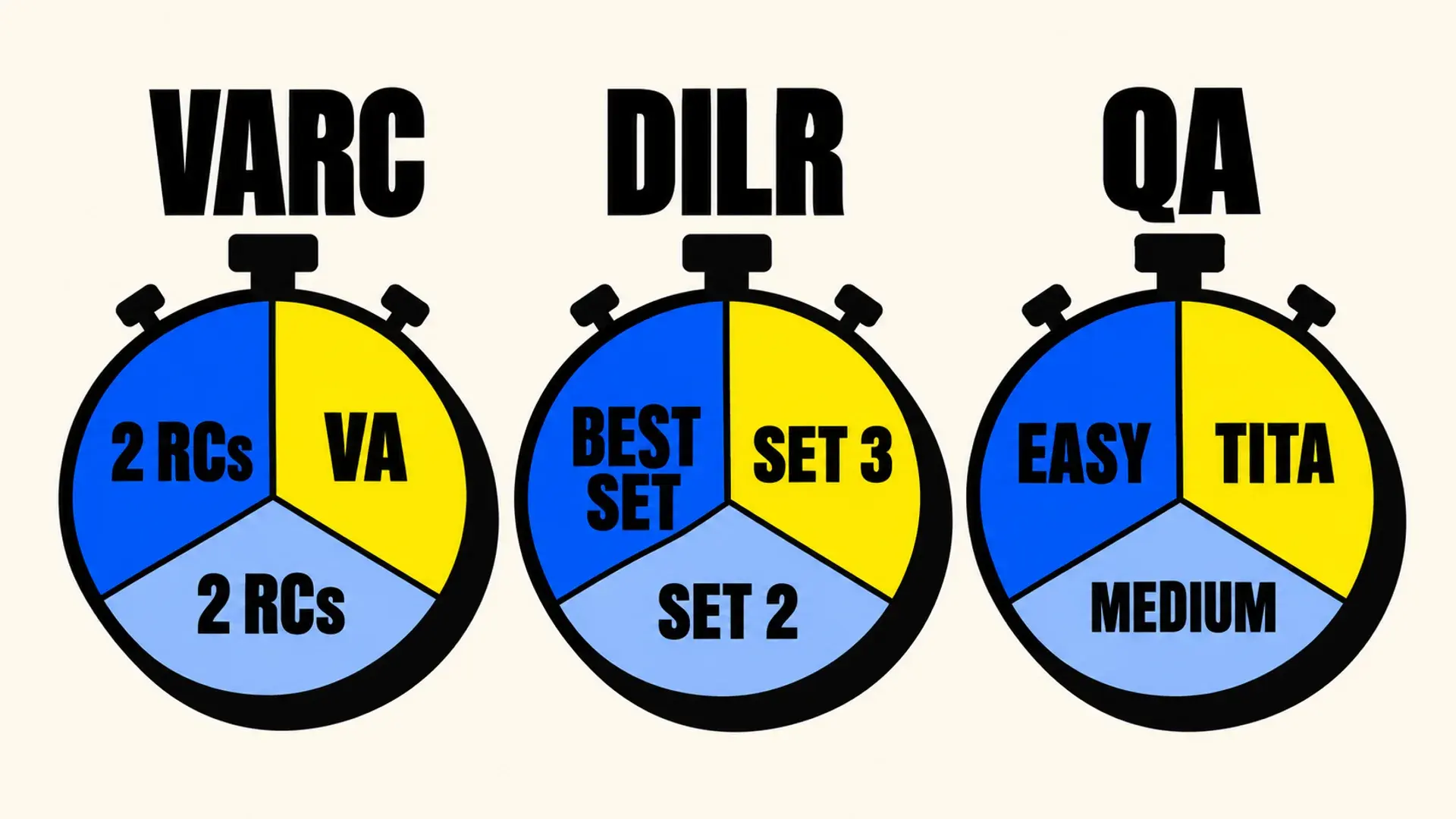
Your plan for each 40-minute section matters as much as your preparation. Practise one plan per section until it is automatic.
| Section | 0 to 15 min | 15 to 30 min | 30 to 40 min |
|---|---|---|---|
| VARC | 2 RCs | 2 RCs | VA, TITA questions first |
| DILR | Scan all sets, solve the easiest | Second set | Third set or safe TITAs |
| QA | First pass: sure-shot questions | Second pass: medium ones | Leftover TITAs, no blind MCQs |
Three rules that save marks:
- DILR five-minute rule. If you can't build a grid or table within five minutes, leave the set. The DILR set selection guide explains how to spot easy sets in the first two minutes.
- QA 45-second rule. No approach in 45 seconds means skip and come back.
- VARC elimination rule. Attempt an RC MCQ only after you have cut two options.
Already have only 45 or 30 days?
Use the same plan and compress the front.
| Days left | What to do |
|---|---|
| 60 | Follow the plan from Day 1 |
| 45 | Squeeze Days 1 to 15 into 7 days (top topics only), then continue from Day 16 |
| 30 | Learn only the top 10 topics of each section, then follow Days 31 to 60 |
The top 10 Quant topics for CAT, in order of value: linear equations and inequalities, triangles and circles, time-speed-distance, time and work, quadratics, number system, ratio and averages, percentages and interest, progressions, and logs and surds.
Five mistakes that waste the 60 days
- Mocks without analysis. A mock you don't review is a two-hour test of your stamina. Spend more time on analysis than on the mock.
- New chapters in the last month. A half-learned chapter usually costs more marks than it brings.
- Fighting one DILR set for 15 minutes. You can't afford it. Five minutes, then move.
- VARC only on weekends. Reading speed comes from daily reading. Three RCs a day beats ten on Sunday.
- Judging yourself by one mock. Look at the trend of your last five scores. A single bad mock tells you about one bad day.
Frequently asked questions
Can I get 99 percentile in CAT with 60 days of preparation?
It is possible if your first mock is already around 85 to 90 percentile and you use the 60 days well. From a much lower starting point, a jump to the high 90s in two months is rare. Set a realistic target from your diagnostic mock and judge progress by your mock trend.
How many mocks should I take in the last 60 days?
About 15 full mocks plus the last two CAT papers is enough for most students. Take one every five days in the first month and one every second day in the second month. Each mock needs 2 to 3 hours of analysis on the same or next day.
Should I learn new topics in the last two months?
In the first 30 days, yes, if they are high-weight topics like geometry or number system. After Day 30, avoid new chapters. Spend that time fixing errors in topics you already know, because that is where most of your extra marks will come from.
What should I do if my mock scores are not improving?
Look at your error log before you change anything. Most stuck scores come from one repeating problem, such as a slow DILR set choice, rushed RC answers or careless calculation. Fix that single problem for three mocks before you judge the plan.
Is 4 hours a day enough for CAT preparation in 60 days?
Four focused hours a day on weekdays, plus a full mock and analysis on weekends, is enough for many working students. Protect the hours: same time every day, phone away, and solving instead of watching videos.
Sources
- CAT pattern and marking: iimcat.ac.in (official site, check the current notification)
- CAT 2025 QA and DILR topic weights: Careers360 and Cracku paper analyses (estimates)
- Study plan, phase structure and timetables: Crack CAT in 60 Days by The 99 Percentiler
Related reading: CAT score vs percentile · How many CAT mocks to take · CAT vs XAT · Free MBA exam calendar 2026–27 · How to crack 99+ percentile in CAT · CAT Quant preparation for beginners
The full day-by-day calendar for all 60 days, with the formula sheets and mock tracker, is in the CAT playbook.