

Your alarm goes at 7. You reach the office at 9:30, leave around 7, and get home at 8:15 with roughly enough energy to scroll your phone. Somewhere in that day, you're supposed to prepare for CAT.
You can, and plenty of IIM students did it exactly this way. What you can't do is copy the timetable of a full-time aspirant who studies ten hours a day. You need fewer hours, used better, with the hard thinking placed where your brain is fresh. This plan gives you about four hours on weekdays and a full mock every weekend for 60 days.
Quick answer: With a full-time job, study about 3 to 4 hours on weekdays and take one full mock plus analysis every weekend. Do Quant in the morning before work, one RC at lunch, and DILR or Quant practice in the evening. Plan for 12 to 15 full mocks in the last 60 days and use a few days of leave in the week before CAT.
Can you crack CAT while working full-time?
Yes. Working professionals take CAT every year and convert top IIMs. You also have an advantage that college students don't: work experience. At IIM Bangalore, for example, work experience carries 10 of the 100 points used for interview shortlisting, according to the institute's admission policy.
Your limit is time, not ability. So the whole plan is built around three ideas:
- Put the hardest work (Quant and DILR) in your freshest hours.
- Use small pockets of the day for reading, because VARC improves with daily volume.
- Make weekends count: one full mock and its analysis, every week.
How many hours a day do you need?
| Phase | Weekdays | Weekends |
|---|---|---|
| Months before the last 60 days | 2 to 3 hours | 5 to 8 hours |
| Last 60 days | 3 to 4 hours | Full mock + analysis + 2 to 3 hours of practice |
Source: Cracku working-professional study plan; Crack CAT in 60 Days.
If 4 hours on a weekday sounds impossible, start with 3 and protect them. Three hours on six days is 18 hours a week, which is more than most "full-time" aspirants manage once you remove phone time.
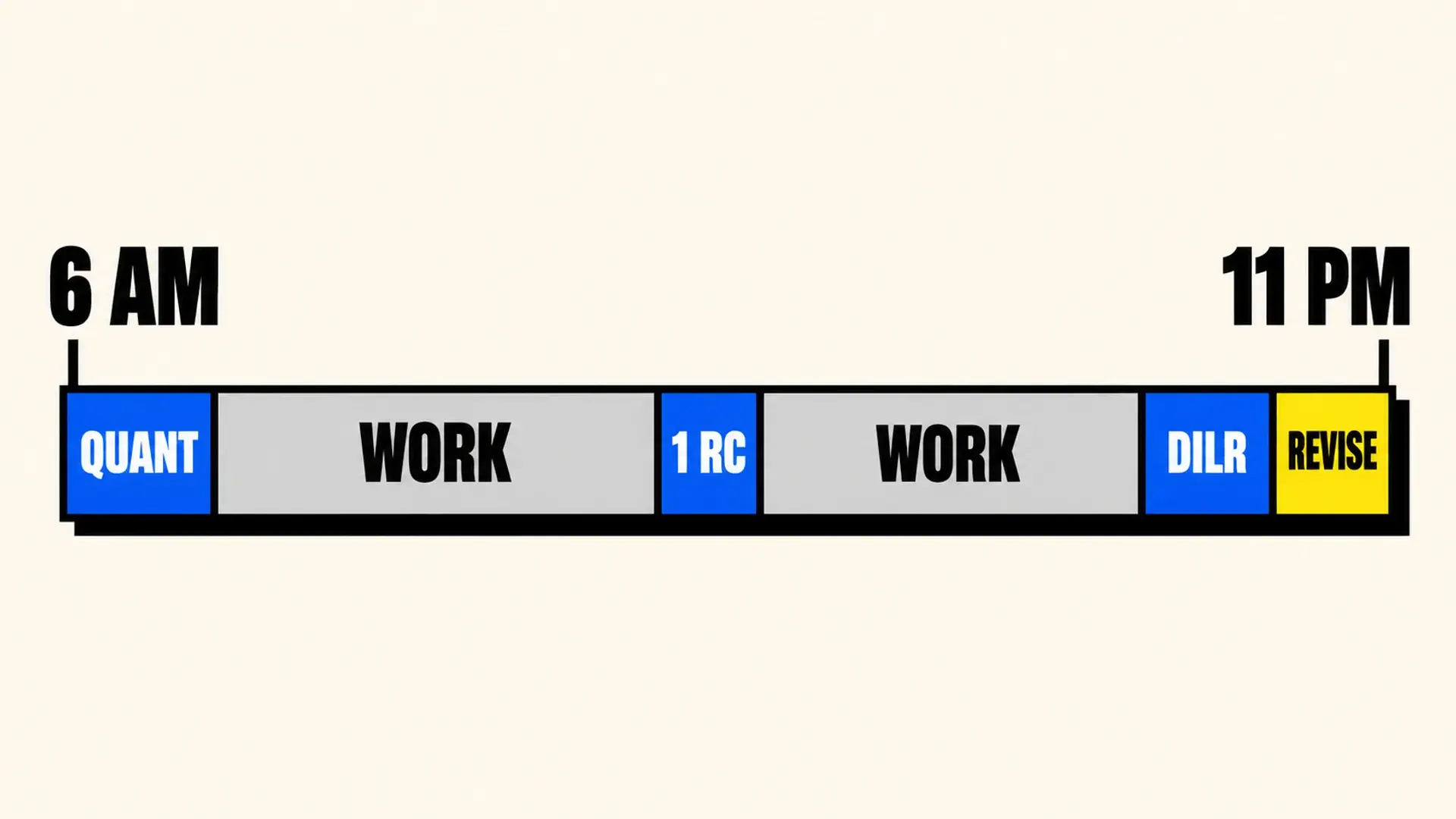
A weekday timetable that works
| Time | What to do | Why this slot |
|---|---|---|
| 6:00 to 7:00 a.m. | Quant: one topic, 20 to 25 questions | Your sharpest hour. Quant needs it. |
| Commute | Vocabulary from your RC log, or reading | Low effort, still useful |
| Lunch break (20 min) | One RC passage with questions | Daily reading builds VARC speed |
| 8:30 to 10:00 p.m. | DILR (2 sets) or Quant practice | Problem-solving after a short rest |
| 10:00 to 10:30 p.m. | Error log and formula revision | Fixes yesterday's mistakes |
Source: adapted from the working-professional timetable in Crack CAT in 60 Days.
On weekdays, swap full mocks for short sectionals. Three 20-minute sectionals of 10 questions each fit into an evening and keep your timing sharp.
A weekly plan for the last 60 days
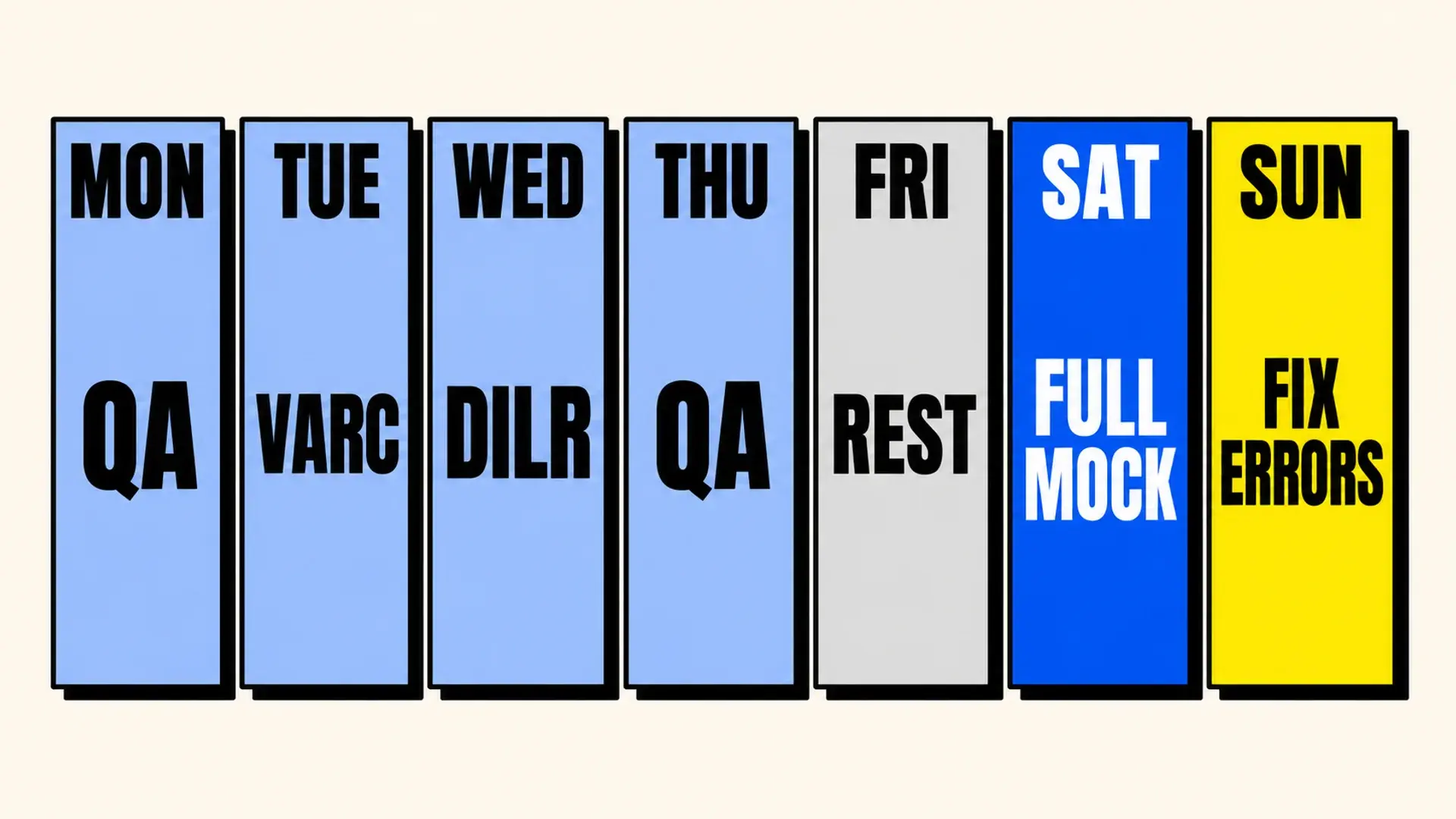
| Day | Morning | Evening |
|---|---|---|
| Monday | QA topic | DILR, 2 sets |
| Tuesday | QA practice | VARC sectional + 1 extra RC |
| Wednesday | QA topic | DILR, 2 sets |
| Thursday | QA practice | QA sectional |
| Friday | Light revision | Rest, or error log only |
| Saturday | Full mock at your slot time | Mock analysis (2 to 3 hours) |
| Sunday | Fix the top 3 errors from the mock | DILR or RC practice, plan the week |
Friday evening is a deliberate rest slot. After a full work week, a tired two-hour study session teaches you very little, and skipping it leaves you fresh for the Saturday mock.
How many mocks should a working professional take?
In the last 60 days, aim for 12 to 15 full mocks: one every weekend in the first month, then two a week (Saturday and one weekday evening, or Saturday and Sunday) in the final month. Add the last two CAT papers under timed conditions.
Over a full year, coaching institutes suggest around 20 to 25 mocks for working professionals, each taken with full focus (Quantifiers). That is fewer than a full-time aspirant takes, and that's fine. You will analyse each one properly, which matters more than the count. The CAT mock analysis method shows how.
When to use your leave
Leave is precious, so spend it where it helps most.
- Three to five days right before CAT. Use them for exam-slot mocks, light revision and rest. You don't want to walk into the exam after a stressful work week.
- One day after a bad mock streak (optional). A full day of focused repair on your weakest section can reset your trend.
- Don't take a long break early. Two weeks off in September often turns into two weeks of unfocused study.
Protecting your study hours
The plan fails when the hours get eaten, not when the topics are hard. A few habits help:
- Same time every day. Your 6 a.m. slot becomes automatic after two weeks.
- Phone in another room during the morning and evening blocks.
- Tell your manager early if you'll need leave in late November. A quiet word in September is easier than a request in the last week.
- Keep material ready the night before. Open the topic and the question set before bed, so the morning starts with solving, not searching.
- Accept missed days. You will lose a few days to work crunches. Skip that day's topic, keep the weekend mock, and move on.
What to cut if you're short on time
You can't cover everything with a job. Cut in this order:
- Rare Quant topics: advanced probability, complex 3D mensuration, niche number theory.
- The hardest DILR set types (networks with many nodes, multi-layer truth-and-lie puzzles).
- Extra vocabulary lists. RC practice gives you more VARC marks per hour.
Never cut the weekend mock or its analysis. Those two blocks drive most of your improvement.
Frequently asked questions
Is 2 to 3 hours a day enough for CAT if I'm working?
It can be, if you start several months early and stay consistent. In the last 60 days, aim for 3 to 4 hours on weekdays plus a full mock and analysis every weekend. Consistent daily hours matter more than long weekend sessions.
What is the best time to study for CAT with a job?
Early morning before work suits Quant and DILR, because your mind is fresh. Use lunch for one RC passage and the evening for practice sets and revision. Pick fixed times so the routine doesn't depend on mood.
Should I quit my job to prepare for CAT?
Most students don't need to. Work experience can help your IIM shortlist and interviews, and a steady income lowers pressure. Quit only if your job leaves you with no usable hours at all, and even then, think hard first.
How many mocks should I take while working full-time?
Plan for 12 to 15 full mocks in the last 60 days, with each one analysed for 2 to 3 hours. Over a full year, about 20 to 25 mocks taken with full focus is a common range for working professionals.
Does work experience help in CAT admissions?
Yes, at many IIMs. Work experience adds points at the shortlisting or final stage, depending on the institute. For example, IIM Bangalore gives work experience 10 of 100 points for interview shortlisting. Check each IIM's current admission policy.
Sources
- Weekday and weekend hours: Cracku working-professional CAT plan; Cracku daily timetable guide
- Mock counts for working professionals: Quantifiers
- IIM Bangalore shortlisting weights: IIM Bangalore admission policy (as summarised in Crack CAT in 60 Days; check the current policy)
- Working timetable: Crack CAT in 60 Days by The 99 Percentiler
Related reading: How to prepare for CAT in 60 days · The last 10 days before CAT · Which MBA entrance exams should you take? · How to crack 99+ percentile in CAT · CAT Quant preparation for beginners
The CAT playbook includes a 4-hour working timetable and the full 60-day calendar.