
You took your twelfth mock last Sunday. Score: 58. Your first mock, six weeks ago, was 55. Twelve mocks, twenty-four hours of testing, and you moved three marks.
This happens to a lot of CAT students, and the cause is usually the same. They treat the mock as the work and the analysis as an optional extra. It is the other way round. A mock shows you your mistakes. The analysis is the part that removes them. Once you change that balance, scores start moving within three or four mocks.
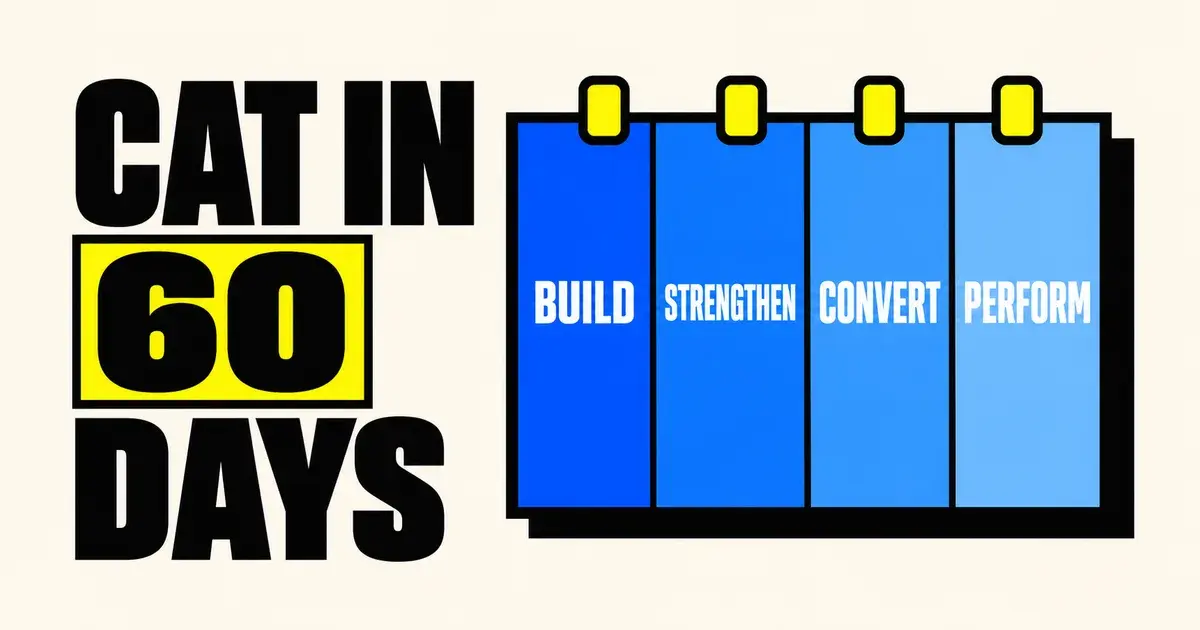
Quick answer: Most students need 15 to 20 full CAT mocks in the last two months, and around 25 to 40 across a full year of preparation. Spend at least as long analysing each mock as taking it, about 2 to 3 hours. Log every mistake by type and fix the top three before the next mock.
How many CAT mocks are enough?
The right number depends on how long you have and who you are. Coaching institutes that track their students land on similar ranges.
| Your situation | Full mocks |
|---|---|
| Last 60 days of preparation | 15 to 20, plus the last 2 CAT papers |
| First-time taker, full year | About 40 to 50 |
| Repeat taker, full year | About 30 to 35 |
| Working professional | About 20 to 25, each with full focus |
Sources: Crack CAT in 60 Days (60-day plan); Quantifiers (yearly ranges by profile).
If you work full-time, the CAT plan for working professionals shows how to fit a weekly mock and its analysis around your job.
The number that predicts your percentile is mocks taken and reviewed. A student who analyses 25 mocks properly will beat a student who rushes through 50 and never looks back at them.
When to take your mocks in a 60-day plan
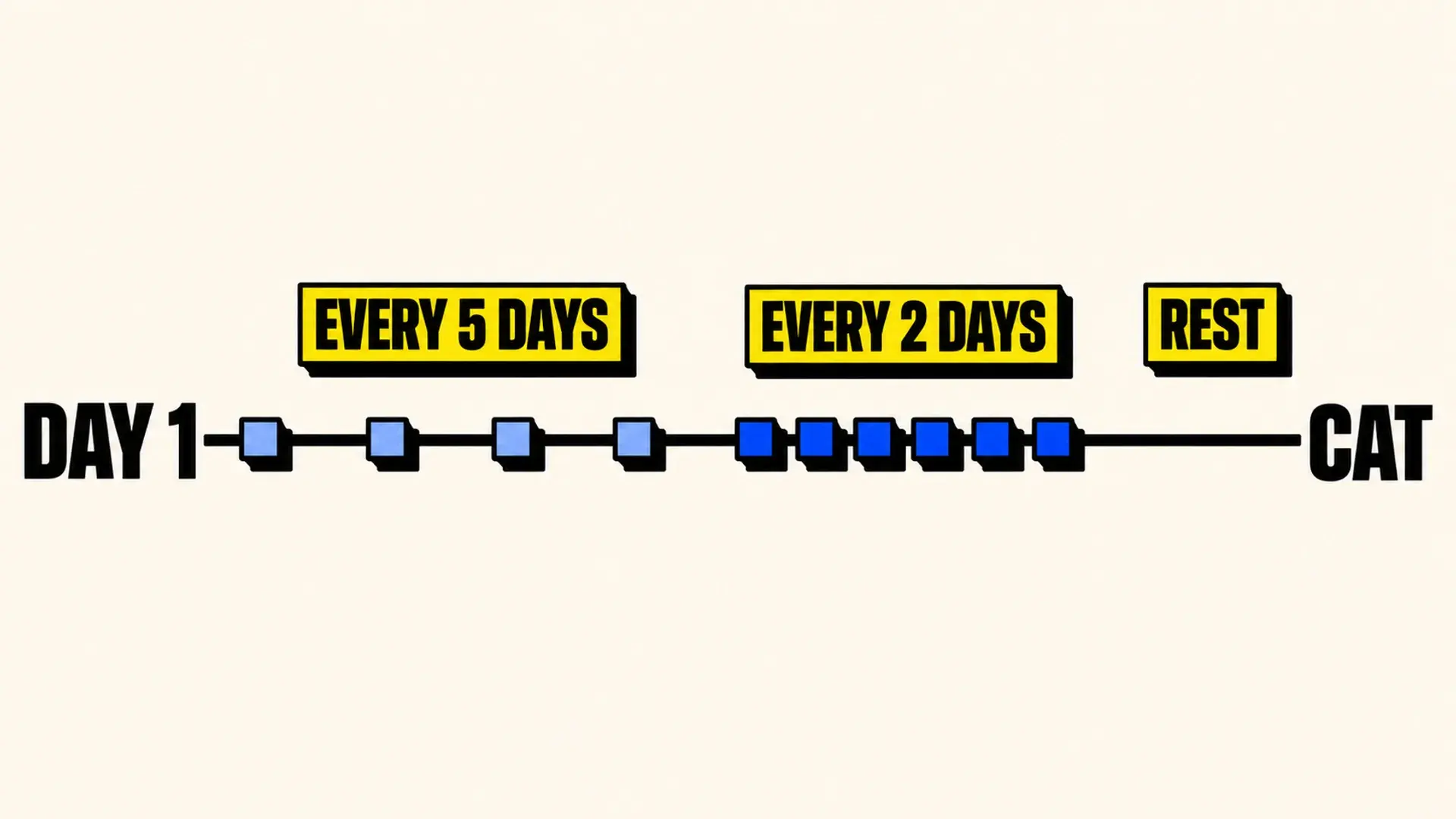
Spread them out. Bunching six mocks into the last fortnight leaves no time to fix anything.
| Days | Mock rhythm | Why |
|---|---|---|
| 1 to 30 | One every 5 to 6 days | You are still learning topics, and need time between tests |
| 31 to 45 | One every 2 days | Turn what you know into marks |
| 46 to 56 | One every 2 days, at your exam slot time | Train your brain for the real slot |
| Last 4 days | No full mock | Light practice and revision only |
Your first four or five mock scores will be low. That is normal. Mock papers are often tougher than the real CAT, and you are still learning the 40-minute rhythm of each section.
How to analyse a CAT mock: a step-by-step method
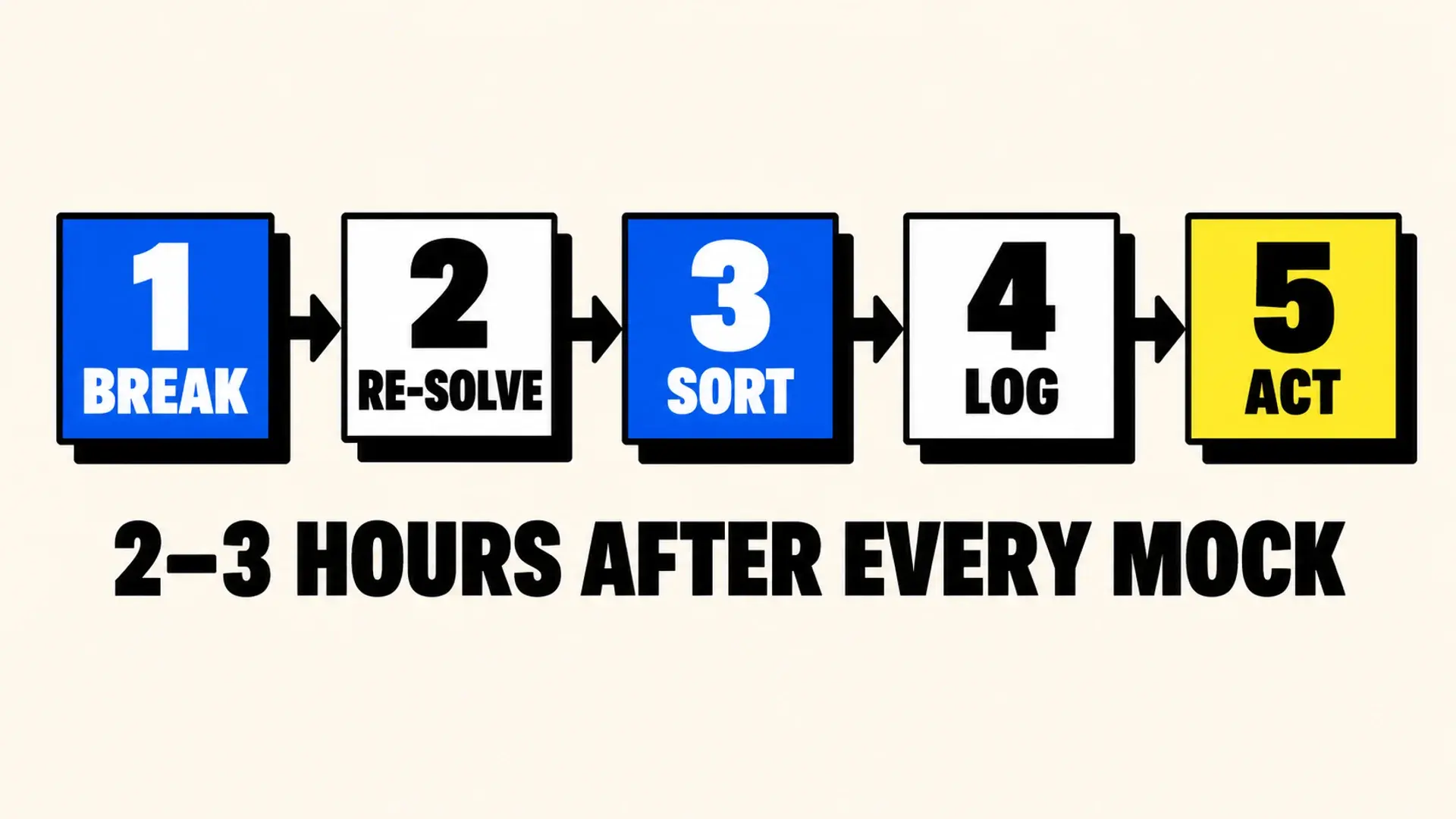
Block the whole afternoon. A mock takes two hours. The full analysis takes another two to three. If you can't do both on the same day, do the analysis the next morning, before anything else.
Step 1: Take a 30-minute break
Walk, eat, look at something other than a screen. You want fresh eyes, and you want the frustration of the hard questions to fade a bit.
Step 2: Re-solve without a timer (1 hour)
Before you open the solutions, go back to every question you got wrong and every question you skipped. Try each one again with no clock running.
This step tells you the truth about each mistake. If you solve it calmly in three minutes, the problem was time or nerves. If you still can't solve it, the problem is the concept.
Step 3: Sort every question into four buckets
| Bucket | What it means | What to do |
|---|---|---|
| Easy, missed | You could solve it but skipped it or got it wrong | Selection or carelessness. Fix your first-pass scan. |
| Lucky correct | Right answer, shaky method | Relearn the method. You won't be lucky twice. |
| Wrong | Concept or calculation error | Find the exact step that failed. |
| Time sink | Took more than 3 minutes | Practise the topic or set a skip rule. |
The first bucket is your fastest source of extra marks. Most students find four to eight "easy, missed" questions per mock. Each one is worth 3 marks.
Step 4: Read the solutions and write the error log (1 hour)
Now open the solutions. For every question in the four buckets, write one line in your error log: the question, the error type and the fix.
Step 5: Pick three actions for the next mock (15 minutes)
Don't try to fix everything. Choose the three biggest leaks and write them on a sticky note on your desk. For example: "Scan all 5 DILR sets before starting", "No RC answer without cutting 2 options", "Write each step in TSD questions".
The five types of mistakes, and how to fix each
Your error log becomes useful only when each mistake has a type. Five types cover almost everything.
| Error type | Example | Fix |
|---|---|---|
| Concept gap | Didn't know the circular track formula | Relearn the concept, then solve 20 questions on it |
| Calculation slip | 17 × 13 written as 211 | Find the exact step, slow down there, write it out |
| Practice gap | Knew the method but took 5 minutes | Timed sets on that topic for a week |
| Selection error | Picked the hardest DILR set first | Better one-minute scan at the start of the section |
| Time error | Spent 6 minutes on one QA question | Hard limit of 2 minutes, then mark and move |
After eight to ten mocks, your log will show a pattern. Maybe 40 percent of your lost marks are selection errors in DILR. That one line tells you more than any coaching video.
A sample error log you can copy
| Question | Type | Fix |
|---|---|---|
| Mock 4, QA 7 (time-speed-distance) | Concept | Relative speed, 20 questions tomorrow |
| Mock 4, DILR set 3 | Selection | Skip sets with 6+ variables in the first pass |
| Mock 5, RC 2, Q3 | Reading | Reread the question stem before choosing |
| Mock 5, QA 15 | Calculation | Write each step for percentage chains |
Re-solve every question in the log three days after you write it. If you get it right without help, cross it out. If not, it stays.
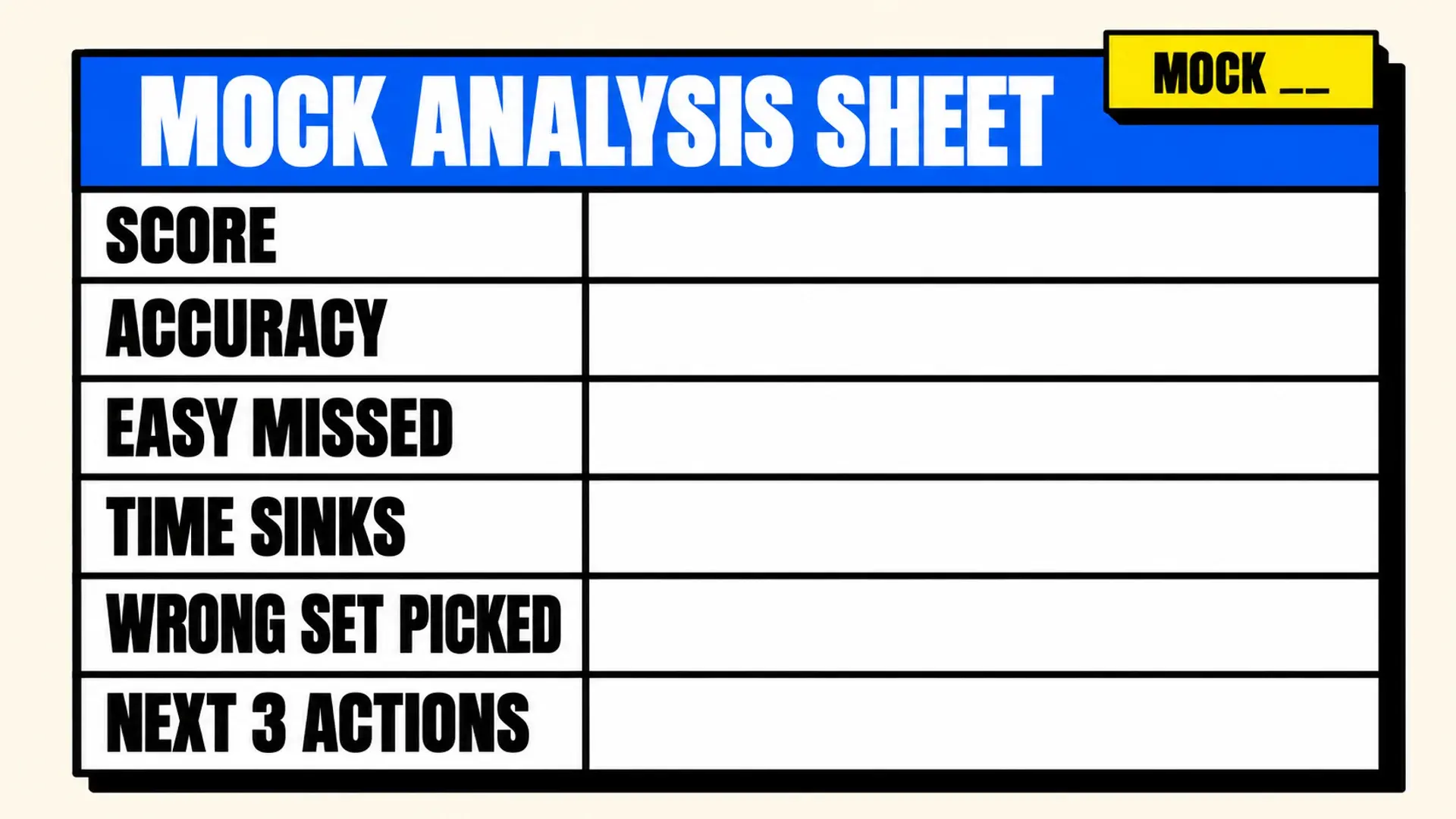
Your mock analysis sheet
Fill one of these after every mock. Over time, the sheet shows you the trend more clearly than any score does.
| Item | Mock ___ |
|---|---|
| Total score | |
| Attempts and accuracy % | |
| VARC / DILR / QA marks | |
| Easy questions missed | |
| Wrong answers | |
| Lucky correct answers | |
| Time sinks (over 3 minutes) | |
| Wrong DILR set or RC picked | |
| Next three actions |
How to read your mock scores without panicking
- Use your raw marks. Mock percentiles depend on who else took that mock, and they shift between series.
- Look at the last five mocks together. Average them. A single score tells you about one day.
- Compare sections as well as totals. If your total is flat but DILR rose from 18 to 26 while VARC fell, you know exactly where to look.
- Don't compare with friends. Different series, different days, different strengths. Your trend is the only score that matters to you.
If you want to know what raw score to aim for, the CAT score vs percentile guide has the CAT 2025 numbers and suggested mock targets.
Common mock mistakes
- Taking a mock every day. You can't analyse a mock a day and still learn. One every second day is the fastest useful pace.
- Skipping analysis after a good score. Good mocks hide lucky answers and wasted time too.
- Changing strategy every mock. Pick one plan per section and test it for at least three mocks.
- Mocks at random times. After the admit card arrives, take every mock at your real slot time.
- Re-reading solutions instead of re-solving. Reading a solution feels like understanding. Solving the question again without help is understanding.
Frequently asked questions
How many mocks should I take before CAT?
Take 15 to 20 full mocks if you have two months left, and about 25 to 40 across a full year of preparation. Add the last two actual CAT papers under timed conditions. The quality of your analysis matters more than the count.
How much time should I spend analysing a CAT mock?
Spend at least as long as the mock, about 2 to 3 hours. Re-solve wrong and skipped questions without a timer, then read solutions, log each mistake by type and pick three actions for the next mock.
Should I take mocks at my exam slot time?
Yes, once your admit card shows your slot. Taking mocks at the same time of day trains your focus and energy for that window, so the real exam feels familiar.
My mock scores are low. Should I stop taking mocks?
No. Low early scores are normal, and mocks are often harder than CAT. Keep the rhythm, analyse each mock properly, and judge your progress by the average of your last five mocks.
Is it better to take more mocks or more sectional tests?
You need both. In the first month, sectionals help you practise one section at a time while you learn topics. In the second month, full mocks matter more, because CAT tests your stamina and section switching over two hours.
Sources
- Mock rhythm, analysis sheet, error types and error log: Crack CAT in 60 Days by The 99 Percentiler
- Mock counts by profile: Quantifiers, "How many CAT mocks to take"; Cracku, "How many mock tests to give before CAT"
- CAT pattern: iimcat.ac.in (official)
Related reading: How to prepare for CAT in 60 days · CAT DILR set selection · The last 10 days before CAT · How to crack 99+ percentile in CAT · CAT Quant preparation for beginners
A printable mock tracker and error log are part of the CAT playbook.