You open your first CAT Quant question. It is about a shopkeeper who marks up a price, gives a discount and still makes a profit. You know what a percentage is, and you may even remember a formula from school. But you cannot see which number goes where. After four minutes you move on with nothing written down.
That feeling is common, and it rarely means you are bad at maths. It usually means nobody showed you the order in which CAT Quant is built.
CAT quant preparation for beginners works best as a sequence. First you learn how the section is marked. Then you see every topic, start with percentages, ratios and averages, and learn to turn sentences into equations. Only after that do you move to real CAT questions under a timer. This guide follows that sequence and teaches the maths at each step, with worked examples and practice questions that have full solutions.
Quick answer: To start CAT Quant from zero, learn how the section is marked, then study arithmetic first: percentages, ratios and averages, then profit and loss, interest, mixtures, work and speed. Learn simple equations in the same weeks. Add algebra, geometry, number systems and modern maths after that. Solve questions yourself every day, keep an error log, and add timed sectional tests once untimed mixed sets go well.
In this guide you will find:
- How the Quant section works, how many questions it has and how each answer is marked.
- The full list of CAT Quant topics, grouped into five families.
- The order to study those topics in, with the reason for each step.
- Every chapter taught from the basics, with worked examples, common mistakes and practice questions.
- How to move from worked examples to timed CAT questions, and a study plan that starts tomorrow.
CAT Quant exam pattern and marking scheme
CAT Quant is the third and last section of CAT. It gives you 40 minutes and, in recent papers, 22 questions. A correct answer earns 3 marks. A wrong multiple-choice answer loses 1 mark. A wrong typed answer and a blank question both score 0. These rules decide how you should attempt the section, so learn them before any chapter.
Where Quant sits in CAT
CAT, the Common Admission Test, is the entrance exam for the Indian Institutes of Management (IIMs) and many other business schools.
CAT has three sections in a fixed order. The first is Verbal Ability and Reading Comprehension (VARC). The second is Data Interpretation and Logical Reasoning (DILR). The third is Quantitative Ability (QA), which everyone calls Quant. Each section has its own 40-minute timer. When the timer ends, the test moves you to the next section and you cannot go back.
How many questions are in CAT Quant?
The Quant section of the 2025 paper had 22 questions, according to IMS's analysis of CAT 2025. Fourteen were multiple-choice questions (MCQs) with four options each. The other eight were TITA questions. TITA means "type in the answer". You type a number into a box, and there are no options to choose from.
The IIMs can change these counts from year to year, so treat 22 as a recent example. The CAT 2026 notification kept the 40-minute sections and the same marking scheme. The official rules for each year are on iimcat.ac.in.
The CAT Quant marking scheme
Every Quant question is marked like this:
| Your response | Marks |
|---|---|
| Correct answer, MCQ or TITA | +3 |
| Wrong answer to an MCQ | −1 |
| Wrong answer to a TITA question | 0 |
| Question left blank | 0 |
Two examples show how the rules work in practice. Suppose you answer seven MCQs and get five right and two wrong. Your score is 5 × 3 − 2 × 1 = 13. Now suppose the same five are right, but the two wrong answers are TITA questions. A wrong TITA answer costs nothing, so your score is 5 × 3 = 15.
The second example compares two students. Student A attempts 14 MCQs and gets 9 right and 5 wrong, which gives 27 − 5 = 22. Student B attempts only 10 MCQs and gets 9 right and 1 wrong, which gives 27 − 1 = 26. Student B attempted four fewer questions but scored four marks more. In CAT Quant, accuracy counts for more than the number of attempts.
Is blind guessing worth it in CAT Quant?
No. A blind guess on an MCQ gains nothing on average. Each MCQ has four options, so a pure guess is right one time in four. Over four guesses, one right answer earns 3 marks and three wrong answers lose 3 marks, so the expected gain is zero.
If you can rule out one option, the chance becomes one in three. A guess is then worth about a third of a mark on average. If you can rule out two options, a guess is worth one mark on average. A TITA guess can never lose marks, so always type a reasoned number before time runs out.
Can you use a calculator in CAT?
You cannot bring a calculator, but CAT gives you a basic on-screen calculator. In 2025, IMS reported a simple calculator, not a scientific one. You click its buttons with the mouse, which is slow. Most students use it only for a large multiplication or a square root and do the rest on paper. You still need quick mental arithmetic, and the speed section later in this guide shows how to build it.
How many questions should a beginner attempt?
With 40 minutes for about 22 questions, you have less than two minutes per question if you try all of them. Almost nobody should. Most beginners do best when they attempt the 10 to 14 questions they can solve with confidence and get nearly all of them right. Most IIMs also set a minimum percentile in each section, so you cannot ignore Quant even if your other sections are strong. The free CAT questions to attempt planner shows how many attempts fit a target score. The CAT score vs percentile guide shows what different scores meant in past papers.
CAT Quant syllabus: the topics in five families
The IIMs do not publish a chapter-by-chapter Quant syllabus. What coaching institutes call the "CAT Quant syllabus" is a list built from the questions that past papers asked. Treat the list below in the same way. It is a map of what to learn, and it does not promise that every chapter appears every year.
- Arithmetic:
- percentages
- ratio and proportion, and partnership
- averages and weighted averages
- profit, loss and discount
- simple and compound interest
- mixtures and alligation
- time and work, and pipes and cisterns
- time, speed and distance, including trains, boats and races
- Algebra:
- expressions and identities
- linear and simultaneous equations
- quadratic equations
- inequalities, including modulus
- indices, surds and logarithms
- sequences and series (arithmetic and geometric progressions)
- functions and graphs, and maximum and minimum values
- Geometry and mensuration:
- lines and angles
- triangles and similar triangles
- circles
- quadrilaterals and polygons
- coordinate geometry
- perimeter, area and volume of plane figures and solids
- Number systems:
- properties of integers and primes
- factors and multiples, HCF and LCM
- divisibility and remainders
- last digits and cyclicity
- factorials
- Modern maths:
- sets and Venn diagrams
- permutations and combinations (counting)
- probability
Coaching institutes do not agree on where some chapters belong. For example, some put progressions and logarithms under algebra, together with counting questions. Others put the same questions under modern maths. That is why topic counts from different sources disagree. For the CAT 2025 paper, IMS counted 12 Quant questions as modern maths. Careers360 counted only 4 there and put more under arithmetic and algebra. Both counts add up to the same 66 questions across the three slots.
The broad picture is still clear. Careers360 counted every Quant question from CAT 2021 to 2025 with one set of labels, 330 questions in total (Careers360's five-year count). Arithmetic had 139, algebra 105, geometry and mensuration 48, number systems 31 and modern maths 7. So arithmetic and algebra together made up about three of every four questions. Geometry still averaged about three questions per paper, which is too many to ignore.
These counts tell you what CAT has asked. They do not decide your study order. Your study order comes from which chapters depend on which, and the next section explains it.
How to start Quant preparation for CAT: the order to study topics
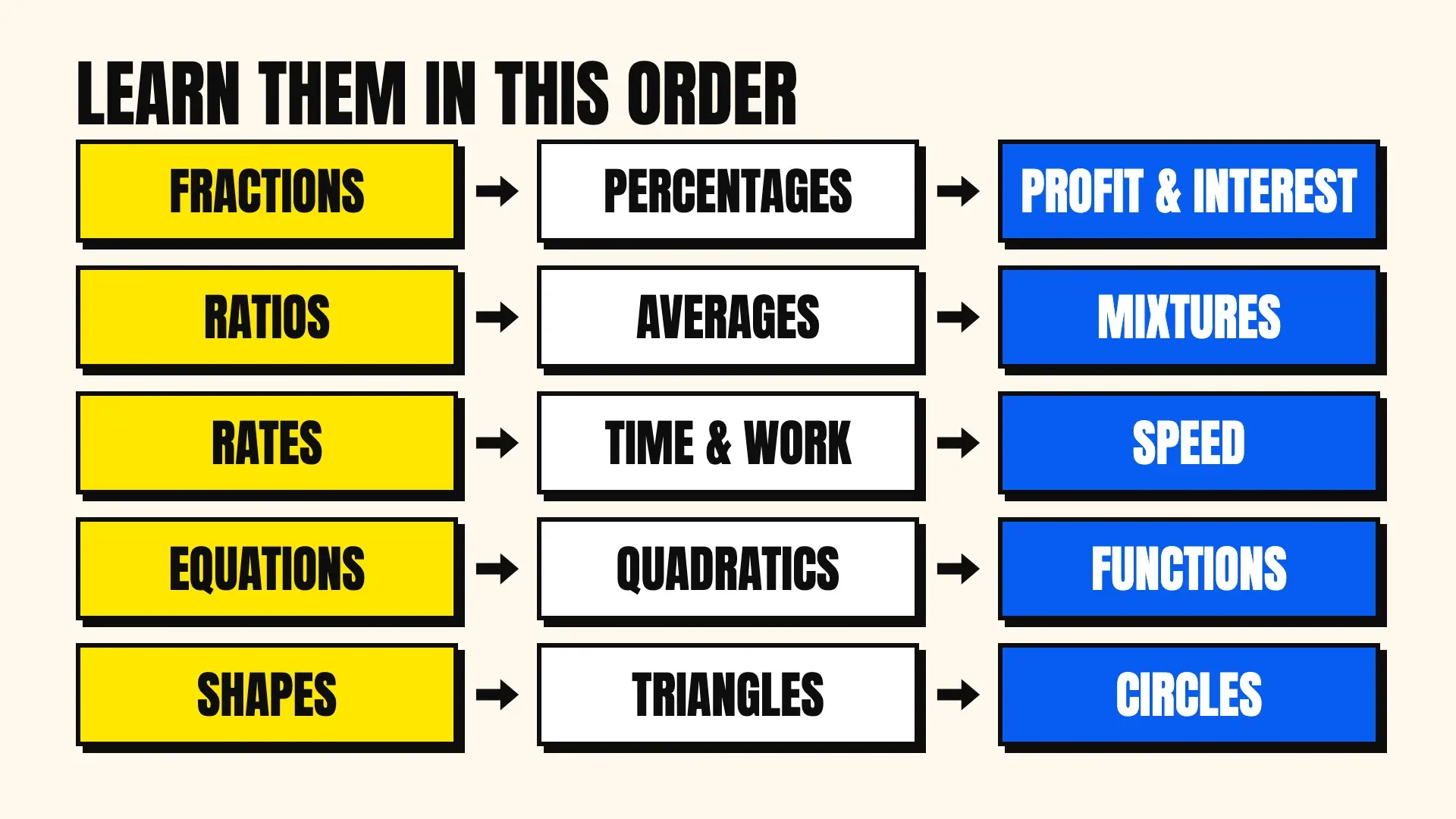
Start with percentages, then ratios, then averages. These three ideas sit inside almost every other arithmetic chapter. Profit and loss is percentages applied to three different prices. Compound interest is the same percentage applied again and again. A mixture question is a weighted average. If percentages are slow and shaky, every chapter after them will be slow and shaky too.
Below is the full order we recommend, with the reason for each step. It is a teaching order, based on which chapters need which. It does not rank chapters by how often CAT asks them.
- Fractions and percentages. Every other chapter uses them. Learn to switch between 3/8, 0.375 and 37.5% without thinking.
- Ratio and proportion. A ratio is a fraction split into parts. You need it for averages, mixtures and speed.
- Averages and weighted averages. These use totals and ratios, and mixtures are built on them.
- Profit, loss and discount. These apply percentages to the cost price, the marked price and the selling price.
- Simple and compound interest. This is percentage change, repeated over time.
- Mixtures and alligation. This is a weighted average with two ingredients.
- Time and work, then time, speed and distance. Both are rate problems, and rates add when people or pipes work together.
- Linear equations, from week one. Learn to write and solve equations alongside the arithmetic above. Many word problems become two lines of algebra once you can do this.
- The rest of algebra. Study inequalities and quadratics first, then indices, logarithms, progressions and functions.
- Geometry and mensuration. Study triangles and circles first, then area and volume, then coordinates.
- Number systems. Study factors, HCF and LCM first, then remainders and last digits.
- Modern maths. Study sets first, because they are often quick marks, then counting and probability.
Two changes to this order are reasonable. If word problems are your main difficulty, start linear equations in the same week as percentages. After arithmetic, you can also take geometry before the harder algebra if you have five months or more and geometry comes easily to you. With three months or less, finish the core of algebra first, because algebra carried more questions in recent papers.
A two-minute check before you start
You do not need a long diagnostic test. Try these five questions on paper, without a calculator. Each one tests a skill that the first chapters depend on.
- Write 3/8 as a percentage.
- A price rose by 20% to ₹600. What was it before the rise?
- Solve 2x + 7 = 19.
- Split ₹90 between two people in the ratio 2:7.
- Write 45 minutes in hours.
The answers are 37.5%, ₹500, x = 6, ₹20 and ₹70, and 0.75 hours. Use your result like this:
- You missed question 1 or 2. Spend your first two or three sessions on fractions and percentages before anything else.
- You missed question 3. Add simple equations to your first week.
- You missed question 4 or 5. The first chapters below cover these skills, so go slowly there.
- All five were easy. Start with the percentage section and move quickly.
CAT Quant arithmetic, chapter by chapter
Arithmetic is the largest topic family in CAT Quant and the right place for a beginner to start. Each chapter below follows the same pattern. You get the idea in plain words, a worked question, the common mistake, and a practice question with a full solution. Try each practice question on paper before you read its solution.
Percentages
A percentage is a fraction with 100 at the bottom. So 25% is 25/100, which is 1/4. "25% of 80" means 80 × 1/4 = 20. The most useful habit in CAT Quant is to treat a percentage change as a multiplication. A 20% increase means you multiply by 1.2, and a 20% decrease means you multiply by 0.8. A 15% increase means you multiply by 1.15.
This habit makes reverse questions easy. Suppose a price rose by 20% and is now ₹960. Then the old price × 1.2 = 960, so the old price is 960 ÷ 1.2 = ₹800. The common mistake is to take 20% off ₹960 and get ₹768. That answer is wrong because the 20% was calculated on the old price, not on ₹960.
The same habit makes successive changes easy. If a price rises by 20% and then falls by 20%, multiply the two factors: 1.2 × 0.8 = 0.96. The price ends 4% lower, not where it started. If a town grows by 10% a year for two years, 1.1 × 1.1 = 1.21. The town grows by 21% in total, not 20%, because the second 10% applies to a bigger number.
The second big idea is the base. A percentage is always a percentage "of" something, and the question tells you what that something is. Most percentage mistakes in CAT come from using the wrong base.
Worked example. A's salary is 25% more than B's salary. By what percentage is B's salary less than A's?
Take B's salary as 100. Then A's salary is 125, and the difference is 25. The question asks "less than A", so A is the base. The answer is 25 ÷ 125 = 20%. If you said 25%, you used B as the base.
A CAT-style step up. A shopkeeper raises a price by 25%. Sales fall, so she wants to bring the price back to the original. By what percentage must she cut the new price?
Take the original price as 100, so the new price is 125. She must cut 25 from 125, which is 25 ÷ 125 = 20%. This is the same arithmetic as the salary example in a different story. Much of CAT practice is learning to see that two questions share the same structure.
Learn these fraction values by heart. They turn many percentage questions into one-step calculations.
- 1/2 = 50%, 1/4 = 25%, 1/5 = 20%, 1/10 = 10%
- 1/3 ≈ 33.33%, 1/6 ≈ 16.67%, 1/9 ≈ 11.11%, 1/12 ≈ 8.33%
- 1/8 = 12.5%, 3/8 = 37.5%, 5/8 = 62.5%, 1/16 = 6.25%
With 1/8 = 12.5% in your head, "37.5% of 640" becomes 3/8 × 640 = 240.
Practice. A number increases by 30% and becomes 390. The new number then decreases by 10%. What is the final number, and what is the overall percentage change from the original number?
Solution. The original number is 390 ÷ 1.3 = 300. After the 10% decrease, the number is 390 × 0.9 = 351. The overall factor is 1.3 × 0.9 = 1.17, which is an increase of 17%. Check: 300 × 1.17 = 351.
Once percentages feel automatic, move to ratios. A ratio is another way of writing fractions, so the skills carry over directly.
Ratio, proportion and partnership
A ratio compares two or more quantities. If boys and girls in a class are in the ratio 4:5, then out of every 9 students, 4 are boys and 5 are girls. So boys are 4/9 of the class, not 4/5. Mixing up "part to part" with "part to whole" is the most common ratio mistake, so always ask which one the question means.
Worked example. A class has 36 students, and the ratio of boys to girls is 4:5. How many girls are in the class?
The ratio has 4 + 5 = 9 parts. Each part is 36 ÷ 9 = 4 students. Girls are 5 parts, so there are 5 × 4 = 20 girls.
A CAT-style step up. Two numbers are in the ratio 3:4. If you add 6 to each number, the ratio becomes 4:5. Find the numbers.
Write the numbers as 3k and 4k. After you add 6, the ratio is (3k + 6)/(4k + 6) = 4/5. Cross-multiply to get 5(3k + 6) = 4(4k + 6), which is 15k + 30 = 16k + 24. So k = 6, and the numbers are 18 and 24. Check: 24/30 = 4/5. Writing the numbers as "3k and 4k" is the standard method for ratio questions, because it replaces two unknowns with one.
To join two ratios, make the shared term equal. Suppose A:B = 2:3 and B:C = 4:5. B is 3 in the first ratio and 4 in the second, so scale both ratios until B is 12. Then A:B = 8:12 and B:C = 12:15, which gives A:B:C = 8:12:15.
Partnership questions are ratio questions too. Partners share profit in the ratio of money × time. Suppose A invests ₹50,000 for 12 months and B invests ₹75,000 for 8 months. Both products are 6,00,000, so the ratio is 1:1. They split the profit equally, even though B invested more money.
Practice. P and Q share ₹2,700 in the ratio 4:5. Q then gives ₹300 to P. What is the new ratio of P's money to Q's money?
Solution. The ratio has 9 parts of ₹300 each, so P has ₹1,200 and Q has ₹1,500. After the transfer, P has ₹1,500 and Q has ₹1,200. The new ratio is 1,500:1,200 = 5:4.
Averages and weighted averages
An average is a total divided by a count. Most average questions become easy when you stop thinking about the average and work with the total instead. Find each total, compare the totals, and the answer usually follows in one step.
Worked example. The average age of 24 students is 15 years. When the teacher's age is included, the average rises by 1 year. How old is the teacher?
The students' total age is 24 × 15 = 360 years. With the teacher there are 25 people with an average of 16, so the new total is 25 × 16 = 400 years. The teacher is 400 − 360 = 40 years old.
A weighted average gives bigger groups more influence. Suppose 20 students average 60 marks and 30 students average 70 marks. The combined average is (20 × 60 + 30 × 70) ÷ 50 = 3,300 ÷ 50 = 66. The simple average of 60 and 70 is 65. The real answer is closer to 70 because that group is larger.
There is a faster way to see this result. The combined average divides the gap between 60 and 70 in the inverse ratio of the group sizes. The sizes are 20:30, which is 2:3. So the average sits 3 parts from 60 and 2 parts from 70, out of 5 parts in total. Each part is 10 ÷ 5 = 2 marks, so the average is 60 + 6 = 66. Mixture questions use this same "inverse ratio" idea, as you will see shortly.
Practice. A batter averages 40 runs over 10 innings. How many runs must the batter score in the 11th innings to raise the average to 42?
Solution. The runs so far are 10 × 40 = 400. An average of 42 over 11 innings needs 11 × 42 = 462 runs. So the 11th innings needs 462 − 400 = 62 runs.
Profit, loss and discount
Three prices appear in these questions. The cost price (CP) is what the seller paid. The marked price (MP) is the price on the tag. The selling price (SP) is what the buyer actually pays. Profit and loss percentages are calculated on the cost price, and discount percentages are calculated on the marked price. Most mistakes in this chapter come from using the wrong price as the base.
Worked example. A trader marks goods 40% above the cost price and then gives a 25% discount. What is the profit percentage?
Take CP = 100. Then MP = 140, and SP = 140 × 0.75 = 105. The profit is 5 on a cost of 100, which is 5%.
Worked example. A seller makes a 10% loss by selling an item for ₹540. At what price should the seller sell it to make a 20% profit?
A 10% loss means SP = 0.9 × CP, so CP = 540 ÷ 0.9 = ₹600. For a 20% profit, SP = 1.2 × 600 = ₹720.
Two discounts in a row do not add. A 20% discount followed by a 10% discount means the buyer pays 0.8 × 0.9 = 0.72 of the marked price. That is a total discount of 28%, not 30%.
Practice. A shopkeeper buys an item for ₹800. She wants a 17% profit after she gives a 10% discount. What should the marked price be?
Solution. The selling price must be 800 × 1.17 = ₹936. This is 90% of the marked price, so MP = 936 ÷ 0.9 = ₹1,040. Check: 10% off ₹1,040 is ₹936, and ₹936 is 17% above ₹800.
Simple and compound interest
Simple interest adds the same amount every year. On ₹10,000 at 8% a year, you earn ₹800 each year. You have ₹10,800 after one year and ₹11,600 after two years.
Compound interest adds interest on the interest. It is the "multiply by 1.08 every year" idea from the percentage chapter. After one year you have ₹10,800, and after two years you have 10,800 × 1.08 = ₹11,664. So over two years, compound interest gives ₹64 more than simple interest. That ₹64 is the second year's interest on the first year's ₹800 of interest, because 8% of 800 = 64. When you see where the difference comes from, you do not need a separate formula for it.
If you want the formula, it is A = P × (1 + r/100)ⁿ. Here P is the starting amount, r is the yearly rate in percent, n is the number of years and A is the final amount.
Worked example. A sum grows to ₹12,100 in two years at 10% compound interest, compounded yearly. What was the sum?
The growth factor is 1.1 × 1.1 = 1.21, so 12,100 = 1.21 × P. That gives P = ₹10,000. This is the reverse-percentage method again.
Practice. Find the compound interest and the simple interest on ₹5,000 for two years at 10% a year.
Solution. Compound: 5,000 × 1.21 = 6,050, so the compound interest is ₹1,050. Simple: 10% of 5,000 is ₹500 a year, so the simple interest is ₹1,000. The difference of ₹50 is 10% of the first year's ₹500 of interest.
Mixtures and alligation
When you mix two solutions, the strength of the mixture is a weighted average of the two strengths. That is the whole idea behind mixture questions. Alligation is a quick way to find the ratio in which to mix them.
Worked example. How many litres of a 50% alcohol solution must you add to 30 litres of a 20% solution to get a 30% solution?
Use the inverse-ratio idea from averages. The target of 30% is 10 points away from 20% and 20 points away from 50%. The quantities are in the inverse ratio of these gaps, so 20% solution : 50% solution = 20 : 10 = 2 : 1. With 30 litres of the 20% solution, you need 15 litres of the 50% solution. Check with totals: the alcohol is 0.2 × 30 + 0.5 × 15 = 13.5 litres in 45 litres, which is 30%. Textbooks call this arrangement of gaps the alligation method.
Worked example. 40 litres of milk contain 25% water. How much water must you add so that water makes up 40% of the mixture?
Find the quantity that does not change. The milk stays the same: 75% of 40 = 30 litres. In the new mixture, milk is 60%, so the new total is 30 ÷ 0.6 = 50 litres. You must add 10 litres of water. The question "what does not change?" solves most add-water and replace-some questions.
Practice. In what ratio should you mix rice at ₹40 a kg with rice at ₹60 a kg to make a mix worth ₹45 a kg?
Solution. The target ₹45 is 5 away from ₹40 and 15 away from ₹60. The quantities are in the inverse ratio, so ₹40 rice : ₹60 rice = 15 : 5 = 3 : 1. Check: (3 × 40 + 1 × 60) ÷ 4 = 180 ÷ 4 = 45.
Time and work, and pipes
If A can finish a job in 10 days, A does 1/10 of the job each day. This "work per day" is a rate. When people work together, their rates add, but their times do not. To avoid fractions, give the whole job a number of units equal to the LCM of the days in the question.
Worked example. A can finish a job in 12 days and B can finish it in 18 days. A works alone for 4 days and then leaves. How long does B take to finish the rest?
Let the job be LCM(12, 18) = 36 units. A does 36 ÷ 12 = 3 units a day, and B does 2 units a day. In 4 days A does 12 units, so 24 units remain. B needs 24 ÷ 2 = 12 days.
Worked example. A pipe fills a tank in 6 hours. A leak empties the full tank in 9 hours. With both open, how long does the tank take to fill?
The leak works against the pipe, so subtract the rates: 1/6 − 1/9 = 3/18 − 2/18 = 1/18 of the tank per hour. The tank fills in 18 hours.
"Twice as efficient" means twice the rate, which means half the time. Suppose A is twice as efficient as B and together they take 12 days. Their rates are 2 units and 1 unit a day, so the job is 3 × 12 = 36 units. A alone takes 36 ÷ 2 = 18 days.
Practice. A does a job in 20 days and B does it in 30 days. They start together, but A leaves after 6 days. How many days does the whole job take?
Solution. Let the job be 60 units, so A does 3 units a day and B does 2. In 6 days together they do 6 × 5 = 30 units. B finishes the other 30 units alone in 15 days. The whole job takes 6 + 15 = 21 days.
Time, speed and distance
Distance = speed × time. Almost every question in this chapter uses that one relationship, plus care with units and with relative speed. To change km/h into metres per second, multiply by 5/18, because 1 km/h = 1,000 m ÷ 3,600 s. So 72 km/h = 72 × 5/18 = 20 m/s.
Average speed is total distance divided by total time. It is not the average of the speeds.
Worked example. You drive from A to B at 60 km/h and drive back at 40 km/h. What is your average speed for the round trip?
Choose a convenient distance, such as 120 km each way. The outward trip takes 2 hours and the return takes 3 hours. That is 240 km in 5 hours, an average of 48 km/h. The answer 50 is wrong because you spend more time at the slower speed. For two equal distances, the shortcut is 2xy ÷ (x + y) = 2 × 60 × 40 ÷ 100 = 48. The shortcut works only when the two distances are equal.
Relative speed is how fast the gap between two moving objects changes. When two objects move towards each other, add their speeds. When they move in the same direction, subtract their speeds.
Worked example. Two trains are 150 m and 100 m long. They run at 54 km/h and 36 km/h on parallel tracks. How long do they take to pass each other in opposite directions, and in the same direction?
To pass completely, the trains must cover the sum of their lengths, which is 250 m. In opposite directions, the relative speed is 54 + 36 = 90 km/h = 25 m/s, so they take 250 ÷ 25 = 10 seconds. In the same direction, the relative speed is 54 − 36 = 18 km/h = 5 m/s. So they take 250 ÷ 5 = 50 seconds.
Boats follow the same rule. Downstream, the stream helps you, so your speed is the boat's speed plus the stream's speed. Upstream, the stream slows you, so your speed is the boat's speed minus the stream's speed.
Practice. A boat goes 24 km downstream in 2 hours and comes back upstream in 3 hours. Find the speed of the boat in still water and the speed of the stream.
Solution. The downstream speed is 12 km/h and the upstream speed is 8 km/h. So boat + stream = 12 and boat − stream = 8. Add the two equations: 2 × boat = 20. The boat's speed is 10 km/h and the stream's speed is 2 km/h.
You have now met every core arithmetic idea. The next skill is the one that connects them all: writing a sentence as an equation.
CAT Quant algebra, starting with equations from sentences
Many beginners who know their arithmetic still lose marks on word problems. They understand each idea but cannot turn the words into maths. Algebra solves that problem. Start the first part of this section in your first or second week, even before arithmetic feels finished. Then move on to inequalities, quadratics and the rest of algebra.
Turning a sentence into an equation
Use the same five steps on every word problem:
- Read the last sentence first, and write down exactly what you must find.
- List every number with its unit and what it belongs to.
- Draw a small table or sketch, for example "before and after" or "person A and person B".
- Write one equation for each relationship the question gives you.
- Solve, then put your answer back into the story to check that it makes sense.
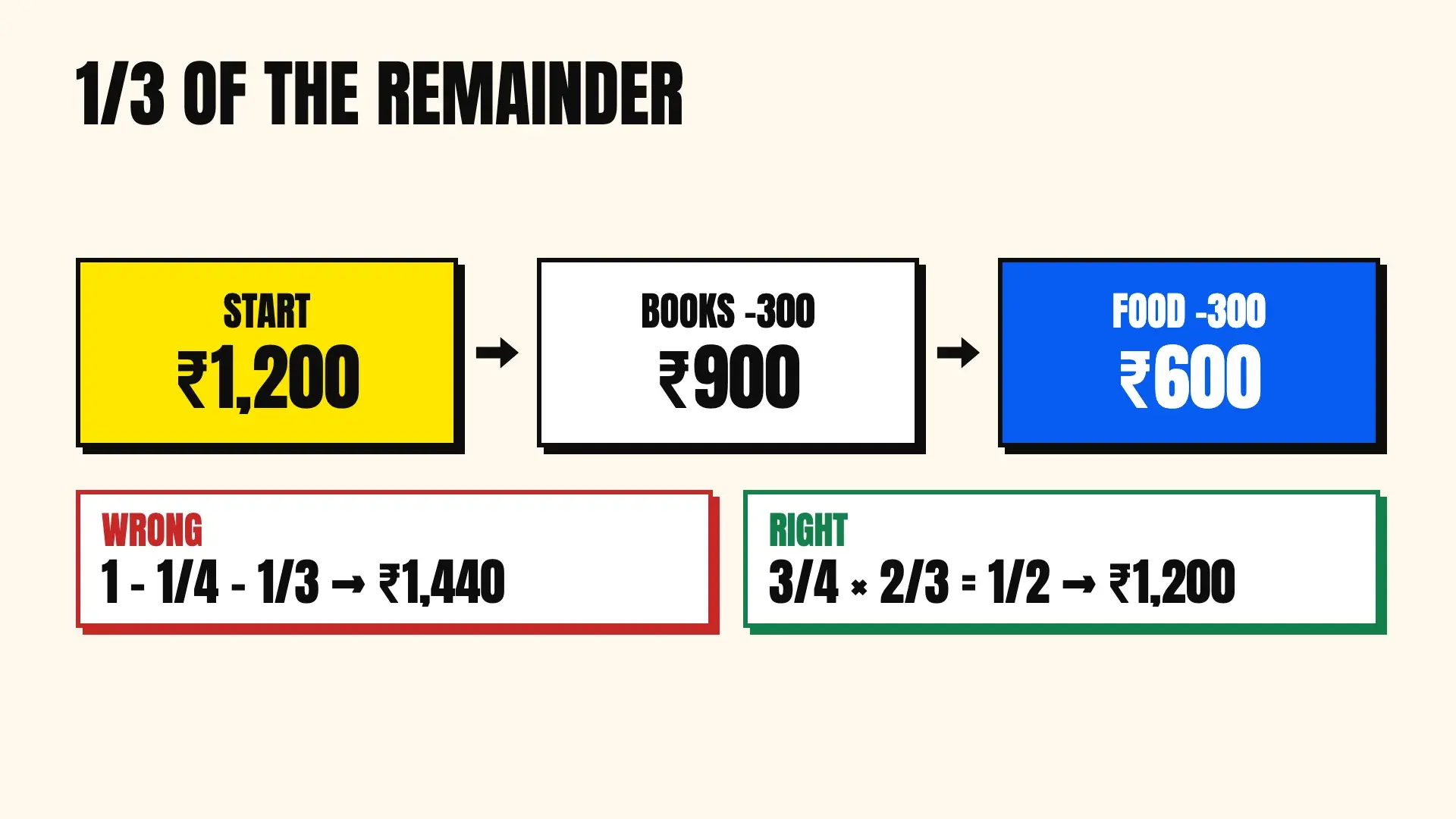
Worked example. Ravi spends 1/4 of his money on books and 1/3 of the remainder on food. He has ₹600 left. How much money did he start with?
The wrong setup subtracts both fractions from the whole: 1 − 1/4 − 1/3 = 5/12. That gives 600 × 12/5 = ₹1,440. This setup treats "1/3 of the remainder" as 1/3 of all the money, which the question does not say.
The right setup follows the story in order. After the books, 3/4 of the money is left. Food takes 1/3 of that, which is 1/4 of the original amount. What remains is 3/4 − 1/4 = 1/2 of the original. So half the money is ₹600, and Ravi started with ₹1,200. Check: ₹1,200 → books ₹300 → ₹900 left → food ₹300 → ₹600 left.
These phrases cause most translation errors:
- "A is 20% more than B" means A = 1.2B. "A is 20% less than B" means A = 0.8B.
- "5 more than twice a number" means 2n + 5, not 2(n + 5).
- "A exceeds B by 8" means A − B = 8.
- "What percentage of A is B?" means B ÷ A × 100. The base is the number after "of".
- "Together" in work and pipe questions means you add the rates, not the times.
- "Twice as fast" means double the speed, which means half the time.
Linear and simultaneous equations
A linear equation has the unknown only to the first power, as in 5x − 7 = 2x + 11. Collect the x terms on one side and the numbers on the other. That gives 3x = 18, so x = 6. When a question has two unknowns, you need two equations.
Worked example. A pen and a notebook together cost ₹70. Two pens and three notebooks cost ₹170. What does a notebook cost?
Let a pen cost p and a notebook cost n. Then p + n = 70 and 2p + 3n = 170. Double the first equation to get 2p + 2n = 140. Subtract this from the second equation, and n = 30. A notebook costs ₹30 and a pen costs ₹40. Check: 2 × 40 + 3 × 30 = 170.
Worked example. Five years ago, a mother was 7 times as old as her son. Today she is 4 times as old as him. How old is the son?
Let the son's age today be s, so the mother's age is 4s. Five years ago, their ages were s − 5 and 4s − 5. The equation is 4s − 5 = 7(s − 5), which gives 4s − 5 = 7s − 35. So 3s = 30, and s = 10. The son is 10 and the mother is 40. Check: five years ago they were 5 and 35, and 35 = 7 × 5.
A frequent mistake is to write 4s − 5 = 7s − 5. This multiplies only s by 7, instead of the son's whole age five years ago. It gives s = 0, which is impossible. An impossible answer almost always means a wrong setup, so go back to step 3 and redraw your table.
Practice. The ratio of A's age to B's age is 3:5. In 6 years, the ratio will be 2:3. Find their present ages.
Solution. Let the ages be 3k and 5k. Then (3k + 6)/(5k + 6) = 2/3, so 9k + 18 = 10k + 12 and k = 6. A is 18 and B is 30. Check: in 6 years they are 24 and 36, and 24/36 = 2/3.
Inequalities and modulus
You solve an inequality like an equation, with one extra rule. If you multiply or divide both sides by a negative number, you must flip the sign. Take −2x + 5 > 11. Subtract 5 to get −2x > 6. Divide by −2 and flip the sign to get x < −3.
If you forget to flip, you get x > −3. Test one value to catch this mistake. Try x = 0: −2(0) + 5 = 5, which is not more than 11, so x > −3 cannot be right. Testing one value is the fastest check you have for any inequality.
Modulus means distance from zero. So |x| = 3 means x = 3 or x = −3. The inequality |x − 2| < 5 means x is less than 5 away from 2. That gives −3 < x < 7.
Practice. Find all integers x that satisfy both 3x − 4 < 11 and 2x + 1 ≥ 3.
Solution. The first inequality gives 3x < 15, so x < 5. The second gives 2x ≥ 2, so x ≥ 1. The integers are 1, 2, 3 and 4.
Quadratic equations
A quadratic equation has an x² term and usually two answers, called roots. When you can, solve it by factorising. If the x² term has a coefficient of 1, find two numbers that multiply to the constant term and add to the coefficient of x. For x² − 5x + 6 = 0, the numbers −2 and −3 multiply to 6 and add to −5. So (x − 2)(x − 3) = 0, and x = 2 or x = 3.
Worked example. The product of two consecutive positive integers is 132. Find them.
Let the integers be n and n + 1, so n(n + 1) = 132. This gives n² + n − 132 = 0. Two numbers that multiply to −132 and add to 1 are 12 and −11. So (n + 12)(n − 11) = 0. Because n is positive, n = 11, and the integers are 11 and 12.
CAT often asks about the roots without asking you to find them. For ax² + bx + c = 0, the roots add to −b/a and multiply to c/a. In 2x² − 7x + 3 = 0, the roots add to 7/2 and multiply to 3/2. You can check this with the roots themselves, which are 3 and 1/2.
When factorising is difficult, use the formula x = (−b ± √(b² − 4ac)) ÷ (2a). The part under the square root, b² − 4ac, tells you how many real roots there are. If it is positive, there are two roots. If it is zero, there is one repeated root. If it is negative, there are no real roots.
Practice. For which positive value of k does x² + kx + 9 = 0 have exactly one root?
Solution. One root means b² − 4ac = 0, so k² − 36 = 0. The positive value is k = 6. The equation becomes x² + 6x + 9 = (x + 3)², with the single root x = −3.
Indices, surds and logarithms
Indices are powers. Three rules cover most questions: aᵐ × aⁿ = aᵐ⁺ⁿ, aᵐ ÷ aⁿ = aᵐ⁻ⁿ, and (aᵐ)ⁿ = aᵐⁿ. Also, a⁰ = 1 and a⁻ⁿ = 1/aⁿ. For example, if 3ˣ⁺¹ = 81, write 81 as 3⁴. Then x + 1 = 4, so x = 3.
A surd is a square root that is not a whole number, such as √2. To simplify a surd, take out the largest perfect square. For example, √72 = √(36 × 2) = 6√2.
A logarithm answers the question "what power?". So log₂ 8 = 3, because 2³ = 8. The log rules mirror the index rules:
- log(ab) = log a + log b
- log(a/b) = log a − log b
- log(aⁿ) = n log a
So, in base 10, log 2 + log 5 = log 10 = 1. Logarithms appear in only a few CAT questions, usually as a short test of these rules. Learn them after indices feel easy.
Practice. Solve 2ˣ × 4 = 128.
Solution. Write 4 as 2² and 128 as 2⁷. Then 2ˣ⁺² = 2⁷, so x + 2 = 7 and x = 5.
Sequences and series
An arithmetic progression (AP) adds the same number each time, as in 7, 11, 15, 19 and so on. Its first term is a = 7 and its common difference is d = 4. The nth term is a + (n − 1)d, so the 20th term is 7 + 19 × 4 = 83. The sum of the first n terms is n/2 × (first term + last term). So the first 20 terms add to 10 × (7 + 83) = 900.
A geometric progression (GP) multiplies by the same number each time, as in 3, 6, 12, 24 and so on. Its first term is a = 3 and its common ratio is r = 2. The nth term is a × rⁿ⁻¹, so the 8th term is 3 × 2⁷ = 384.
Practice. How many terms of the AP 4, 9, 14 and so on are less than 100?
Solution. The nth term is 4 + (n − 1) × 5 = 5n − 1. You need 5n − 1 < 100, so n < 20.2. That gives 20 terms. Check: the 20th term is 99 and the 21st term is 104.
Functions
A function is a rule that changes one number into another. If f(x) = 2x + 3, then f(1) = 5 and f(f(1)) = f(5) = 13. CAT function questions usually test three skills. You apply a rule carefully, you read a graph, or you find the smallest or largest value a rule can give.
For the smallest value, use one fact: a square is never negative. So x² − 6x + 13 = (x − 3)² + 4 is never smaller than 4. It equals 4 when x = 3. Writing an expression as "a square plus a number" is the standard way to find its minimum.
Algebra gives you the tools for word problems. Geometry is the next family, and it needs a different habit: draw the figure before you calculate.
CAT Quant geometry and mensuration
Geometry questions in CAT are mostly about triangles and circles, with some area and volume. Before you calculate anything, draw the figure roughly to scale. Mark every length and angle that you know. A clear sketch often shows a right triangle that the question does not mention.
Lines, angles and triangles
Angles on a straight line add to 180°. The three angles of a triangle also add to 180°. An exterior angle of a triangle equals the sum of the two opposite interior angles. These three facts find most missing angles.
In a right triangle, Pythagoras' theorem says a² + b² = c². Here c is the longest side, opposite the right angle, and it is called the hypotenuse. Some side lengths appear so often that you should recognise them: 3-4-5, 5-12-13, 8-15-17 and 7-24-25. Any multiple of these also works, such as 6-8-10.
Worked example. A 13 m ladder leans against a wall and reaches a window 12 m above the ground. How far is the foot of the ladder from the wall?
The ladder, the wall and the ground form a right triangle with a hypotenuse of 13. The distance is √(13² − 12²) = √(169 − 144) = √25 = 5 m. If you recognise the 5-12-13 triangle, you get the answer without any calculation.
The area of a triangle is ½ × base × height. The height must be at right angles to the base. An equilateral triangle with side a has an area of (√3/4) × a². So an equilateral triangle with side 6 has an area of 9√3.
Similar triangles
Two triangles are similar when their angles are equal. Their matching sides are then in the same ratio. Their areas are in the square of that ratio.
Worked example. A 6 m pole casts a 4 m shadow. At the same time, a tower casts a 30 m shadow. How tall is the tower?
The sun's rays make similar triangles, so height ÷ shadow is the same for both. That gives 6/4 = h/30, so h = 45 m.
If two similar triangles have sides in the ratio 2:3, their areas are in the ratio 4:9. Beginners often forget to square the ratio when a question asks about area.
Circles
For a circle of radius r, the area is πr² and the circumference is 2πr. With π = 22/7 and r = 7, the area is 154 and the circumference is 44. Two more facts solve many circle questions. First, the angle in a semicircle is 90°, so a triangle drawn on a diameter is a right triangle. Second, a radius drawn to the point where a tangent touches the circle meets the tangent at 90°.
Area and volume
| Solid | Volume | Surface area |
|---|---|---|
| Cube of side a | a³ | 6a² |
| Cuboid l × b × h | lbh | 2(lb + bh + hl) |
| Cylinder, radius r, height h | πr²h | 2πr(r + h) |
| Cone, radius r, height h, slant height l | ⅓πr²h | πr(r + l) |
| Sphere, radius r | ⁴⁄₃πr³ | 4πr² |
For example, a cube of side 4 has a volume of 64 and a surface area of 96. A cylinder of radius 7 and height 10 has a volume of 22/7 × 49 × 10 = 1,540.
Coordinate geometry
The distance between the points (x₁, y₁) and (x₂, y₂) is √((x₂ − x₁)² + (y₂ − y₁)²). From (1, 2) to (4, 6), the distance is √(9 + 16) = 5. This is the 3-4-5 triangle again. The slope of the line through two points is (y₂ − y₁) ÷ (x₂ − x₁), so the slope of this line is 4/3.
Practice. The two shorter sides of a right triangle are 8 cm and 15 cm. Find the hypotenuse and the area.
Solution. The hypotenuse is √(64 + 225) = √289 = 17 cm, which is the 8-15-17 triangle. The area is ½ × 8 × 15 = 60 cm².
CAT Quant number system
Number system questions test how well you understand whole numbers. They ask what divides what, what is left over, and what pattern the last digit follows. Start with prime factorisation, because factor counts, HCF and LCM all come from it.
Factors, HCF and LCM
Write 72 as a product of primes: 72 = 2³ × 3². Every factor of 72 uses the prime 2 zero to three times and the prime 3 zero to two times. So 72 has (3 + 1) × (2 + 1) = 12 factors. They are 1, 2, 3, 4, 6, 8, 9, 12, 18, 24, 36 and 72.
The HCF (highest common factor) takes the lower power of each common prime. The LCM (lowest common multiple) takes the higher power of every prime. For 12 = 2² × 3 and 18 = 2 × 3², the HCF is 2 × 3 = 6. The LCM is 2² × 3² = 36. For any two numbers, HCF × LCM equals the product of the two numbers: 6 × 36 = 216 = 12 × 18.
LCM questions often come in everyday settings. Suppose three bells ring every 6, 8 and 12 minutes, and they ring together at 9:00. They ring together again after LCM(6, 8, 12) = 24 minutes, which is 9:24.
Divisibility and remainders
A number is divisible by 3 or 9 if the sum of its digits is divisible by 3 or 9. It is divisible by 4 if its last two digits are, and by 8 if its last three digits are. So 7,436 is divisible by 4, because 36 is. It is not divisible by 3, because its digit sum is 20.
To find a remainder, you can replace each number by its own remainder before you multiply. For 37 × 45 divided by 8, 37 leaves 5 and 45 leaves 5. Then 5 × 5 = 25, which leaves 1. Check: 37 × 45 = 1,665 = 8 × 208 + 1.
Remainders of powers repeat in cycles. Powers of 2 divided by 7 leave 2, 4, 1, 2, 4, 1 and so on, so the cycle length is 3. Because 10 = 3 × 3 + 1, the number 2¹⁰ leaves the same remainder as 2¹, which is 2. Check: 1,024 = 7 × 146 + 2.
Last digits and factorials
The last digits of powers also repeat. For powers of 7 the last digits are 7, 9, 3, 1, and then the cycle starts again. The cycle length is 4. To find the last digit of 7²³, divide 23 by 4. The remainder is 3, so the last digit is the third in the cycle, which is 3.
The number of zeros at the end of n! equals the number of 5s in its prime factors. Each 5 pairs with a 2 to make a 10, and there are always more 2s than 5s. In 25!, the multiples of 5 give 25 ÷ 5 = 5 fives, and 25 itself gives one more five. So 25! ends in 6 zeros.
Practice. Find the remainder when 59 × 61 is divided by 7. Then find the last digit of 3¹⁰.
Solution. 59 leaves 3 and 61 leaves 5, so the product leaves the same remainder as 15, which is 1. Check: 59 × 61 = 3,599 = 7 × 514 + 1. The last digits of powers of 3 are 3, 9, 7, 1, a cycle of 4. 10 leaves 2 when divided by 4, so 3¹⁰ ends in 9.
CAT modern maths: sets, counting and probability
Modern maths had the fewest questions in the Careers360 five-year count. Set questions can still be quick marks, so learn Venn diagrams early. Leave counting and probability until arithmetic and algebra feel comfortable.
Sets and Venn diagrams
Worked example. In a class of 40 students, 25 like tea, 20 like coffee and 10 like both. How many like neither?
Draw two overlapping circles and fill the overlap first, with 10. Then tea only is 25 − 10 = 15, and coffee only is 20 − 10 = 10. At least one drink is 15 + 10 + 10 = 35, so neither is 40 − 35 = 5. The general rule is: at least one = A + B − both. You subtract the overlap so that you do not count it twice.
Permutations and combinations
If you choose one thing and then another, multiply the number of choices. For example, 3 shirts and 4 trousers give 3 × 4 = 12 outfits. You can arrange n different things in a row in n! ways, where n! = n × (n − 1) × ... × 1. The letters of the word WORD can be arranged in 4! = 24 ways.
When the order does not matter, you are choosing a group, written as nCr. To pick 2 students from 5 for a quiz team, there are 5 × 4 ÷ 2 = 10 ways. If the order matters, for example a captain and a vice-captain, there are 5 × 4 = 20 ways.
Probability
Probability = favourable outcomes ÷ total outcomes, when every outcome is equally likely.
Worked example. You throw two dice. What is the probability that the total is 7?
There are 6 × 6 = 36 outcomes. A total of 7 comes from (1,6), (2,5), (3,4), (4,3), (5,2) and (6,1), which is six outcomes. So the probability is 6/36 = 1/6.
For "at least one" questions, find the chance of "none" and subtract it from 1. For example, the chance of at least one head in three coin tosses is 1 − 1/8 = 7/8.
Practice. In a group of 60 people, 35 play cricket, 30 play football and 15 play both. You pick one person at random. What is the probability that this person plays neither sport?
Solution. At least one sport is 35 + 30 − 15 = 50 people, so 10 people play neither. The probability is 10/60 = 1/6.
How to study Quant for CAT: from examples to timed questions
Understanding a worked example and solving a new question alone are two different skills. Most beginners get stuck in the gap between them. If you often say "I understand the solution, but I cannot solve the question", you have probably watched too much and solved too little. The method below closes that gap one chapter at a time.
The practice ladder
Climb these six steps for each chapter:
- Explain two worked examples in your own words, aloud or on paper, until you can say why each step is there.
- Solve three to five similar questions without looking at any solution.
- Solve versions with changed wording. Reverse the unknown, change the units or change the story. For example, "find 20% of 450" becomes "450 is 20% more than what number?"
- Mix the chapter with two earlier chapters. Now you must first recognise which idea each question needs.
- Solve real CAT previous year questions (PYQs) on the chapter, without a timer.
- Add a timer once your untimed accuracy on mixed sets stays steady.
Move up one step when you get about four out of five questions right. If you keep failing step 3, go back to step 2 and solve more questions. That pattern means the idea has not settled yet. Speed drills at that point only make you faster at guessing.
When to start CAT previous year questions
Start PYQs on a chapter as soon as you pass step 4 of the ladder for it. Solve PYQs topic-wise while you learn each chapter, so you see how CAT asks that topic. Keep a few complete past papers aside, and solve them later as timed 40-minute sectional tests. The IIMs release official past papers on the CAT website when they publish them, and most coaching websites have free topic-wise collections.
When to start a timer and sectional tests
A timer helps only after you can solve a question type reliably. Before that, a clock teaches you to rush. A sensible rule is to wait for about 70% accuracy without a timer. Measure it on a mixed set of easy and medium questions, then start timing that chapter. Start with about three minutes per question and slowly reduce it towards two minutes.
Take one short diagnostic Quant section early, even in your first month, so you know what 40 minutes of CAT feels like. Do not judge yourself by that score. Start regular timed sectional tests, about one a week, after you finish arithmetic and basic algebra. Add full mocks after that. Our CAT mock test strategy guide explains how many mocks to take and how to space them.
How to increase speed in Quant for CAT
Speed in CAT Quant comes from three things. You calculate quickly and accurately, you recognise the question type quickly, and you do not waste time on questions you should skip. For a beginner, calculation drills help most. Spend ten minutes a day on them, before your main session.
- Squares and cubes. Learn squares up to 30 and cubes up to 12. For example, 17² = 289, 23² = 529 and 12³ = 1,728.
- Squares near a round number. 48² = (50 − 2)² = 2,500 − 200 + 4 = 2,304.
- Multiply by 5, 25 and 9. Times 5 is times 10, then halve: 86 × 5 = 430. Times 25 is times 100, then divide by 4: 48 × 25 = 1,200. Times 9 is times 10, then subtract the number: 47 × 9 = 470 − 47 = 423.
- Split percentages. 35% of 240 = 30% of 240 + 5% of 240 = 72 + 12 = 84.
- Estimate first. 19.8% of 503 is close to 20% of 500, which is 100. If the options are far apart, the estimate is enough.
- Check the last digit. 17 × 13 must end in 1, because 7 × 3 = 21. So 211 is wrong and 221 is right.
Do not chase speed at the cost of accuracy. A fast wrong answer costs a mark, and a slower right answer earns three.
How to choose which questions to attempt
In a timed section, look at every question briefly before you commit to one. Spend 15 to 30 seconds on each first look, and ask two things: do you know the chapter, and can you see the setup?
- You know the chapter and the setup is clear. Attempt it now.
- You know the chapter, but the calculation looks long. Mark it and come back at the end.
- You cannot see what the question wants after one careful reading. Mark it and come back.
- The question is from a chapter you have not studied. Skip it. On an MCQ, a blind guess gains nothing on average.
A long question and a hard question are not the same thing. A question with eight lines of text may hide a simple percentage. A two-line question about functions may need an idea you do not have yet. Read the last sentence first. If it asks for something you know how to find, the length does not matter.
How to review a wrong answer
Each wrong or skipped question teaches you more than several new questions, if you review it properly. Use this loop every time:
- Attempt the question again without the solution.
- Check your reasoning against the solution, and find the exact step that went wrong.
- Repair the gap. Relearn the idea, add the tricky phrase to your list, or fix the calculation habit.
- Solve a variation of the same question with different numbers.
- Revisit it later, a few days later and again a week or two later, without your notes.
Keep an error log in a notebook so that the loop happens every time. Four columns are enough:
| Question | What went wrong | Fix | Retest date |
|---|---|---|---|
| Profit after markup and discount | Took the discount on the cost price | Discount is on the marked price; redo 5 questions | In 3 days |
| Average speed, round trip | Averaged the two speeds | Total distance ÷ total time; equal distances use 2xy/(x + y) | In 1 week |
| Remainder of a product | Multiplied the full numbers | Replace each number by its remainder first | In 1 week |
How to revise so you do not forget
Test yourself on old chapters on a schedule instead of rereading your notes. A widely cited review of study methods by Dunlosky and colleagues rated practice testing and spaced practice among the most useful techniques. It rated rereading and highlighting among the least useful. Those studies looked at school and college students and did not measure CAT scores, but the habit carries over. A simple schedule is to retest a chapter one day, three days, one week and two weeks after you learn it. Each retest is a short set of five questions with your notes closed.
CAT Quant study plan for beginners
This plan starts tomorrow and grows with you. It gives a first day, a first week, a daily session for different amounts of time, and outlines for 30 to 180 days. Adjust it to your starting point and your hours.
Day 1
Spend 45 minutes on percentages. First, do the two-minute check from earlier in this guide. Next, read the percentage section, cover the solutions, and solve the salary, shopkeeper and reverse-price examples yourself. Then write the fraction-to-percentage values from memory. Finish with ten percentage questions from any book or free question bank. Write the reason for each wrong answer in a new notebook, which becomes your error log until exam day.
The first seven days
- Day 1: percentages as multiplication, the base, and reverse percentages.
- Day 2: successive changes, and ten mixed percentage questions.
- Day 3: ratio and proportion, the 3k and 4k method, and joining two ratios.
- Day 4: averages, weighted averages and the inverse-ratio idea.
- Day 5: linear equations and the five-step method for word problems.
- Day 6: a mixed set of 15 questions from days 1 to 5, without a timer, then a review of every mistake.
- Day 7: rest, or redo the week's wrong questions if you missed a day.
At the end of the week, try the practice questions for percentages, ratios and averages without the solutions. If you cannot solve them, spend another week on these three chapters before you move to profit and loss. Going slower now saves time later, because every other arithmetic chapter depends on these three.
A daily study session
Every session needs five parts. Recall yesterday's ideas from memory, learn one new idea, and solve questions on your own. Then update the error log and revisit a few old questions. Scale the parts to the time you have:
- 45 to 60 minutes: 5 minutes of recall, 15 to 20 minutes of learning, 15 to 20 minutes of solving alone, 5 to 10 minutes on the error log, and 5 minutes of old questions.
- 90 minutes: 10 minutes of recall, 25 minutes of learning, 35 minutes of solving, 10 minutes on the error log, and 10 minutes of old questions.
- 2 hours: 10 minutes of recall, 30 minutes of learning, 50 minutes of solving, 15 minutes on the error log, and 15 minutes of mixed old questions.
These times are for Quant only. CAT has two other sections, so keep time for reading and DILR every week. If you work full time, an hour on weekdays and a longer block at the weekend is enough for steady progress. The guide to CAT preparation with a full-time job shows how to fit all three sections into one week.
If you have 30, 60, 90 or 180 days
How much you can cover depends on your starting point and your daily hours. Use these outlines as starting points and adjust them as you go.
- 180 days. Cover every topic family in the order above. Spend about two months on arithmetic, five to six weeks on algebra, a month on geometry, and the rest on number systems and modern maths. Start weekly sectional tests in the third month and full mocks in the last two months.
- 90 days. Spend the first five to six weeks on arithmetic and linear equations. Then study quadratics, inequalities, triangles and circles. Leave counting, advanced number systems and logarithms to the end, if time allows. Start sectional tests by week five.
- 60 days. Learn arithmetic and basic algebra properly, plus triangles and circles if possible. Start sectional tests by about day 25. Stop new chapters about ten days before the exam, and use that time for mocks and your error log. The CAT 60-day preparation plan covers all three sections for this window.
- 30 days. Make the chapters you already know reliable instead of starting new ones. Focus on percentages, ratios, averages, profit and loss, and speed. In the exam, skip questions from chapters you have not studied.
To turn your exam date and daily hours into a day-by-day timetable for all three sections, use the free CAT study plan tool.
Frequently asked questions
Is CAT Quant tough for a beginner?
CAT Quant is hard mainly because of time and wording. The maths itself is Class 8 to 10 level: percentages, ratios, equations, triangles and the properties of whole numbers. One question may combine two or three of these ideas in a long paragraph, and you have 40 minutes for the whole section. If you learn the chapters in order and practise turning words into equations, most of that difficulty goes away.
What level of maths is required for CAT?
CAT needs Class 8 to 10 maths. You do not need calculus, matrices or vectors. A few chapters, such as progressions, logarithms and permutations, are taught in Class 11, but CAT asks only their basic forms. Master Class 8 to 10 arithmetic and algebra first, and learn those Class 11 chapters later.
Is arithmetic and algebra enough for CAT?
Arithmetic and algebra are enough to start scoring. They made up about three of every four Quant questions in the Careers360 count for CAT 2021 to 2025. They are not enough to attempt the whole section. A typical paper still has a few geometry, number system and modern maths questions, and some of those are among the easiest on the page.
Can I skip geometry for CAT?
You can postpone geometry, but skipping it completely is risky. Geometry and mensuration averaged about three questions per paper from 2021 to 2025 in the Careers360 count. With less than 60 days left, learn only triangles, circles and basic area and volume. With more time, study geometry fully after algebra.
Can a non-maths student crack CAT Quant?
Yes. CAT has no subject requirement for applying, and the Quant section uses school maths in word problems. Commerce students already use percentages, interest and ratios in their accounts papers. Arts and humanities students usually need a few extra weeks on fractions, percentages and equations. In both cases, daily practice closes the gap.
How long does it take to prepare CAT Quant from zero?
There is no fixed answer, because it depends on your starting level and your daily hours. As a rough guide, take a beginner who studies Quant for about an hour a day. That beginner usually needs two to three months to get comfortable with arithmetic and basic algebra. Covering every topic family usually takes five to six months. Track your practice accuracy each week to see your real pace.
How many questions should I practise each day?
Count the questions you solve and review, not the hours you spend. On a 60-minute day, 15 to 20 questions that you solve alone and then review is a good target. On a two-hour day, aim for 30 to 40. Fifteen questions solved, checked and logged teach you more than thirty solved carelessly.
Can I prepare for CAT Quant without coaching?
Yes. Many students learn CAT Quant on their own with free past papers, a question bank and a disciplined error log. Coaching gives you structure and help with doubts. With self-study, you build that structure yourself, and the chapter order, practice ladder and plans in this guide are designed for that.
What should I do if my Quant mock scores stay low?
Stop taking new mocks for a week. Go through your last three mocks, list every wrong and skipped question, and write the reason for each one. Usually one cause dominates: a weak chapter, translation errors, calculation mistakes or poor question choice. Fix that one cause, retest the same question types, and then take the next mock.
Your first step tonight
Go back to the percentage section. Cover the solutions, work the three examples on paper, and start your error log with whatever goes wrong. Tomorrow, follow Day 2 of the first-week plan.
For the whole exam beyond Quant, including VARC, DILR, target scores and colleges, read how to crack CAT with a 99+ percentile. Once your Quant basics are in place, you may want a fixed calendar for the final 60 days. The Crack CAT in 60 Days playbook has that plan, the Quant chapter playbooks and a mock tracker you can print.