

Two friends start preparing in the same month. Both study five hours a day. Both finish the same syllabus. In January, one has calls from three top colleges and the other is waiting on a waitlist.
The gap between them was small. One knew that CAT pays you for leaving questions and SNAP punishes you for it. One knew that XAT fines blanks and MBA CET rewards guessing. One took a mock a week and wrote down each mistake. The syllabus across these exams is close to identical. The rules are not, and the rules decide who lands in the top one percent.
Quick answer: To crack 99+ percentile in MBA entrance exams, build one common base of arithmetic, algebra, reading comprehension and logical reasoning, then adjust to each exam's marking rules. You need under half the marks in CAT and XAT, about two thirds in CMAT and MBA CET, and over 80 percent in SNAP. Take 12 to 20 mocks for each exam and analyse each one.
The six MBA entrance exams at a glance
| Exam | Conducted by | Usually held | Questions | Time | Marking |
|---|---|---|---|---|---|
| CAT | The IIMs | Late November | 68 | 120 min | +3, −1 for a wrong MCQ |
| XAT | XLRI Jamshedpur | Early January | About 95 | 180 min | +1, −0.25, and −0.10 for each blank after 8 |
| SNAP | Symbiosis International | December, three tests | 60 | 60 min | +1, −0.25 |
| NMAT | GMAC | November to December window | 108 | 120 min | No negative marking, adaptive |
| CMAT | National Testing Agency | Late January or early February | 100 | 180 min | +4, −1 |
| MBA CET | State CET Cell, Maharashtra | March to May | 200 | 150 min | +1, no negative marking |
Each exam name links to a full guide for that exam. This page gives you the plan that sits above all six. Exam bodies publish exact dates on their official sites each year, and the free MBA exam calendar keeps them in one place.
What does a 99+ percentile mean?
A percentile tells you how many test takers scored below you. At 99 percentile, you beat 99 out of every 100 people who sat the exam. It is a rank, and it says nothing about the share of the paper you got right.
That difference matters more than any other fact on this page. In CAT, a 99 percentiler gets about 40 percent of the marks. In SNAP, a 99 percentiler gets over 80 percent. The percentile is the same. The paper, and the kind of preparation it demands, are far apart.
Three scores show up on most scorecards:
- Raw score: marks from the answer key.
- Scaled or normalised score: raw marks adjusted when an exam runs in more than one slot.
- Percentile: your position among all test takers, built from the adjusted scores.
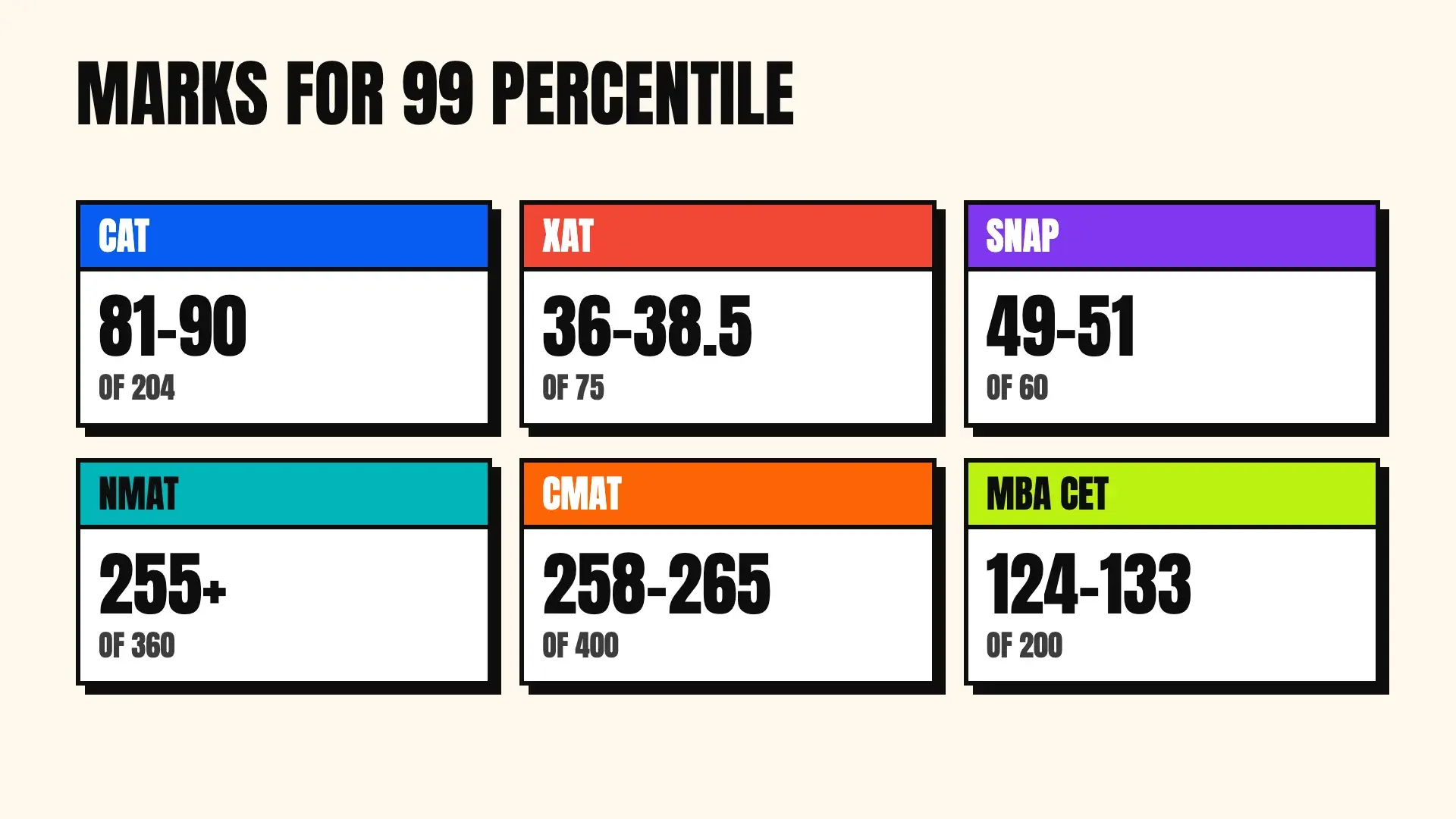
How many marks do you need for 99 percentile in each exam?
| Exam | Maximum marks | Marks for 99 percentile | Share of the paper | Type of figure |
|---|---|---|---|---|
| CAT | 204 | About 81 to 90 | 40 to 44 percent | Institute estimates |
| XAT | 75 (Part 1) | About 36 to 38.5 | 48 to 51 percent | Institute estimates |
| SNAP | 60 | About 49 to 51 | 81 to 85 percent | Candidate scorecards |
| NMAT | 360 | 255 to 265 | 71 to 74 percent | GMAC's official table |
| CMAT | 400 | About 258 to 265 | 65 to 66 percent | Institute estimates |
| MBA CET | 200 | About 124 to 133 | 62 to 67 percent | Institute estimates |
Figures are for the latest paper of each exam, from the sources listed at the end. They move every year with the difficulty of the paper.
The "share of the paper" column sorts the six exams into two groups.
Selection exams: CAT and XAT. You need half the marks or less. The papers are hard, and the winners are the students who pick the right questions and leave the rest.
Speed and accuracy exams: SNAP, NMAT, CMAT and MBA CET. You need two thirds of the marks or more. The questions are easier, and the winners are the students who solve almost all of them without slipping.
Most students prepare for the first group and walk into the second without changing gears. That is a common reason strong CAT scorers fall short in SNAP.
Check your own numbers with the free score calculators: CAT, XAT, SNAP, NMAT, CMAT and MBA CET.
What each exam rewards
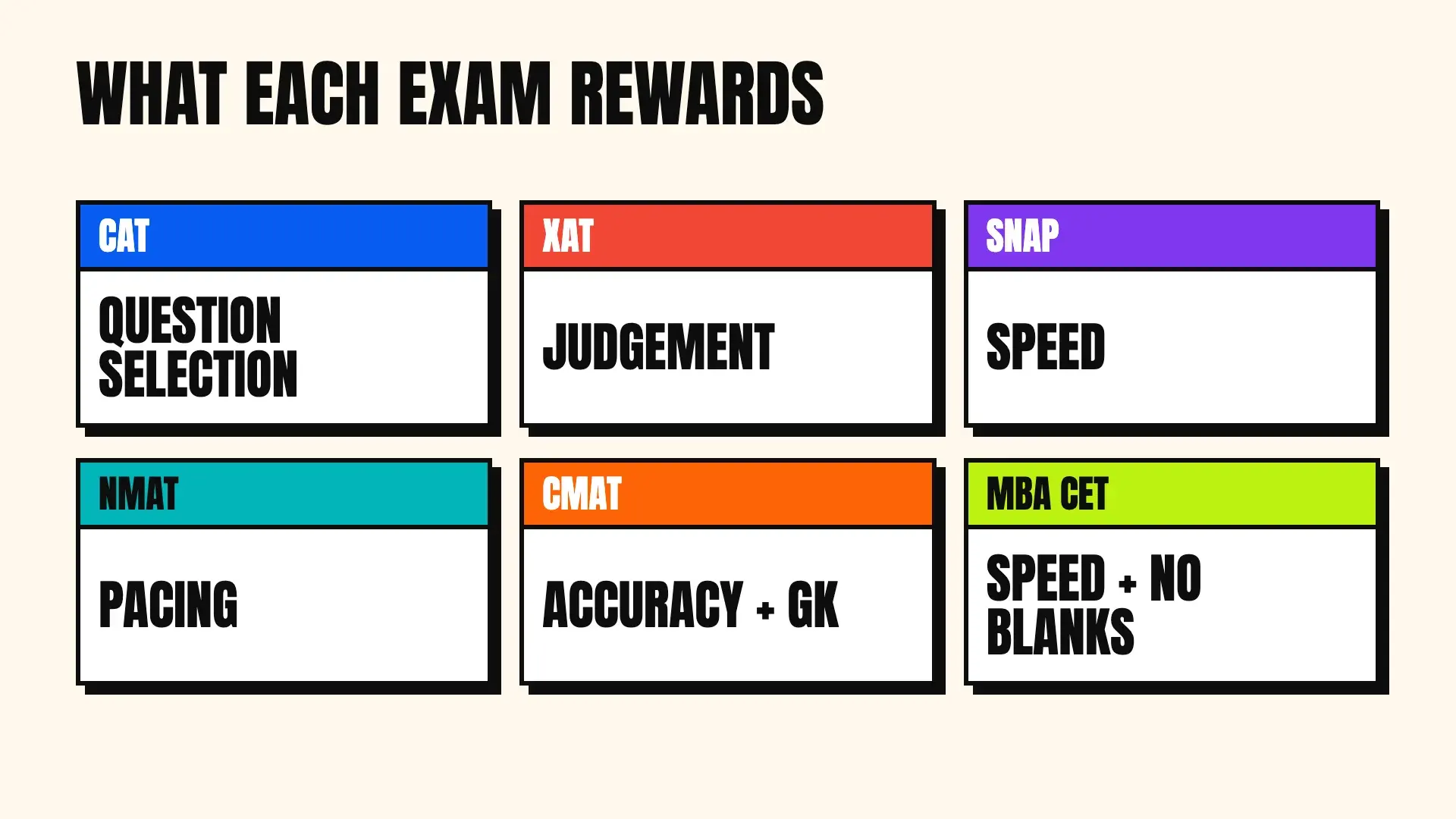
| Exam | It rewards | The trap |
|---|---|---|
| CAT | Choosing questions, above all in DILR | Chasing attempts and collecting negatives |
| XAT | Judgement in Decision Making, and smart guessing | Leaving more than 8 blanks |
| SNAP | Speed on easy questions | Getting stuck on one puzzle |
| NMAT | Steady pace inside three separate timers | Rushing the first questions of an adaptive section |
| CMAT | Accuracy, plus General Awareness and Innovation and Entrepreneurship | Guessing blind in GA |
| MBA CET | Raw speed across 200 questions | Leaving blanks when there is no penalty |
Marking schemes compared: when a guess pays
The marking rule decides whether you should guess. Work it out once for each exam and you won't have to think about it in the hall.
| Exam | Blind guess | After cutting one option | After cutting two options | Rule |
|---|---|---|---|---|
| CAT (MCQ, 4 options) | 0 on average | +0.33 | +1.0 | Guess after cutting one option. Attempt each TITA, since it has no penalty |
| XAT (5 options) | 0 on average | +0.06 | +0.17 | After 8 blanks, any guess beats a blank, which costs 0.10 |
| SNAP (4 options) | +0.06 | +0.17 | +0.38 | Guess after cutting one option |
| CMAT (4 options) | +0.25 | +0.67 | +1.5 | No blind guesses. Guess after cutting one option |
| NMAT | No penalty | No penalty | No penalty | Answer all 108 |
| MBA CET (5 options) | +0.2 | +0.25 | +0.33 | Answer all 200 |
Average marks for each guessed question. A positive number means guessing gains marks over many questions.
The table shows why one habit can't serve all six exams. In CAT, leaving a question you can't crack is a skill. In MBA CET, leaving one is a mistake. Before each exam, spend a week of mocks under its own rule.
Which MBA entrance exams should you take?
Start from the colleges, then pick the exams that lead to them.
| Your target | Exam you need |
|---|---|
| IIMs, FMS Delhi, MDI, IIT management schools | CAT |
| XLRI, XIM University | XAT |
| SIBM Pune, SCMHRD and other Symbiosis institutes | SNAP |
| NMIMS Mumbai, K J Somaiya | NMAT |
| JBIMS, SIMSREE, PUMBA (all-India seats) | CMAT or MBA CET, through the Maharashtra CAP |
| JBIMS, SIMSREE, PUMBA (Maharashtra seats) | MBA CET |
Three or four exams is a sensible load. CAT and XAT cover the widest set of top colleges. Add SNAP or NMAT as a December option, and CMAT or MBA CET if the Mumbai government colleges interest you. The guide to choosing your exams has combinations by profile, and MBA entrance exams compared sets the six patterns side by side.
One syllabus, six exams
Most of what you study counts for each exam you take.
| Area | CAT | XAT | SNAP | NMAT | CMAT | MBA CET |
|---|---|---|---|---|---|---|
| Arithmetic and algebra | Yes | Yes | Yes | Yes | Yes | Yes |
| Geometry and modern maths | Yes | Yes, heavier | Yes | Yes | Yes | Some |
| Data interpretation | Yes | Yes | Yes | Yes | Yes | Yes |
| Logical reasoning and puzzles | Yes, hardest | Some | Yes | Yes | Yes | Yes, half the paper |
| Reading comprehension | Yes, heaviest | Yes | Short | Yes | Yes | Yes |
| Grammar and vocabulary | Little | Some | Yes | Yes, heavy | Yes | Yes |
| Data sufficiency | Rare | Rare | Yes | Yes | Some | Yes |
Then each exam adds something of its own.
| Exam | Its own section or skill |
|---|---|
| CAT | Tough DILR sets, TITA questions |
| XAT | Decision Making, General Knowledge |
| SNAP | Ethics, Morality and Values |
| NMAT | Adaptive format, vocabulary |
| CMAT | General Awareness, Innovation and Entrepreneurship |
| MBA CET | Abstract Reasoning |
Prepare the common base once, to CAT level. Then give each exam's own section two to five weeks. That order saves months.
A seven-step plan to crack 99+ percentile
Step 1: Fix your colleges and exams
Write down five to eight colleges and the exams they accept. This list tells you which marking rules you need to master and how many months you have.
Step 2: Take a diagnostic mock
Sit one full mock before you study anything. Your score will be low. You want the section-wise breakup: it shows which third of the syllabus needs the most hours.
Step 3: Build the common base
Cover arithmetic, algebra, reading comprehension and the standard reasoning topics first. These four areas appear in all six exams and carry the most marks in each. Split quant time as one quarter concepts and three quarters solving.
Step 4: Start mocks early
Don't wait to "finish the syllabus". Take a mock every week or two from the first month. Mocks teach you question selection and timing, and no chapter can.
Step 5: Keep an error log
Write one line for each mistake: the question, the type of error and the fix. Solve each wrong question again after three days. In the last month, this log is the most useful thing you will read.
Step 6: Change gears before each exam
In the two to five weeks before each exam, switch to its pattern: its mocks, its marking rule, its own section. After CAT, that means Decision Making for XAT, speed drills for SNAP, vocabulary and data sufficiency for NMAT, GK for CMAT and Abstract Reasoning for MBA CET.
Step 7: Taper and perform
In the last ten days before any exam, cut the number of mocks, revise from your formula sheets and error log, and move your sleep to match the exam's time slot. Add no new topic.
How long does it take to prepare?
| Time before your first exam | Hours a day | Who it suits |
|---|---|---|
| 9 to 12 months | 2 to 3 | Working professionals, and students who need to rebuild maths or reading |
| 6 months | 3 to 4 | Most college students |
| 3 months | 5 to 6 | Students with sound basics |
| 60 days | 8 to 10 full-time, about 4 with a job | Repeaters and late starters with strong basics |
By situation, a workable day looks like this:
| Situation | Hours a day | Split |
|---|---|---|
| Full-time aspirant | 8 to 10 | Quant 3, reasoning 2.5, verbal 2.5, plus revision |
| College student | 5 to 6 | Quant 2, reasoning 1.5, verbal 1.5, plus revision |
| Working professional | About 4 | Quant before work, one RC at lunch, reasoning at night, a mock each weekend |
What you do in those hours counts for more than the total. Timed solving and error review build a score. Watching solved examples feels productive and builds little.
A four-phase study plan
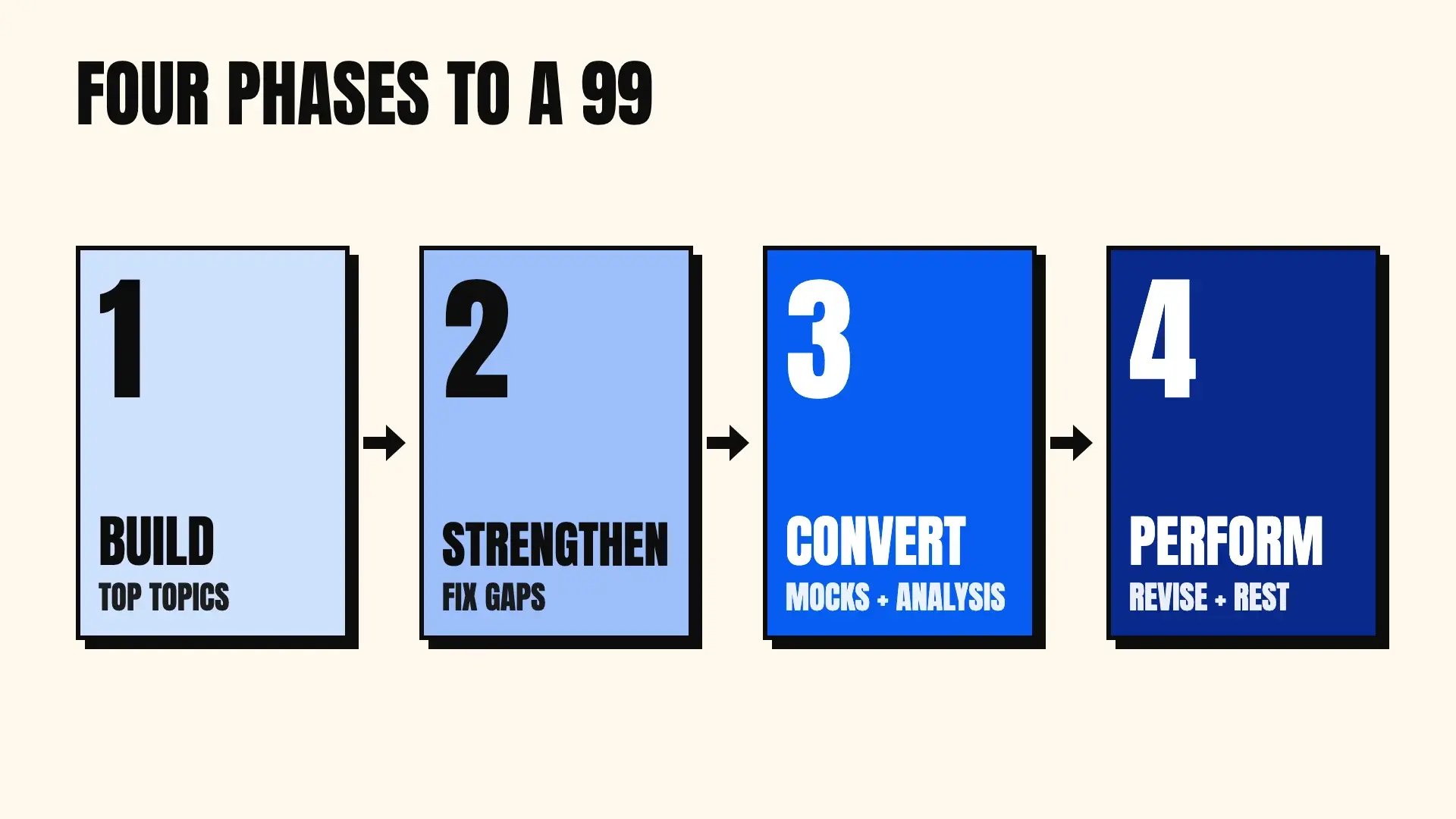
Split whatever time you have into four equal phases.
| Phase | Goal | Main work | Mocks |
|---|---|---|---|
| 1. Build | Cover the topics that carry the most marks | Arithmetic, algebra, daily reading, standard reasoning | A diagnostic mock, then one more |
| 2. Strengthen | Close the gaps your mocks show | Geometry, numbers, harder sets, sectional tests | One every five or six days |
| 3. Convert | Turn practice into marks | Mock, analysis, repair of weak topics | One every two or three days |
| 4. Perform | Peak on exam day | Mocks at the exam's time slot, revision, sleep routine | Fewer in the last ten days |
With 60 days, each phase is 15 days. With six months, each is about six weeks. The plan for preparing for all MBA exams together lays these phases over the whole season.
| Exam | Playbook |
|---|---|
| CAT | Crack CAT in 60 Days |
| XAT | Crack XAT in 60 Days |
| SNAP | Crack SNAP in 60 Days |
| NMAT | Crack NMAT in 60 Days |
| CMAT | Crack CMAT in 60 Days |
| MBA CET | Crack MBA CET in 60 Days |
Mock tests: how many, and how to analyse them
| Exam | Full mocks to take | Length of one mock |
|---|---|---|
| CAT | 15 to 20 | 2 hours |
| XAT | 12 to 14 | 3 hours |
| SNAP | 15 to 18 | 1 hour |
| NMAT | 14 to 16 | 2 hours |
| CMAT | 12 to 14 | 3 hours |
| MBA CET | 12 to 14 | 2.5 hours |
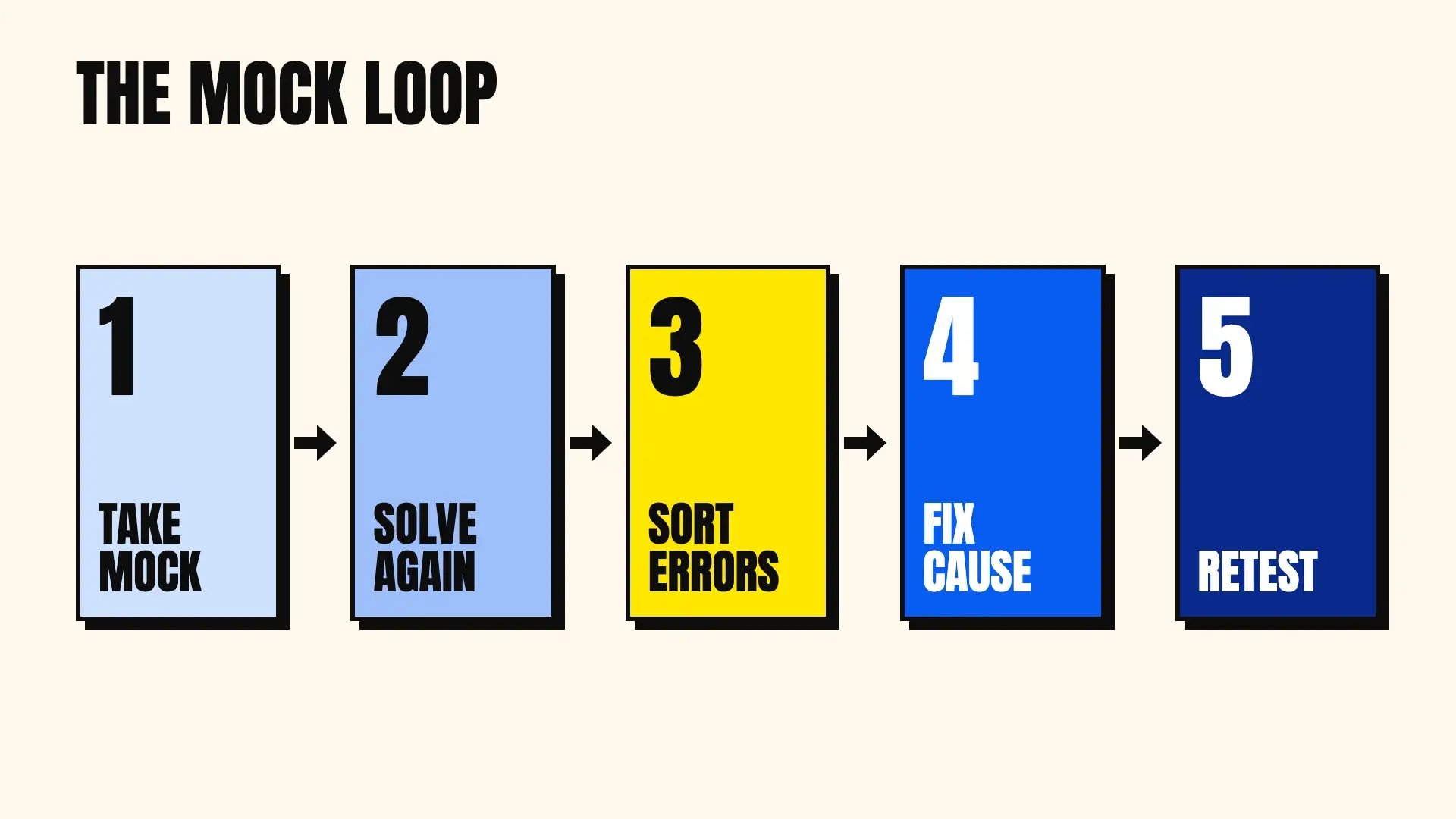
A mock without analysis is a wasted afternoon. Give the analysis at least as long as the mock.
- Take the mock under exam conditions, with your phone in another room.
- Solve again each wrong and skipped question, without a timer.
- Sort each error into a type.
- Fix the cause that week.
- Retest the same questions after three days.
| Error type | Fix |
|---|---|
| Concept gap | Relearn the concept, then solve 20 questions on it |
| Calculation or silly error | Find the exact step and slow down there |
| Practice gap | Add timed questions on the topic |
| Selection error | Improve your scan at the start of the section |
| Time error | Hold a time limit for any single question |
Judge your progress by the average of your last five mocks, and track raw marks. Mock percentiles differ between test series. For CAT, the mock test strategy guide has a printable analysis sheet.
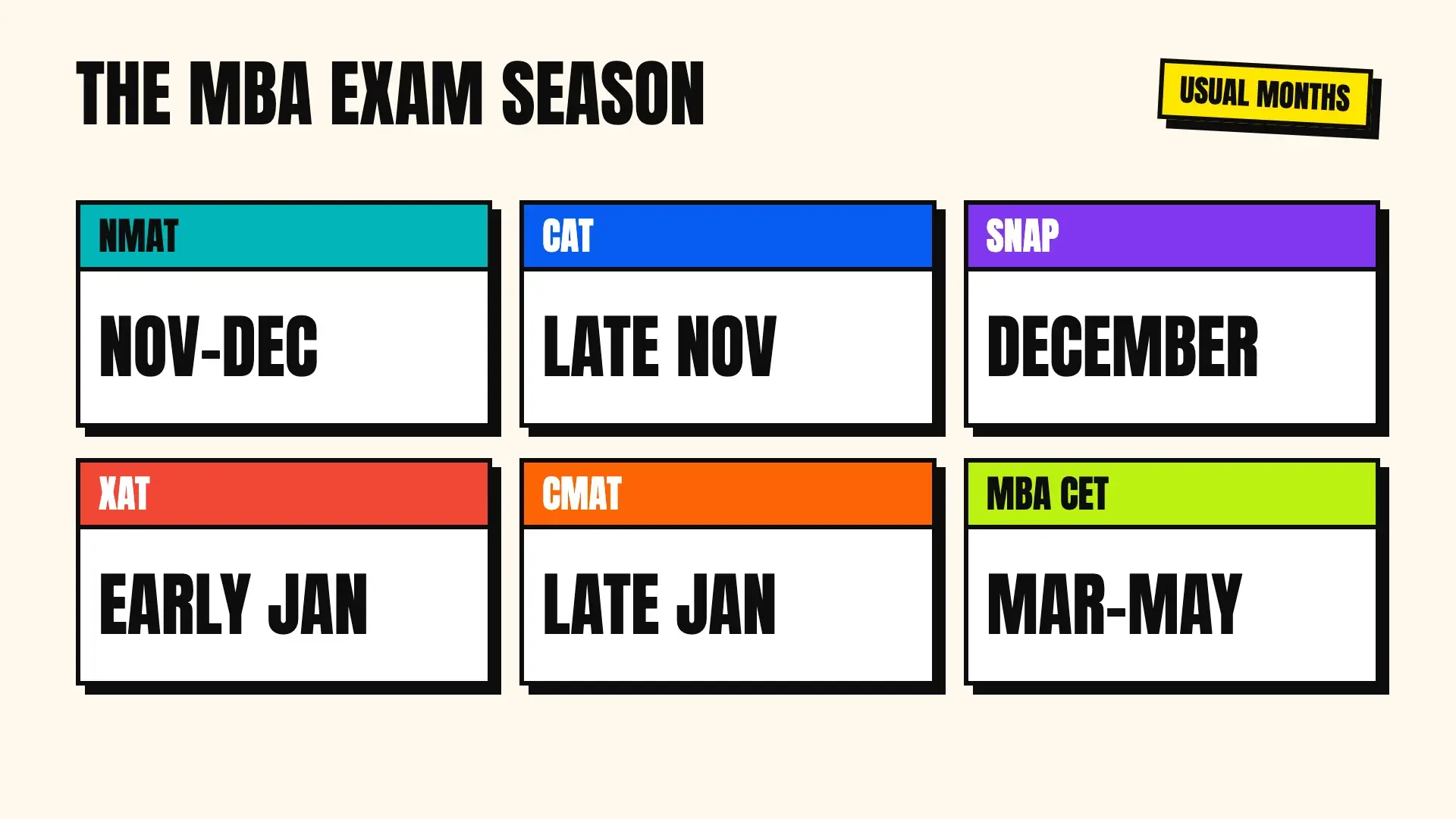
The exam season, in order
The six exams run from November to May. Knowing the order lets you plan which exam to change gears for, and when.
| Order | Exam | Usually held | Gear change before it |
|---|---|---|---|
| 1 | NMAT | A window from November to December | Vocabulary, data sufficiency, adaptive mocks |
| 2 | CAT | Late November | The core of your preparation |
| 3 | SNAP | December, three test dates | Speed drills and ethics rules |
| 4 | XAT | Early January | Decision Making, geometry, GK |
| 5 | CMAT | Late January or early February | General Awareness, Innovation and Entrepreneurship |
| 6 | MBA CET | March to May | Abstract Reasoning, puzzles, raw speed |
NMAT lets you book your own slot inside its window, so many students take it after CAT. These are the usual months. Exam bodies announce exact dates each year.
Exam-wise strategy in brief
CAT
- You need about 37 correct answers out of 68 for a 99 percentile in each section.
- Study arithmetic and algebra first; they make up about two thirds of Quant.
- In DILR, choose two sets and finish them. Leave a set if you have no grid after five minutes.
- Read two or three RC passages a day.
- Attempt each TITA question, since a wrong one costs nothing.
Full guide: how to crack 99+ percentile in CAT.
XAT
- You need about 36 to 39 marks out of 75 in Part 1.
- Keep blanks to 8. After that, a guess beats a blank.
- Practise two Decision Making caselets a day from the start of your preparation.
- Add geometry and DI sets to your CAT quant.
- Give each section about 55 minutes, since XAT has no sectional timer.
Full guide: how to crack 99+ percentile in XAT.
SNAP
- You need about 49 to 51 marks out of 60.
- Start with Ethics and English for 14 minutes, then Reasoning and Quant for 22 minutes each.
- Hold a 60-second limit for each question.
- Learn squares, cubes and fraction-to-percentage values by heart, since there is no calculator.
- Book all three tests. Symbiosis counts your best score.
Full guide: how to crack 99+ percentile in SNAP.
NMAT
- You need 255 or more out of 360 on GMAC's table. NMIMS Mumbai's cutoff is lower, at about 235.
- Answer all 108 questions. There is no negative marking.
- Go slow on the first ten questions of each section, since the test adapts to your answers.
- Choose your section order in mocks and keep it.
- Prepare fully before your first attempt. NMIMS counts only that one.
Full guide: how to crack 99+ percentile in NMAT.
CMAT
- You need about 258 to 265 marks out of 400.
- Give General Awareness and Innovation and Entrepreneurship 45 minutes a day.
- Keep accuracy near 90 percent. Seventy-six attempts with 68 right is enough.
- Don't guess blind. Guess after you cut one option.
- Do GA and I&E first in the exam, in about 30 minutes.
Full guide: how to crack 99+ percentile in CMAT.
MBA CET
- You need about 124 to 133 marks out of 200 for 99 percentile, and 155 or more for JBIMS.
- You have 45 seconds for each question.
- Start with Abstract Reasoning, then Verbal, Quant and Logical Reasoning.
- Mark an answer for each blank in the last five minutes.
- Sit both attempts. The better score counts.
Full guide: how to crack 99+ percentile in MBA CET.
Top colleges through each exam
| Exam | Top college | Approximate cutoff | Other colleges in the top group |
|---|---|---|---|
| CAT | IIM Ahmedabad | 99+ percentile | IIM Bangalore, IIM Calcutta, FMS Delhi, IIM Lucknow, IIM Kozhikode |
| XAT | XLRI Jamshedpur | 95 to 96+ percentile | XIM University, SPJIMR, Great Lakes, MICA, IMT Ghaziabad |
| SNAP | SIBM Pune | 98+ percentile | SCMHRD, SIIB, SIBM Bengaluru |
| NMAT | NMIMS Mumbai | About 235 out of 360 | K J Somaiya, XIM University, TAPMI |
| CMAT | JBIMS Mumbai | 99.9+ percentile (all-India seats) | SIMSREE, PUMBA, K J Somaiya |
| MBA CET | JBIMS Mumbai | 99.99+ percentile (all-India seats) | SIMSREE, WeSchool, SIES, PUMBA |
Approximate figures from the latest cycle, as listed in the six playbooks. Each college publishes its own cutoff.
How selection works after the exam
Your percentile gets you shortlisted. What happens next depends on the route.
| Route | What counts after the shortlist |
|---|---|
| IIMs (CAT) | Sectional percentiles, class 10, class 12 and graduation marks, work experience, diversity, a written test and an interview |
| XLRI (XAT) | Sectional cutoffs, then an essay, an interview, academics and work experience |
| Symbiosis (SNAP) | SNAP score, a Group Exercise and a Personal Interview. Academic marks are not in SIBM Pune's formula |
| NMIMS and others (NMAT) | Sectional cutoffs, a case discussion or written test, and an interview |
| Maharashtra CAP (CMAT, MBA CET) | Your entrance score alone. No interview |
If your school or college marks are weak, this table is good news. Two of these routes leave your academic marks out of the formula. A strong score in SNAP, CMAT or MBA CET can take you to SIBM Pune or JBIMS on the test and, for Symbiosis, the interview.
Can you crack these exams without coaching?
Yes. Coaching gives you a schedule, a test series and a place to clear doubts. A written plan replaces the first, and solutions and forums replace the third. The test series has no substitute, so buy one for each exam you take.
Working professionals crack these exams each year on about four hours a day: quant before work, one RC passage at lunch, reasoning at night and a full mock with analysis each weekend. The CAT plan for a full-time job shows the week in detail.
Ten mistakes that keep students below 99
| # | Mistake | Fix |
|---|---|---|
| 1 | Using CAT's habits in each exam | Learn each exam's marking rule and practise under it |
| 2 | Taking mocks with no analysis | Give analysis as long as the mock |
| 3 | Waiting to finish the syllabus before the first mock | Take a diagnostic mock in week one |
| 4 | Starting new topics in the last month | Revise, and stay with high-weight topics |
| 5 | Chasing attempts in exams with negative marking | Hold 85 to 90 percent accuracy first |
| 6 | Leaving blanks in exams with no penalty | Answer all of NMAT and MBA CET |
| 7 | Ignoring the exam's own section | Decision Making, Ethics, GA, I&E and Abstract Reasoning carry easy marks |
| 8 | Judging by one mock | Average your last five |
| 9 | Missing a form or a deadline | Track registrations for exams, colleges and the CAP |
| 10 | Stopping after the exam | Start interview preparation the week after |
Frequently asked questions
How many marks are required for 99 percentile in MBA entrance exams?
In the latest papers, a 99 percentile needed about 81 to 90 marks out of 204 in CAT, 36 to 38.5 out of 75 in XAT, 49 to 51 out of 60 in SNAP, 255 out of 360 in NMAT, 258 to 265 out of 400 in CMAT and 124 to 133 out of 200 in MBA CET.
Which MBA entrance exam is the easiest to crack?
MBA CET, CMAT, NMAT and SNAP have easier questions than CAT and XAT. Their cutoffs are higher for that reason: a 99 percentile needs 65 to 85 percent of the marks. No exam is easy at the 99 percentile level; each tests a different skill.
Which MBA entrance exam is the toughest?
CAT has the hardest DILR sets and the largest pool of serious candidates. XAT has tougher quant and a Decision Making section with no formulas. Most students find those two the hardest papers, and the other four the hardest to finish on time.
Can I prepare for CAT, XAT, SNAP and NMAT together?
Yes. Arithmetic, algebra, reading comprehension and reasoning are common to all four. Prepare to CAT level first, then give two to five weeks to each exam's own demands: Decision Making for XAT, speed for SNAP, and vocabulary and data sufficiency for NMAT.
How many months does it take to prepare for MBA entrance exams?
Six months at three to four hours a day suits most college students. Working professionals and beginners do better with nine to twelve months. Students with strong basics can prepare in three months, or in 60 days of full-time study.
Can I crack MBA entrance exams in my first attempt?
Yes. Many students do. First-attempt success comes from an early start, a mock every week or two from the first month, a written error log and practice under each exam's own marking rule.
Is coaching necessary to get 99 percentile?
No. You need a plan, good study material and a test series. Coaching helps students who struggle to keep a routine. Self-study works for students who can follow a schedule and analyse their own mocks honestly.
How many hours should I study each day?
Full-time aspirants study 8 to 10 hours, college students 5 to 6, and working professionals about 4 with a longer session on weekends. Split the time across quant, reasoning and verbal each day, and keep an hour for revision.
Do weak class 10 and 12 marks stop me from getting a top college?
They hurt at IIMs, where academics carry weight in the shortlist. They carry little or no weight at Symbiosis institutes and none in the Maharashtra CAP, which leads to JBIMS, SIMSREE and PUMBA. FMS Delhi and MDI lean heavily on the CAT score.
What should I do after the exams?
Calculate your score from the answer key, fill in the separate application forms of each college, and start interview preparation that week: your profile story, your reasons for an MBA and current affairs. For Maharashtra colleges, register for the CAP and track each round.
Sources
- Official exam sites: iimcat.ac.in, xatonline.in, snaptest.org, mba.com/exams/nmat, cmat.nta.nic.in and cetcell.mahacet.org
- NMAT percentile table: GMAC's NMAT percentile rankings (official)
- Score vs percentile estimates for the other five exams: Cracku, MBAUniverse, Career Launcher, Careers360 and CollegeDekho
- Study phases, mock counts, section plans and college lists: the six Crack ... in 60 Days playbooks by The 99 Percentiler
Related reading: MBA entrance exams compared · Which MBA entrance exams should you take? · Prepare for all MBA exams together · Free score calculators and planners · Free MBA exam calendar · Which MBA entrance exam is the easiest?
Each exam has its own 60-day playbook, with the full percentile tables, topic chapters, a day-by-day calendar and a mock tracker.