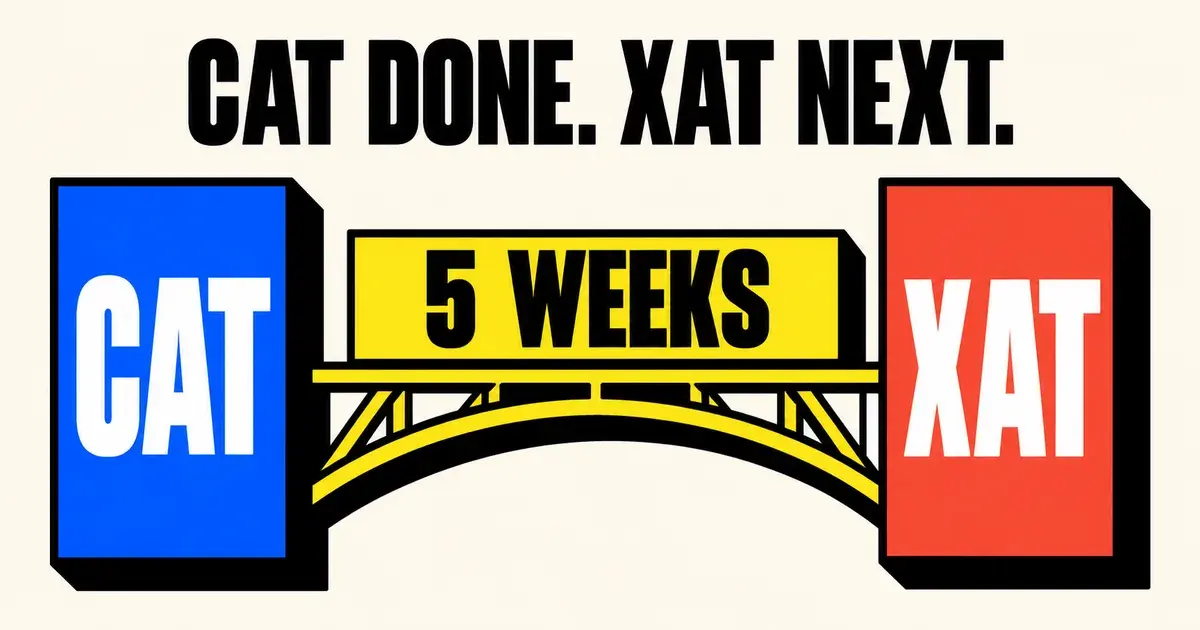
You finished CAT five weeks ago. Your quant is sharp, your reading is quick, and your first XAT mock still came back at 24 marks. You skipped 31 questions the way CAT taught you to, and XAT fined you for it.
XAT is a different paper with its own rules. It charges you for blanks, it has no sectional timer, and one of its three scored sections has no formulas at all. Students who treat it as "CAT with GK" land in the 80s. Students who learn its rules lift their score within a month.
Quick answer: To crack 99+ percentile in XAT, you need about 36 to 39 marks out of 75 in Part 1. That takes 47 to 55 attempts at around 85 percent accuracy, with no more than 8 questions left blank. Practise Decision Making daily, give each section about 55 minutes, and take 12 to 14 full mocks.
XAT at a glance
| Item | Detail |
|---|---|
| Full name | Xavier Aptitude Test |
| Conducted by | XLRI Jamshedpur |
| Usually held | First Sunday of January, in one session |
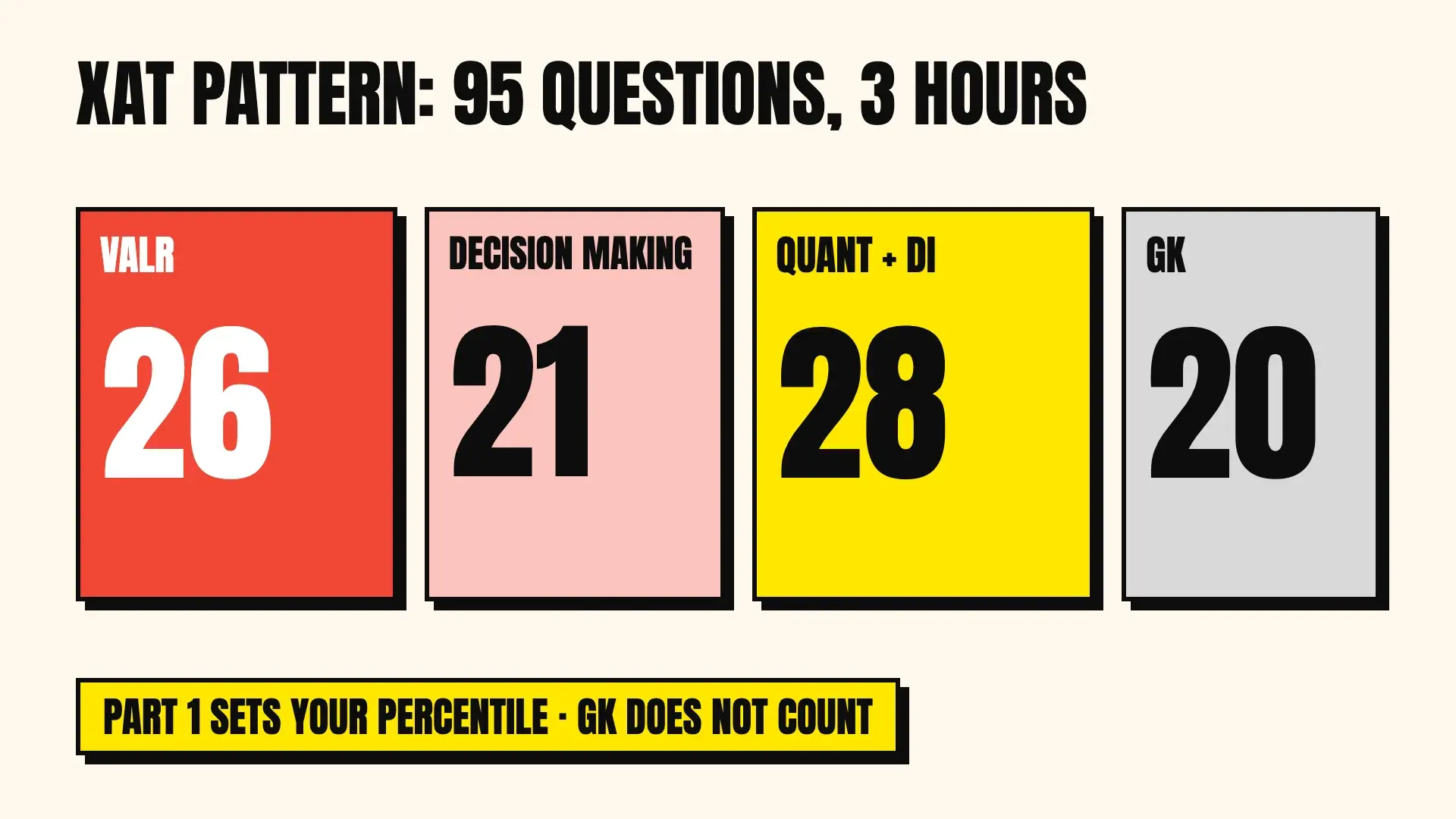
| Questions | About 95: 75 in Part 1 and 20 in General Knowledge |
| Scored sections | Verbal Ability and Logical Reasoning, Decision Making, Quantitative Ability and Data Interpretation |
| Time | 3 hours: about 170 minutes for Part 1, then about 10 minutes for GK |
| Marking | +1 correct, −0.25 wrong, −0.10 for each blank after the first 8 |
| Marks for 99 percentile | About 36 to 38.5 out of 75 in the latest paper |
| Accepted by | XLRI and more than 150 other colleges |
| Official site | xatonline.in |
What does a 99+ percentile in XAT mean?
At 99 percentile, you scored more than 99 out of every 100 people who took XAT. Since the whole country writes the same paper in one session, XLRI doesn't need to adjust scores between slots. Your raw marks in Part 1 set your percentile.
Two things make XAT's percentile different from CAT's.
- General Knowledge doesn't count. XLRI leaves GK marks out of the percentile. Schools may look at them later in the process.
- Each section has a cutoff. XLRI sets a minimum percentile for each of the three scored sections, by programme and by gender. A 99 overall with a weak Decision Making score can still miss the XLRI shortlist.
XAT exam pattern and marking scheme
| Part | Section | Questions | Time |
|---|---|---|---|
| Part 1 | Verbal Ability and Logical Reasoning (VALR) | 26 | About 170 minutes for all three, with no sectional limit |
| Part 1 | Decision Making (DM) | 21 | |
| Part 1 | Quantitative Ability and Data Interpretation (QA-DI) | 28 | |
| Part 2 | General Knowledge (GK) | 20 | About 10 minutes |
| Total | About 95 | 3 hours |
Question counts shift by a question or two between years. The latest papers had no essay in the test; XLRI asks for it at the interview stage.
Inside Part 1, you can move between the three sections as you like. Nobody stops you at 40 minutes. That freedom is the first trap, since one hard section can eat the time you owe the other two.
The marking has a rule you won't find in any other MBA exam.
| Your answer | Part 1 | GK |
|---|---|---|
| Correct | +1 | +1 |
| Wrong | −0.25 | 0 |
| Blank, first 8 questions | 0 | 0 |
| Blank, 9th question onward | −0.10 each | 0 |
The skip penalty: how it changes your attempts
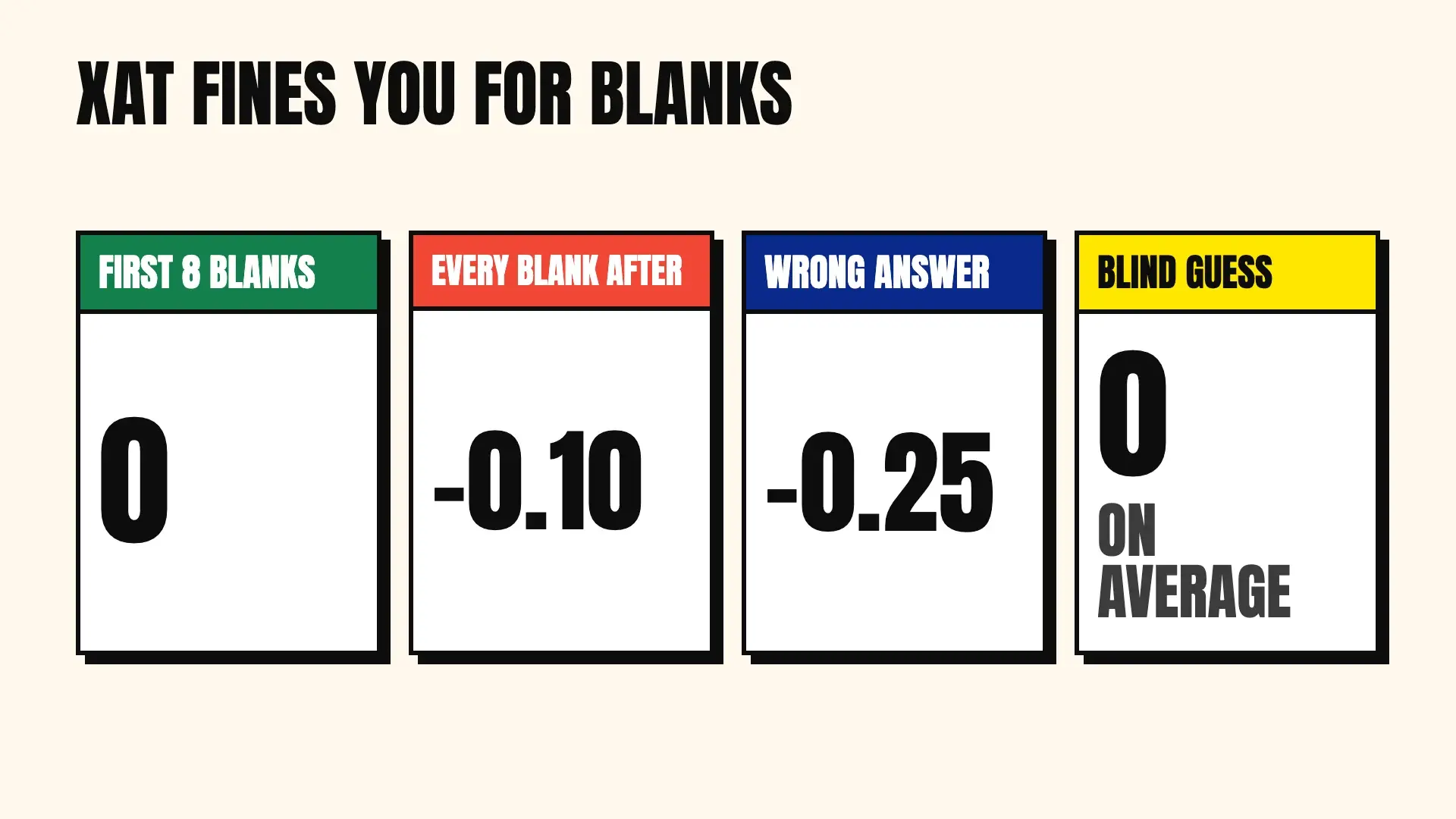
In CAT, a blank is free. In XAT, you get 8 free blanks in Part 1. Each blank after that costs 0.10 marks.
Say you leave 25 questions blank. The first 8 are free. The other 17 cost you 1.7 marks. In an exam where 2 marks can separate 97 percentile from 99, that hurts.
Now compare a blank with a guess. XAT gives five options.
| What you do with a question | Average result |
|---|---|
| Leave it blank (after your 8 free ones) | −0.10 |
| Guess blind among five options | 0 |
| Guess after cutting one option | +0.06 |
| Guess after cutting two options | +0.17 |
| Guess after cutting three options | +0.38 |
A blind guess averages zero: you win 1 mark one time in five and lose 0.25 the other four times. Zero beats −0.10. Cut even one option and the guess turns positive.
So your rule for Part 1 is short. Leave at most 8 questions blank, and pick those 8 with care: long geometry questions or caselets where you can't cut a single option. For the rest, eliminate and mark.
How many marks do you need for 99 percentile in XAT?
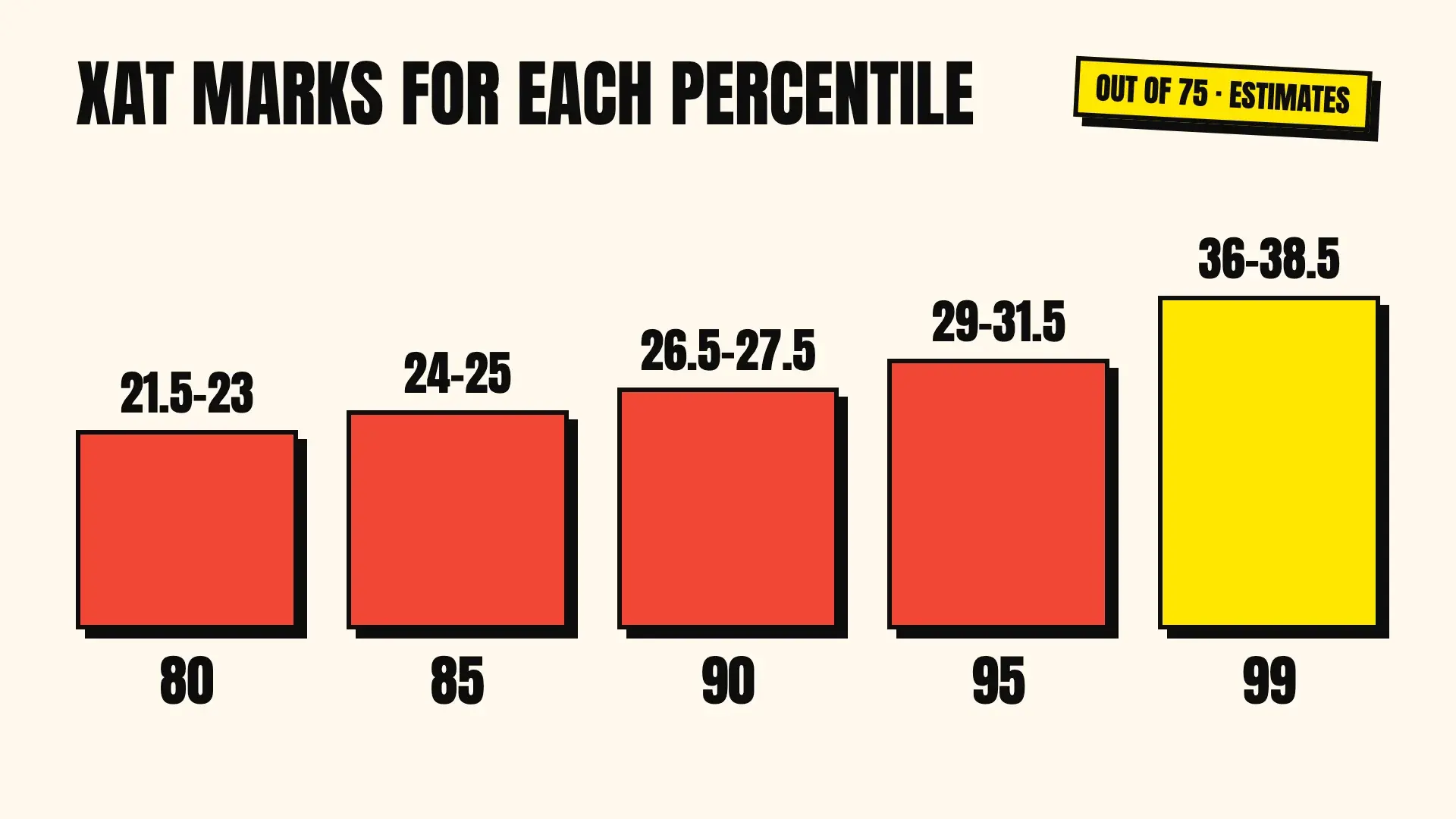
About 36 to 38.5 raw marks out of 75 earned a 99 percentile in the latest XAT. That is roughly half the paper.
| Percentile | Marks out of 75 in the latest XAT (2026) |
|---|---|
| 99.9 | 43 to 44.5 |
| 99 | 36 to 38.5 |
| 95 | 29 to 31.5 |
| 90 | 26.5 to 27.5 |
| 85 | 24 to 25 |
| 80 | 21.5 to 23 |
| 70 | 19 to 20 |
| 60 | 16.5 to 17.5 |
Estimates from IMS, Career Launcher and Cracku, checked against candidate scorecards compiled by MBAUniverse. XLRI doesn't publish a conversion table.
Some websites list XAT scores above 50 for the 99th percentile. Those tables use a 100-mark scale. Multiply a raw score out of 75 by 4/3 and you get the same figure, so 37.5 raw marks shows up as 50 on that scale.
The marks for a 99 swing with the paper: a tougher paper needs fewer marks and an easier one needs more. Set your mock target at 40 or more net marks so that a hard paper doesn't catch you short.
Enter your right, wrong and blank counts in the free XAT score calculator to see your marks with the skip penalty applied.
How many questions should you attempt in XAT for 99 percentile?
The table below runs the full XAT formula: 1 mark for each right answer, minus 0.25 for each wrong one, minus 0.10 for each blank beyond 8.
| Attempts (of 75) | Right | Wrong | Blank | Net score | Rough percentile |
|---|---|---|---|---|---|
| 55 | 47 | 8 | 20 | 43.8 | 99.9 |
| 50 | 42 | 8 | 25 | 38.3 | 99 |
| 46 | 38 | 8 | 29 | 33.9 | About 97 |
| 40 | 32 | 8 | 35 | 27.3 | About 90 |
| 36 | 28 | 8 | 39 | 22.9 | About 80 |
Look at the 50-attempt row. Forty-two right answers earn 42 marks. Eight wrong answers take away 2. Twenty-five blanks take away another 1.7. If that student had guessed the 17 paid blanks after cutting one option each, the average gain would be about 2.8 marks, which lifts the score to about 41.
A section-wise split that reaches 99 percentile:
| Section | Attempts | Accuracy | Net marks |
|---|---|---|---|
| VALR (26) | 16 to 19 | 80 to 85 percent | 12.5 to 14.5 |
| Decision Making (21) | 14 to 16 | 75 to 80 percent | 10.5 to 12.5 |
| QA-DI (28) | 17 to 20 | 85 to 90 percent | 14.5 to 16.5 |
| Part 1 (75) | 47 to 55 | About 85 percent | 38.5 to 43 |
Source: Crack XAT in 60 Days.
XAT syllabus: the topics that carry the most marks
XLRI publishes no syllabus. Recent papers point to these areas.
| Section | Topics to study first |
|---|---|
| Decision Making | Ethical dilemmas, HR and people cases, business decisions, stakeholder cases, ordering of actions, data-based cases |
| VALR | RC inference, RC main idea and tone, poems and unusual texts, critical reasoning, para jumbles and odd sentence |
| QA-DI | Geometry, arithmetic, algebra, DI sets, number system, with trigonometry basics, mensuration, probability and logs after those |
| GK | Current affairs of the last 6 to 8 months, economy and business, awards and sports, science and technology, static GK |
Two differences from CAT matter here. XAT quant leans harder on geometry: the latest paper had five or six geometry questions, some of them tough. And XAT verbal includes poems and dense critical reasoning, which CAT doesn't ask.
Section-wise strategy to score 99+ percentile in XAT
Decision Making: the section that decides XLRI calls
Decision Making gives you short cases about a manager, an employee or a business owner, and asks what that person should do. There is no formula sheet. There are rules, and you can learn them.
| Plan | Target |
|---|---|
| Time | 50 to 55 minutes |
| Attempts | 12 to 14 of 21 for a good score, 14 to 16 for 99 percentile |
| Accuracy | 75 to 80 percent or more |
Ten rules solve most DM questions.
- Find the role first. You answer as the person the case names, with that person's authority.
- Read the question stem. It tells you the lens: profit, ethics, convenience or urgency.
- Stay literal. Use the facts the case states. An allegation isn't proof.
- Decide. The role is the decision maker. Options that form a committee, ask the CEO or "wait and watch" are weak unless the facts are unclear.
- List the stakeholders. Staff, customers, investors and the public. A good answer holds up in front of all of them.
- Balance ethics with business. Ethical doesn't mean doing nothing. Avoid extremes such as firing everyone or forgiving everything.
- For ordering questions, find the best and the worst action first.
- For HR cases, follow a fair process: hear both sides, apply the same criteria to all.
- For data cases, calculate before you judge, and compare options on the same base.
- Eliminate. Cut illegal options, then options that don't solve the stated problem, then passive ones.
When two options remain, pick the one that helps more stakeholders. Do two caselets a day and review each wrong answer by asking which rule you broke. The XAT Decision Making guide works through full examples.
VALR: dense passages and close options
| Plan | Target |
|---|---|
| Time | 55 to 60 minutes |
| Attempts | 16 to 19 of 26 |
| Accuracy | 80 to 85 percent |
- XAT passages come from philosophy, economics and culture, and they read slower than CAT passages. Budget your time for that.
- Read a poem twice: once for the feeling, once for the meaning. Find the central image or contrast. Questions test theme.
- In critical reasoning, name the question type before you read the options: assumption, strengthen, weaken, inference or paradox.
- A wrong answer costs 0.25, so answer after you cut two options.
- If you read fast, start with the single verbal questions and keep the long RC for later.
Daily practice: two RC passages, five critical reasoning questions and five verbal questions.
QA-DI: pick your questions
| Plan | Target |
|---|---|
| Time | 55 to 60 minutes |
| Attempts | 17 to 20 of 28 |
| Accuracy | 85 to 90 percent |
- Scan all 28 questions first and mark the easy ones.
- Solve arithmetic, algebra and clean DI tables in the first pass.
- Leave long geometry figures and lengthy DI caselets for the second pass. Skip one after two minutes with no progress.
- Pick one or two DI sets with clean tables. Read the whole set before any question.
CAT preparation covers arithmetic and algebra. Add geometry, mensuration, trigonometry basics and a daily DI set for XAT. Daily practice: 25 quant questions and one DI set.
General Knowledge: 20 free attempts
GK has no negative marking and doesn't count toward your percentile. Attempt all 20 questions in the last 10 minutes. Twenty minutes of news a day and a weekly current affairs quiz cover it. Don't let GK take study time from the three scored sections.
How to split the three hours
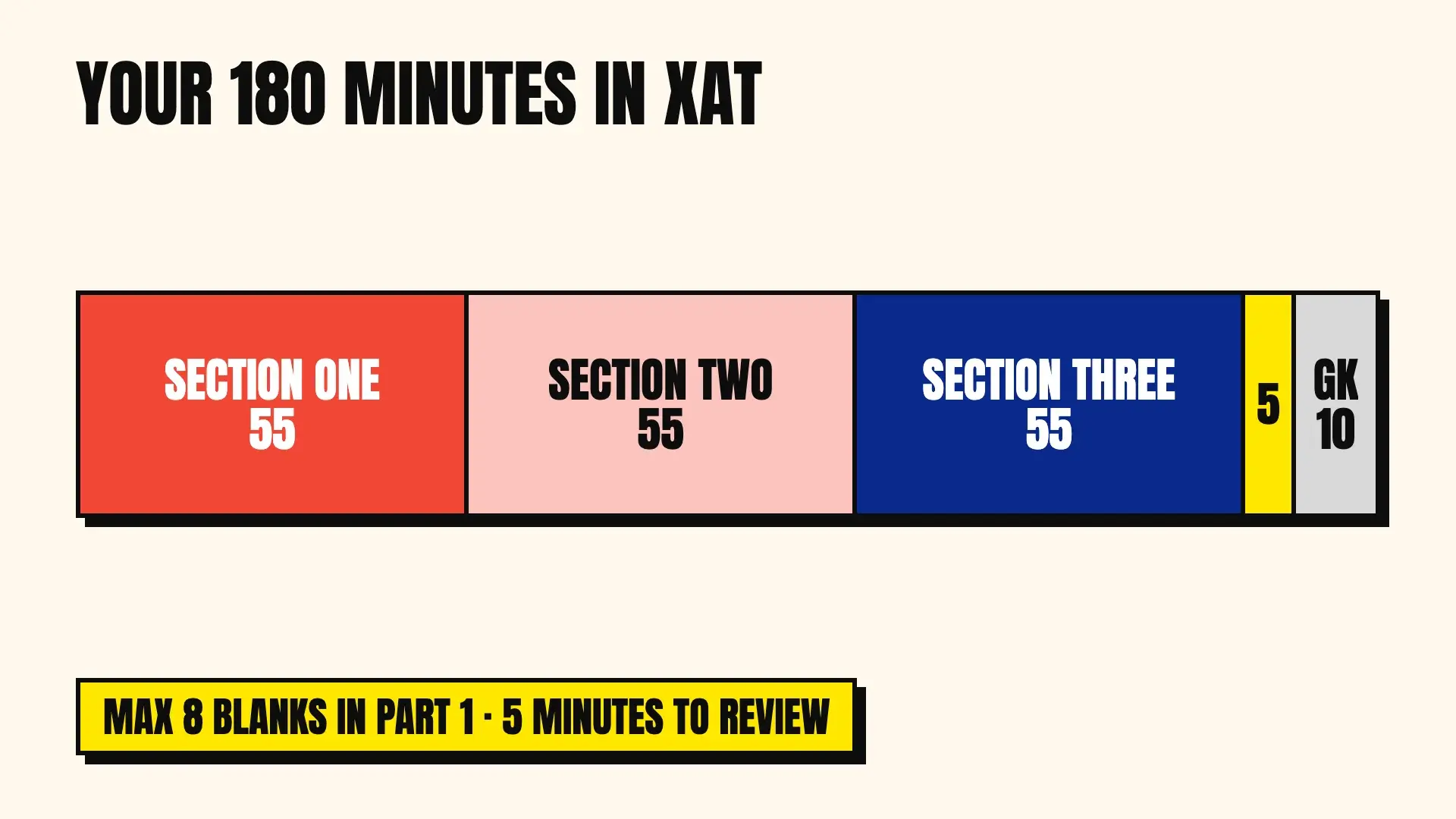
With no sectional timer, you need your own.
| Block | Minutes | Do this |
|---|---|---|
| Section one | 55 | Your chosen first section |
| Section two | 55 | Second section |
| Section three | 55 | Third section |
| Review | 5 | Count your blanks, mark answers for the extra ones |
| GK | 10 | Attempt all 20 |
Three section orders work. Test each in a mock and keep the one that gives you the best score.
| Order | Suits you if |
|---|---|
| DM, then VALR, then QA-DI | You want a fresh mind for Decision Making |
| QA-DI, then DM, then VALR | Quant is your strength |
| VALR, then DM, then QA-DI | You want to keep your reading flow |
Keep a running count of blanks. When the count passes 8, start eliminating and marking.
How long does it take to prepare for XAT?
| Your situation | Time needed | Focus |
|---|---|---|
| You prepared for CAT | The 5 weeks between CAT and XAT, plus two DM caselets a day before CAT | Decision Making, geometry, DI, GK and the skip strategy |
| You start fresh, with good basics | About 60 days at 5 to 7 hours a day | All three sections, with DM daily from day one |
| You start fresh as a beginner | 4 to 6 months at 2 to 4 hours a day | Arithmetic, algebra and reading first, then XAT-specific work |
Most XAT takers also write CAT. If that is you, keep XAT light until CAT ends: two DM caselets a day and nothing else. The day after CAT, switch fully. The XAT after CAT guide has a week-by-week plan for those five weeks, and CAT vs XAT shows how much of your preparation carries over.
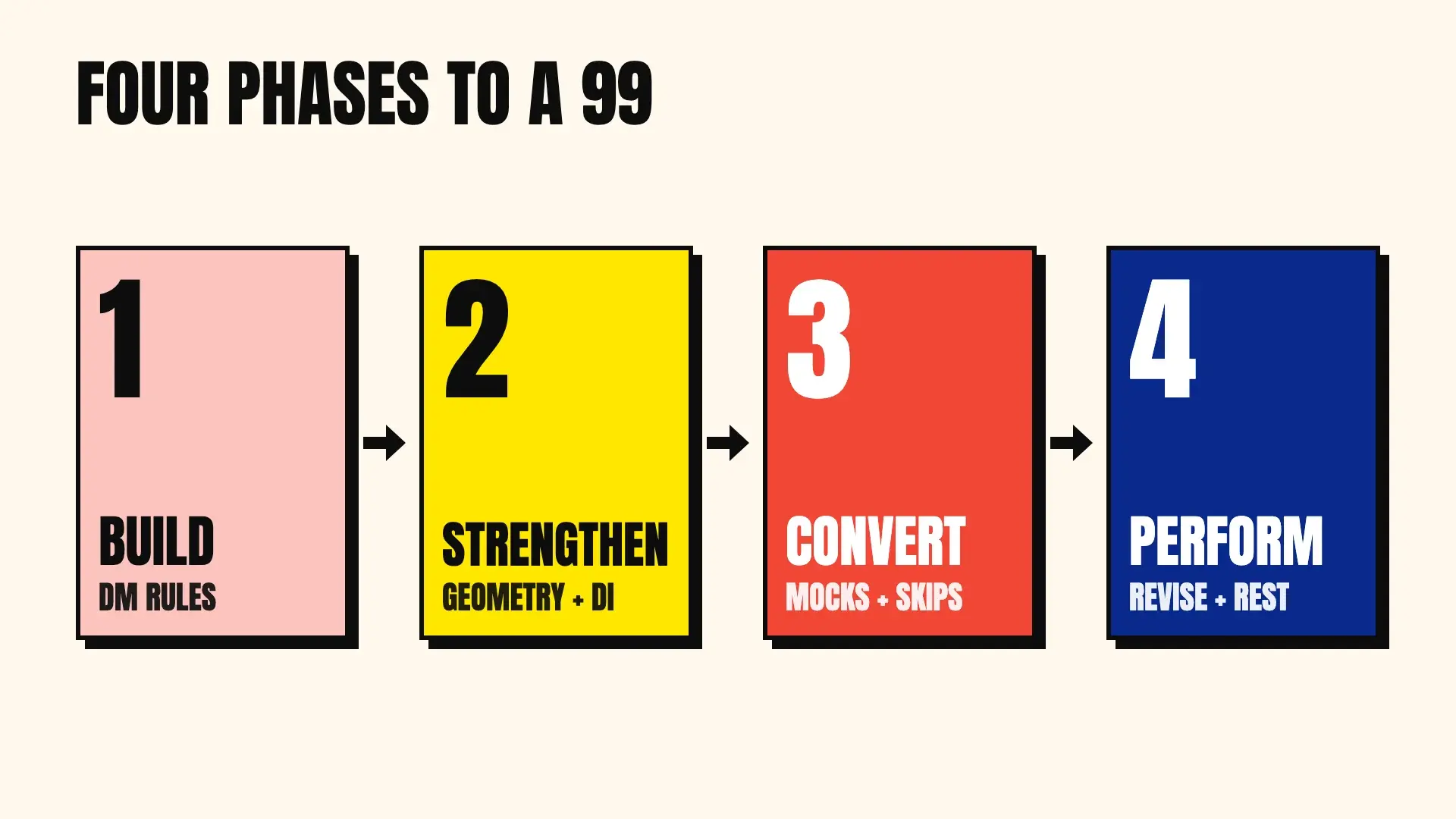
A four-phase study plan for XAT
| Phase | Goal | Main work | Mocks |
|---|---|---|---|
| 1. Build | Learn the DM rules and fix basics | DM rules one by one, arithmetic, one RC a day | A diagnostic mock, then two more |
| 2. Strengthen | Add XAT-only topics | Geometry, trigonometry, critical reasoning, DI sets, a GK routine | One every five days |
| 3. Convert | Fix your section order and skip count | Mock, analysis, DM error review | One every three days |
| 4. Perform | Peak on exam day | Three-hour mocks at the exam's afternoon time, revision | Two in the last week |
A day for a full-time student:
| Time | Task |
|---|---|
| 7 to 9 am | Quant: one concept and 25 questions |
| 9:30 to 10:30 am | Decision Making: two caselets and a review |
| 11 am to 12:30 pm | VALR: two RCs, critical reasoning, verbal questions |
| 2 to 3 pm | One DI set and geometry |
| 5 to 5:30 pm | GK news |
| 8 to 9 pm | Error log and revision |
How many mocks should you take for XAT?
Take 12 to 14 full mocks of three hours each, plus the last two official XAT papers under a timer. XAT is held in the afternoon, so sit your mocks at the same hour.
After each mock, fill in these lines.
| Item | Note it for each mock |
|---|---|
| Total and section scores | VALR, DM, QA-DI |
| Attempts in each section | |
| Wrong answers | Each costs 0.25 |
| Blanks beyond 8 | Each costs 0.10 |
| DM mistakes | Which rule did you break? |
| Time in each section | Did one section run over 55 minutes? |
| GK score | |
| Next three actions |
A mock takes three hours and its analysis takes two to three more. Keep the day after a mock light.
Top colleges you can target with a high XAT percentile
| Rank | College | City | Approximate cutoff percentile |
|---|---|---|---|
| 1 | XLRI Jamshedpur | Jamshedpur | 95 to 96+ |
| 2 | XIM University | Bhubaneswar | 94+ |
| 3 | SPJIMR | Mumbai | 90+, profile-based |
| 4 | Great Lakes | Chennai | 92+ |
| 5 | MICA | Ahmedabad | 90+ |
| 6 | IMT Ghaziabad | Ghaziabad | 90+ |
| 7 | IMI New Delhi | New Delhi | 88+ |
| 8 | GIM Goa | Goa | 88+ |
| 9 | IRMA | Anand | 87+ |
| 10 | TAPMI or K J Somaiya | Manipal, Mumbai | 85+ |
Approximate shortlist percentiles from the latest cycle, as listed in Crack XAT in 60 Days. Each school needs a separate application.
How XLRI shortlists candidates
- XAT cutoffs. XLRI sets an overall cutoff and a cutoff for each section. The numbers differ by programme, gender and academic background. Male engineers face the highest bar, so aim for 97 or more if that is you.
- Interview stage. Shortlisted candidates write an essay and sit a personal interview.
- Final list. XLRI combines your XAT score, interview, academics and work experience.
A 99 percentile clears the overall cutoff with room to spare. Your work is to make sure no single section falls below its own line. A strong XAT score opens the door, and the interview decides the result.
Seven mistakes that keep you below 99
| # | Mistake | Fix |
|---|---|---|
| 1 | Spending too long in one section | Set 55-minute checkpoints |
| 2 | Leaving 20 or more questions blank in Part 1 | Keep blanks to 8 and guess the rest after eliminating |
| 3 | Answering DM by emotion | Role, stem, rules |
| 4 | Ignoring sectional cutoffs | Leave no section weak |
| 5 | Treating XAT quant as CAT quant | Add geometry, trigonometry and DI sets |
| 6 | Skipping GK | Attempt all 20, since nothing is deducted |
| 7 | Starting DM after CAT | Do two caselets a day from the start |
Frequently asked questions
How many marks are required for 99 percentile in XAT?
About 36 to 38.5 raw marks out of 75 in Part 1 earned a 99 percentile in the latest XAT. The figure changes with the paper, and tough papers have needed fewer marks. Aim for 40 or more net marks in mocks to stay safe.
How many questions should I attempt in XAT for 99 percentile?
Plan for 47 to 55 attempts out of 75 at about 85 percent accuracy. Fifty attempts with 42 right, 8 wrong and 25 blank gives about 38.3 marks after the skip penalty. Guessing the extra blanks after cutting an option raises that further.
Is there a penalty for unattempted questions in XAT?
Yes. The first 8 unattempted questions in Part 1 cost nothing. Each unattempted question after that costs 0.10 marks. General Knowledge has no penalty of any kind.
Does General Knowledge count in the XAT percentile?
No. XLRI calculates the percentile from Part 1 alone: Verbal Ability and Logical Reasoning, Decision Making, and Quantitative Ability and Data Interpretation. Some schools consider GK marks at later stages, so attempt all 20 questions.
Is XAT tougher than CAT?
XAT quant is tougher and longer, and Decision Making has no equivalent in CAT. CAT has harder DILR sets and strict 40-minute sectional timers. Students who prepare for CAT cover most of XAT and need about five weeks for Decision Making, geometry, GK and the skip strategy.
Can I prepare for XAT in one month after CAT?
Yes. Five weeks separate CAT and XAT in a typical year. Use them for two to four DM caselets a day, geometry and DI, GK revision and seven or eight full mocks at the exam's afternoon time. Start DM caselets before CAT so you don't begin from zero.
How do I prepare for Decision Making in XAT?
Learn the rules: answer as the role in the case, use only stated facts, make a decision instead of deferring it, weigh every stakeholder and eliminate illegal or passive options. Solve two caselets a day from past XAT papers and write down the rule behind each mistake.
What is the XAT cutoff for XLRI?
XLRI's overall cutoff for Business Management has been about 95 to 96 percentile for the highest-cutoff group in the latest cycle, with lower figures for some groups. XLRI also sets a cutoff for each section. Check the cutoffs XLRI publishes on its admissions page for your programme.
Which colleges accept XAT scores?
XLRI Jamshedpur and XLRI Delhi need XAT. XIM University, SPJIMR, Great Lakes, MICA, IMT Ghaziabad, IMI New Delhi, GIM Goa, IRMA, TAPMI and K J Somaiya accept it too, along with more than 150 other colleges.
How many mocks should I take for XAT?
Twelve to fourteen full mocks are enough, along with the last two official XAT papers solved under a timer. Take each mock at the same afternoon hour as the exam, and count your blanks in Part 1 in each one.
Sources
- Pattern, marking scheme and schedule: xatonline.in (official)
- Score vs percentile estimates: MBAUniverse and the Cracku XAT score calculator
- Attempt targets, Decision Making rules, section plans, colleges and the four-phase plan: Crack XAT in 60 Days by The 99 Percentiler
Related reading: XAT Decision Making strategy · XAT preparation after CAT · CAT vs XAT · How to crack 99+ percentile in CAT · How to crack 99+ percentile in MBA entrance exams · Free MBA exam calendar
The XAT playbook has the Decision Making chapters, the full percentile tables, the 60-day calendar and a mock tracker you can print.