
You read the caselet twice. A factory manager has to decide what to do about a worker who broke a safety rule but saved a machine from fire. All five options sound reasonable. Two sound very reasonable. You pick one, check the answer later, and you're wrong again. It feels like the examiner is reading a different case from the one you read.
XAT Decision Making is learnable. The questions follow patterns, and the right answer usually comes from a few rules: read what your role is, answer exactly what the question asks, use only the facts in the case, and pick the option that solves the problem fairly within your authority. Once you apply those rules on every caselet, your DM accuracy stops being a coin toss.
Quick answer: To solve XAT Decision Making questions, first find your role in the case and what the question stem asks (profit, ethics, urgency or fairness). List everyone affected. Cut illegal, passive and extreme options. From what's left, choose the option that fixes the stated problem, treats stakeholders fairly and stays within your role's authority.
What is XAT Decision Making?
Decision Making (DM) is the section that makes XAT different from CAT. It gives you short business and ethical situations, called caselets, and asks what the person in the case should do, or which option is the best or worst choice.
| DM fact | Value (XAT 2026) |
|---|---|
| Questions | About 21 to 22 |
| Options per question | 5 |
| Wrong answer | −0.25 |
| Skipping | No penalty for the first 8 skips in Part 1; −0.10 for each skip after that |
| Good attempts | About 12 to 14, at 75 to 80 percent accuracy |
| Score for about 99 percentile in DM | About 14 to 15 net marks |
Sources: xatonline.in (marking rules); Crack XAT in 60 Days (question count, good attempts and sectional targets, estimates).
XLRI also uses sectional cutoffs. A weak DM score can block an XLRI call even when your overall percentile is high, so you can't skip this section and hope Quant carries you.
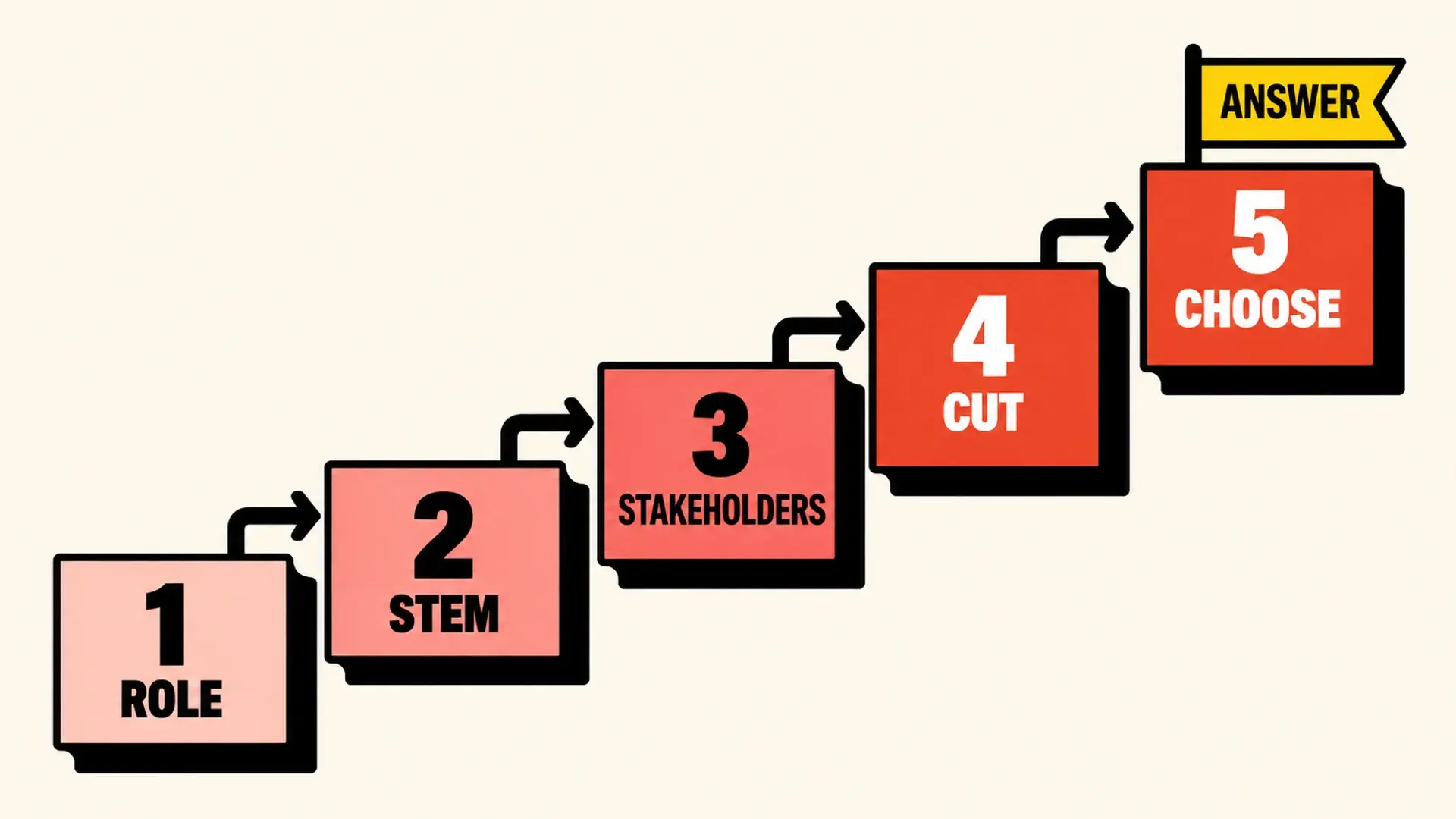
The five-step method
Use these five steps on every caselet until they feel automatic.
Step 1: Find your role
The first thing to look for is who you are in the case. A branch manager, an HR head, a CEO, a government officer, a student. Your role sets your authority. A branch manager can't change company policy. A CEO can.
Step 2: Read the stem for its lens
The question stem tells you how to judge the options. Students lose marks when they answer with the wrong lens.
| The stem asks about | The best option... |
|---|---|
| Profitability | Raises revenue or cuts cost, legally |
| Ethics or fairness | Is honest, follows the rules, treats people fairly |
| Urgency | Acts now, with a longer-term fix after |
| Convenience | Works for the most people with the least disruption |
| Legal or conviction | Follows proven facts, not allegations |
Step 3: List the stakeholders
Write down everyone the decision affects: employees, customers, shareholders, the public, the regulator. Then ask a simple question about each option: could you defend it at a press conference? A decision that makes sense on paper and looks terrible in public is still a weak option.
Step 4: Cut options in this order
- Illegal or clearly unethical options.
- Options that don't solve the problem the case describes.
- Passive options (wait and watch, form a committee for six months, ask the boss) when you have enough facts to decide.
- Extreme options (fire everyone, shut down the plant, forgive everything).
Step 5: Choose between the last two
When two options survive, pick the one that fixes the immediate problem and the system that caused it, within your authority. If they still tie, pick the one that helps more stakeholders.
Worked example 1: an ethics and people case
You are the branch manager of a mid-sized bank. Ravi, your best loan officer, approved three loans without doing the mandatory income check. All three borrowers are repaying on time. The internal audit team has flagged the lapse to you. What should you do?
- A. Ignore the audit note, since the loans are performing well.
- B. Dismiss Ravi immediately and announce it to all staff as a warning.
- C. Issue Ravi a formal warning as per policy, get the three files re-verified, and remind the whole team that the income check is mandatory.
- D. Set up a committee to study whether the income check is needed, and decide in six months.
- E. Ask Ravi to resign quietly so the branch avoids a bad audit record.
Working it through. Your role is branch manager, so you enforce policy but don't rewrite it. The stem asks what you should do, so fairness and rule-following lead. A ignores a broken rule. E hides the problem, which is dishonest. D delays a decision you have enough facts to make, and questioning the policy isn't your call. B is extreme for a first lapse with no loss. C applies the rule, fixes the three files and prevents a repeat.
Answer: C.
Worked example 2: a data-based case
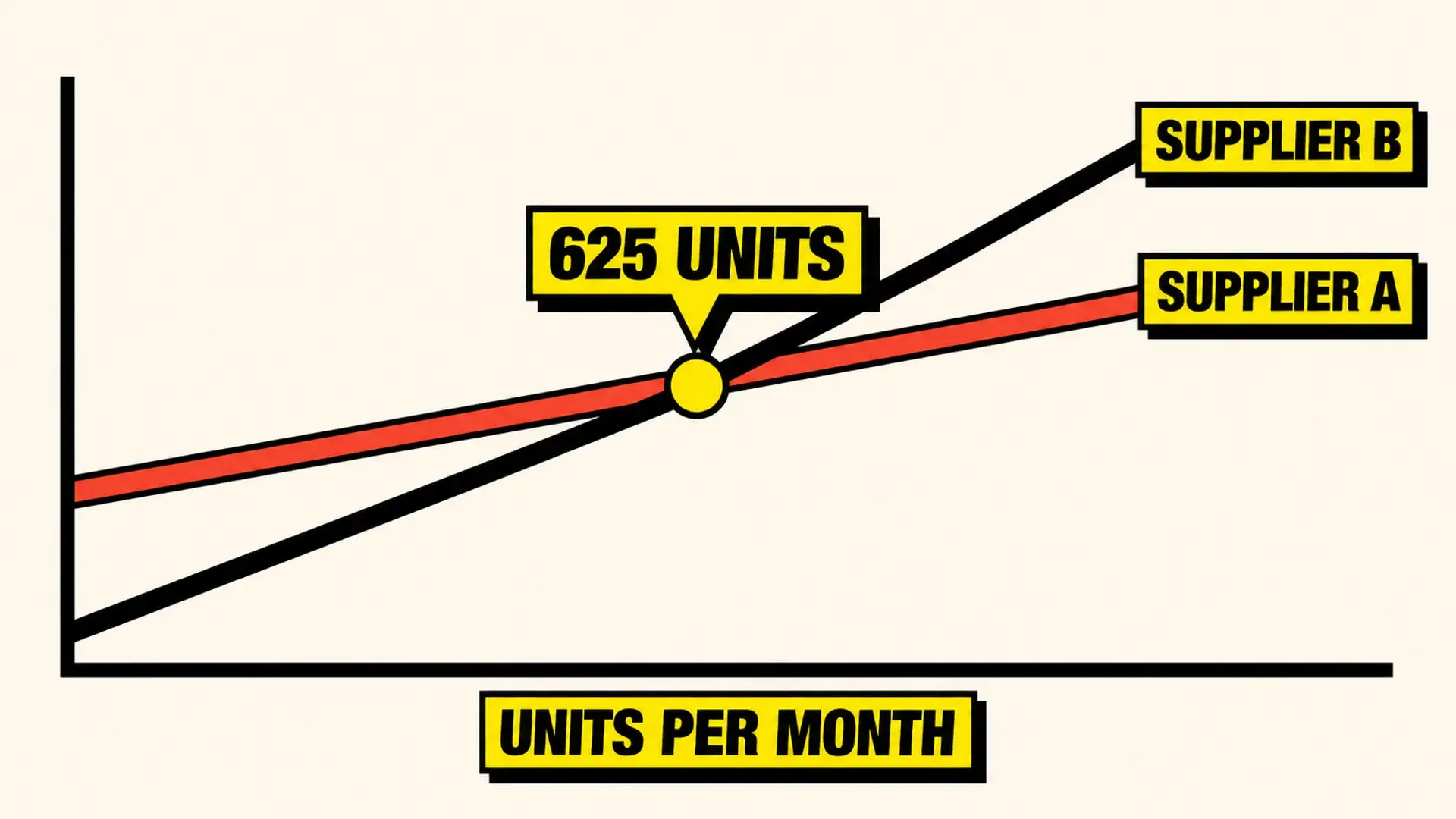
You run operations for a small packaging firm. Supplier A charges ₹50,000 a month plus ₹20 per unit. Supplier B charges ₹25,000 a month plus ₹60 per unit. Your monthly demand is about 900 units. Which supplier should you choose on cost?
When numbers are given, calculate before you decide. Find the break-even point:
50,000 + 20x = 25,000 + 60x 25,000 = 40x x = 625 units
Above 625 units a month, Supplier A is cheaper. At 900 units:
- Supplier A: 50,000 + (20 × 900) = ₹68,000
- Supplier B: 25,000 + (60 × 900) = ₹79,000
Answer: Supplier A. XAT gives you an on-screen scientific calculator, so use it for the arithmetic.
The DM traps that cost the most marks
| Trap | What happens | Fix |
|---|---|---|
| Answering as yourself | You pick what you would do, not what the role should do | Re-read the role before choosing |
| Wrong lens | The stem asks for the most profitable option and you pick the most ethical one | Underline the stem's key word |
| Adding facts | "Maybe the rule is unfair" or "maybe he had a reason" | Use only what the case states |
| Choosing the nicest option | The kind option ignores the real problem | Check that the option solves the stated issue |
| Deferring | "Consult everyone" when the facts are clear | The role is the decision maker. Decide. |
Common case types and the usual right approach
| Situation | Usually right |
|---|---|
| Harassment complaint | Formal committee process, protect the complainant |
| Poor performer | Feedback and a clear plan, then action if nothing changes |
| Favouritism complaint | Check the facts, use transparent criteria |
| Layoffs | Fair criteria, notice and support |
| Conflict in a team | Talk to both sides, then fix the process |
| Product safety issue | Act on safety first, then investigate and fix the cause |
Treat these as starting points. The specific facts in each caselet can change the answer.
How long should you spend on Decision Making?
Part 1 of XAT (Verbal and Logical Ability, Decision Making, and Quant with DI) has no sectional time limits, so you set your own split. A common plan is about 50 to 55 minutes for DM.
- Read each caselet once, slowly. Rereading costs more time than careful first reading.
- Start with caselets that carry three questions. One reading, three answers.
- Leave the longest ethics cases for your second pass.
- Track your skips. Up to 8 skips in Part 1 are free. After that, each skip costs 0.10, so a question where you can cut one option is worth a guess.
How to practise DM in 30 to 60 days
- Solve two caselets every day, and review every wrong answer against the five steps.
- Keep a DM rule log. When you get one wrong, write which rule you broke.
- Solve past XAT papers. They show you how XLRI frames its "best" options, and nothing else does that as well.
- Take full XAT mocks at the real exam time, in the afternoon, and test which section order gives you the freshest mind for DM.
If you are also writing CAT, two DM caselets a day before CAT keeps the skill alive, and full XAT mode can start after CAT. The XAT after CAT guide covers that switch.
Frequently asked questions
How many questions should I attempt in XAT Decision Making?
Aim for about 12 to 14 of the roughly 21 DM questions, at 75 to 80 percent accuracy. That range put students near the top percentiles in DM in XAT 2026. Accuracy matters because each wrong answer costs 0.25.
Is there a shortcut for XAT DM questions?
There is no shortcut, but there is a method. Find your role, read the stem's lens, list stakeholders and cut illegal, passive and extreme options. This removes two or three options quickly on most caselets.
Should the answer in XAT DM be the most ethical option?
Only when the question asks about ethics or fairness. If the stem asks for the most profitable or the most practical option, judge by that lens, while still avoiding anything illegal or clearly dishonest.
How do I prepare for XAT Decision Making in one month?
Solve two caselets a day, review every wrong answer against a fixed method, and solve as many past XAT DM questions as you can. Take three or four full XAT mocks and keep a log of the rules you break.
Does Decision Making affect XLRI shortlisting?
Yes. XLRI uses overall and sectional percentile cutoffs, so a weak DM percentile can block a call even with a high overall score. Check XLRI's admission policy for the current cycle.
Sources
- XAT marking scheme, skip penalty and calculator: xatonline.in (official)
- DM question count, good attempts, sectional targets and DM rules: Crack XAT in 60 Days by The 99 Percentiler
- Caselets in this article: written by The 99 Percentiler for practice, not taken from XAT papers
Related reading: CAT vs XAT · CAT is over, XAT is next · MBA entrance exams compared · Free MBA exam calendar 2026–27 · How to crack 99+ percentile in XAT
All ten DM rules with examples, plus a DM log template, are in the XAT playbook.