
Your quant is ready. Your reasoning is ready. You sit a CMAT mock and score 62 out of 80 in each. Then you reach General Awareness, guess your way through 18 questions, and finish the section with fewer marks than you started it with.
CMAT has five sections, and two of them have nothing to do with maths or logic. General Awareness and Innovation and Entrepreneurship carry 160 of the 400 marks. Most students give them the last week. The students who reach 99 percentile give them 45 minutes a day from the start, and they don't guess blind.
Quick answer: To crack 99+ percentile in CMAT, you need about 258 to 265 marks out of 400, which is around 76 attempts with 68 right. Give General Awareness and Innovation and Entrepreneurship 45 minutes a day, keep your accuracy near 90 percent, guess only after cutting one option, and take 12 to 14 full mocks.
CMAT at a glance
| Item | Detail |
|---|---|
| Full name | Common Management Admission Test |
| Conducted by | National Testing Agency (NTA) |
| Usually held | Late January or early February |
| Questions | 100, with four options each |
| Sections | Quantitative Techniques and DI, Logical Reasoning, Language Comprehension, General Awareness, Innovation and Entrepreneurship |
| Time | 180 minutes, with no sectional limit |
| Marking | +4 for a correct answer, −1 for a wrong one |
| Maximum marks | 400 |
| Marks for 99 percentile | About 258 to 265 in the latest paper |
| Accepted by | More than a thousand AICTE-approved institutes, including JBIMS, SIMSREE and PUMBA for all-India seats |
| Official site | cmat.nta.nic.in |
What does a 99+ percentile in CMAT mean?
At 99 percentile, you scored more than 99 out of every 100 CMAT candidates. NTA reports a percentile score for each candidate, and colleges shortlist on it.
In CMAT, the decimals after 99 decide your college. The three government colleges at the top of the list admit through the Maharashtra CAP, and their all-India seats close above 99 percentile:
- JBIMS Mumbai at about 99.9 or higher.
- SIMSREE Mumbai at about 99.7 or higher.
- PUMBA Pune at about 99 or higher.
So if JBIMS is your goal, "99 percentile" is the starting line. You need the marks for 99.5 and above.
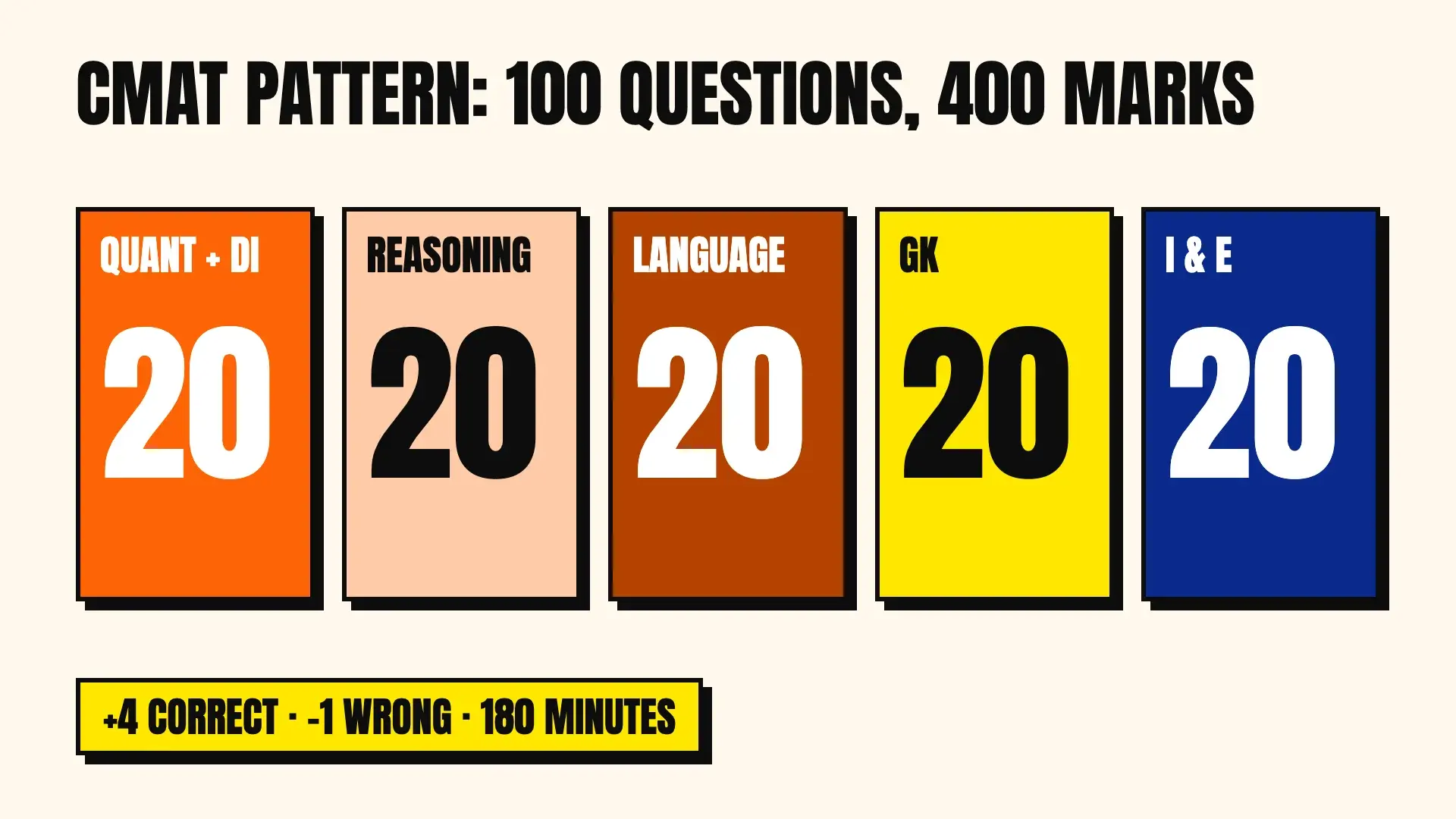
CMAT exam pattern and marking scheme
| Section | Questions | Marks |
|---|---|---|
| Quantitative Techniques and Data Interpretation | 20 | 80 |
| Logical Reasoning | 20 | 80 |
| Language Comprehension | 20 | 80 |
| General Awareness | 20 | 80 |
| Innovation and Entrepreneurship | 20 | 80 |
| Total | 100 | 400 |
You get three hours for 100 questions, which is 108 seconds for each. No section has its own timer, so you can attempt them in any order.
| Your answer | Marks |
|---|---|
| Correct | +4 |
| Wrong | −1 |
| Not attempted | 0 |
Compare that with SNAP's 60 seconds or MBA CET's 45 seconds for each question. CMAT gives you time. It rewards the student who uses that time to get questions right, which makes it an accuracy paper more than a speed paper.
How many marks do you need for 99 percentile in CMAT?
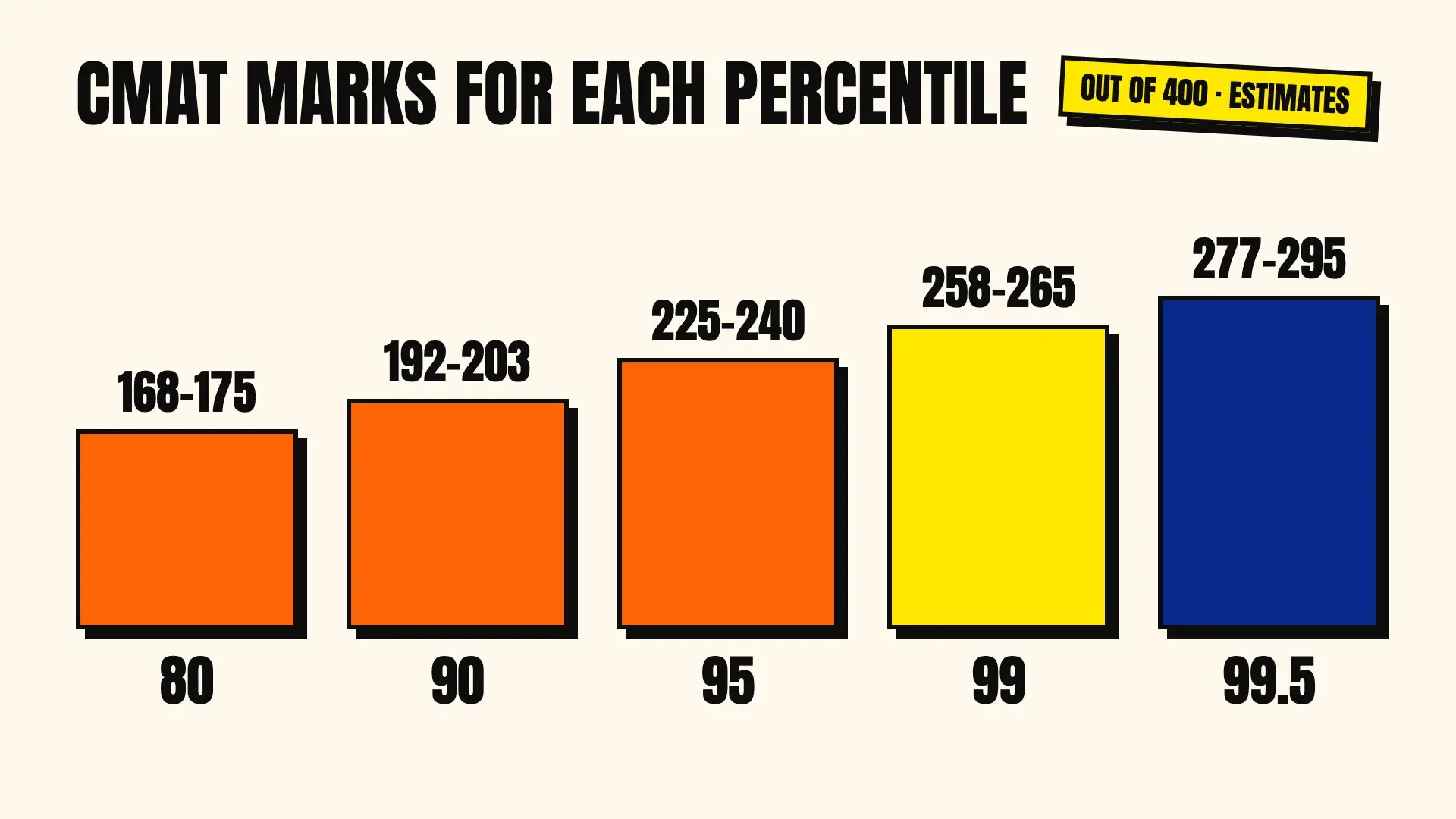
About 258 to 265 marks out of 400 earned a 99 percentile in the latest CMAT.
| Percentile | Marks in the latest CMAT (2026) | Marks the year before (2025) |
|---|---|---|
| 99.5 | 277 to 295 | About 300 |
| 99 | 258 to 265 | About 270 |
| 95 | 225 to 240 | About 245 |
| 90 | 192 to 203 | About 205 |
| 80 | 168 to 175 | About 180 |
Estimates compiled from MBAUniverse and Cracku. NTA doesn't publish a conversion table.
The latest paper scored lower than the one before it, so fewer marks earned each percentile. Across the two cycles, the marks for a 99 have ranged from about 258 to 270. Set your mock target at 280 or more, and at 300 if JBIMS is the goal.
Enter your right and wrong answers in the free CMAT score calculator to see where a mock score stands against both years.
How many questions should you attempt in CMAT for 99 percentile?
Score = (4 × right answers) − wrong answers.
| Attempts | Right | Wrong | Score | Rough percentile |
|---|---|---|---|---|
| 85 | 75 | 10 | 290 | 99.5 or more |
| 80 | 72 | 8 | 280 | About 99.5 |
| 76 | 68 | 8 | 264 | 99 |
| 70 | 63 | 7 | 245 | About 97 |
| 64 | 58 | 6 | 226 | 95 |
| 58 | 52 | 6 | 202 | 90 |
Source: Crack CMAT in 60 Days, read against the latest CMAT estimates.
You can leave 24 questions and still reach 99 percentile, as long as you get 68 of the other 76 right. That is 89 percent accuracy.
One way to reach 264:
| Section | Attempt | Right |
|---|---|---|
| Quantitative Techniques and DI | 16 | 14 |
| Logical Reasoning | 16 | 14 |
| Language Comprehension | 16 | 15 |
| General Awareness | 12 | 10 |
| Innovation and Entrepreneurship | 16 | 15 |
| Total | 76 | 68 |
Notice the General Awareness row. You attempt 12 of 20 and skip the 8 you don't know. That restraint is where CMAT ranks are made.
Attempts or accuracy: which matters more in CMAT?
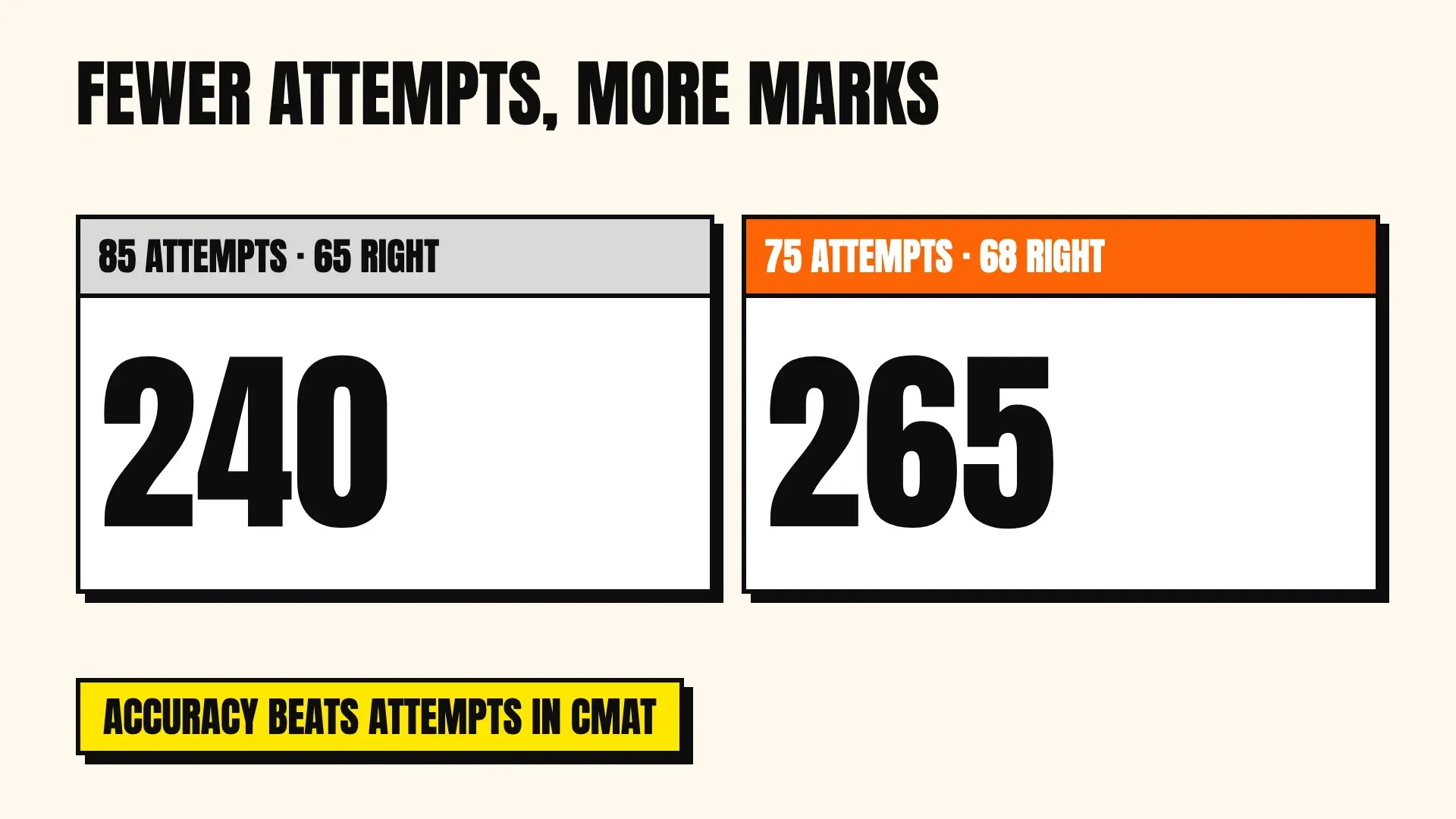
Accuracy, by a wide margin. Compare two students.
| Student | Attempts | Right | Wrong | Score |
|---|---|---|---|---|
| A | 85 | 65 | 20 | 240 |
| B | 75 | 68 | 7 | 265 |
Student B attempted ten fewer questions and scored 25 marks more. That is the difference between about 95 percentile and 99.
When should you guess in CMAT?
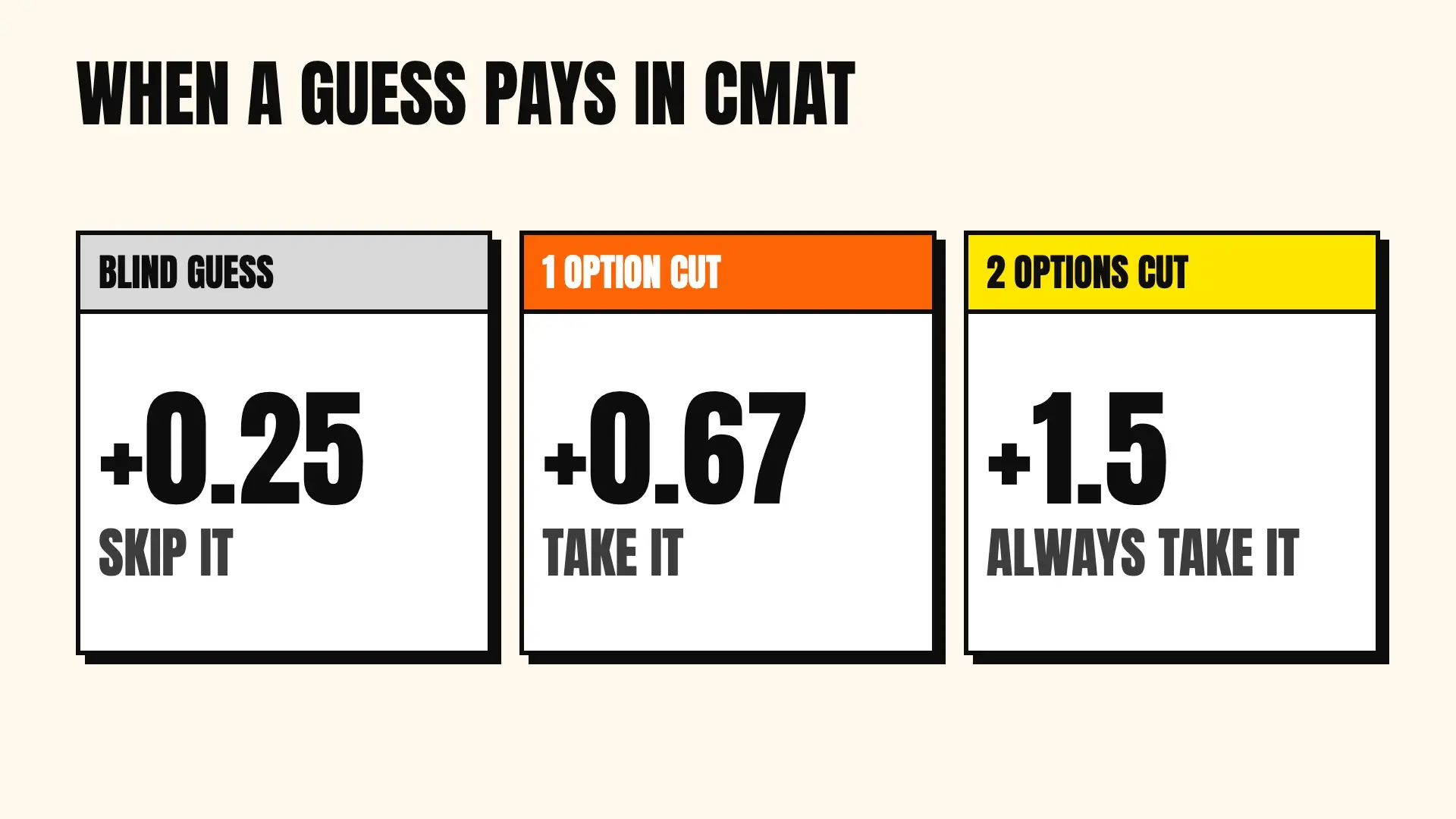
With +4, −1 and four options, a guess pays more than most students expect.
| Situation | Average marks for each guess |
|---|---|
| Blind guess among four options | +0.25 |
| Guess after cutting one option | +0.67 |
| Guess after cutting two options | +1.5 |
A blind guess averages a quarter mark, which isn't worth the damage a run of wrong answers does to your nerve. Cut one option and the guess becomes worth taking. Cut two and you should take it each time. The rule: no blind guesses, and mark an answer whenever you can eliminate.
CMAT syllabus: the topics that carry the most marks
| Section | Topics to study first |
|---|---|
| Quantitative Techniques and DI | Percentages and profit, ratio, averages and mixtures, interest, time and work, time, speed and distance, number system, algebra, geometry and mensuration, probability, tables, bar and pie charts |
| Logical Reasoning | Coding and decoding, blood relations, direction sense, series, seating arrangement, syllogisms, statements and assumptions, ranking, analogies, clocks and calendars |
| Language Comprehension | Reading comprehension, synonyms and antonyms, fill in the blanks, error spotting, sentence improvement, para jumbles, idioms, one-word substitution |
| General Awareness | Static GK, economy and business, polity and history, awards, sports and books, current affairs |
| Innovation and Entrepreneurship | Startup terms, funding stages, business models, intellectual property basics, government schemes, well-known thinkers and founders |
What recent papers show:
- Quant: arithmetic gave 7 to 9 of the 20 questions, about 40 percent of the section. DI gave 3 to 5.
- Reasoning: traditional question types, with few long puzzles.
- Language: grammar and vocabulary questions outnumbered reading comprehension by a wide margin.
- General Awareness: static GK made up most of the section, more than current affairs. This section ran tougher than the others.
- Innovation and Entrepreneurship: definitions, funding stages, business models and short caselets.
Section-wise strategy to score 99+ percentile in CMAT
General Awareness: know it or leave it
GA is the one section where thinking longer doesn't help. You know the answer in ten seconds or you don't.
- Give 45 minutes a day to a newspaper and a static GK book from your first week.
- Static GK carries more questions than current affairs, so don't stop at the news.
- In the exam, attempt 10 to 12 questions you are sure of. Skip the rest unless you can cut an option.
- The whole section should take about 12 minutes.
A half-known fact costs you a mark each time it is wrong. Ten right and two wrong gives 38 marks in 12 minutes, which is a fine return.
Innovation and Entrepreneurship: the easiest 60 marks in the paper
NTA added this section a few years ago, and many students still don't prepare for it. Its questions are factual and the pool of topics is small.
Build one sheet of notes with five headings:
- Startup terms: bootstrapping, burn rate, runway, pivot, unicorn, minimum viable product.
- Funding stages: pre-seed, seed, Series A and beyond, IPO, and who invests at each stage.
- Business models: subscription, marketplace, freemium, franchise, direct to consumer.
- Intellectual property: a patent protects an invention, a copyright protects a creative work, a trademark protects a brand name or logo.
- Schemes and people: major government startup schemes and the founders of well-known Indian companies.
Six pages of notes, revised weekly, can bring 15 right answers out of 20. Give the section about 18 minutes in the exam.
Language Comprehension: fast marks from grammar and vocabulary
- Do the grammar and vocabulary questions first. Each takes 30 to 45 seconds.
- For RC, read the questions before the passage.
- In error spotting, check the small words: articles, prepositions and verb agreement.
- Learn 20 words a day, along with idioms and one-word substitutions.
Aim for 16 attempts and 15 right in about 35 minutes.
Logical Reasoning: draw each one
- Start with coding, series, blood relations and direction questions.
- Draw the diagram for each arrangement, blood relation and direction question. Most CMAT reasoning errors come from solving in your head.
- For direction questions, use the walker's left and right, not the page's.
- Assume a person's gender only if the question states it.
Aim for 16 attempts and 14 right in about 50 minutes.
Quantitative Techniques and DI: arithmetic first
- Solve arithmetic first. It is about 40 percent of the section.
- In DI, read the base year or base value in the question before you calculate.
- Convert units before you start: rupees and paise, kilometres and metres.
- Skip a question after two minutes with no progress and come back at the end.
CMAT quant is easier than CAT quant. If you prepared for CAT, your task here is to stop making slips. Aim for 16 attempts and 14 right in about 55 minutes.
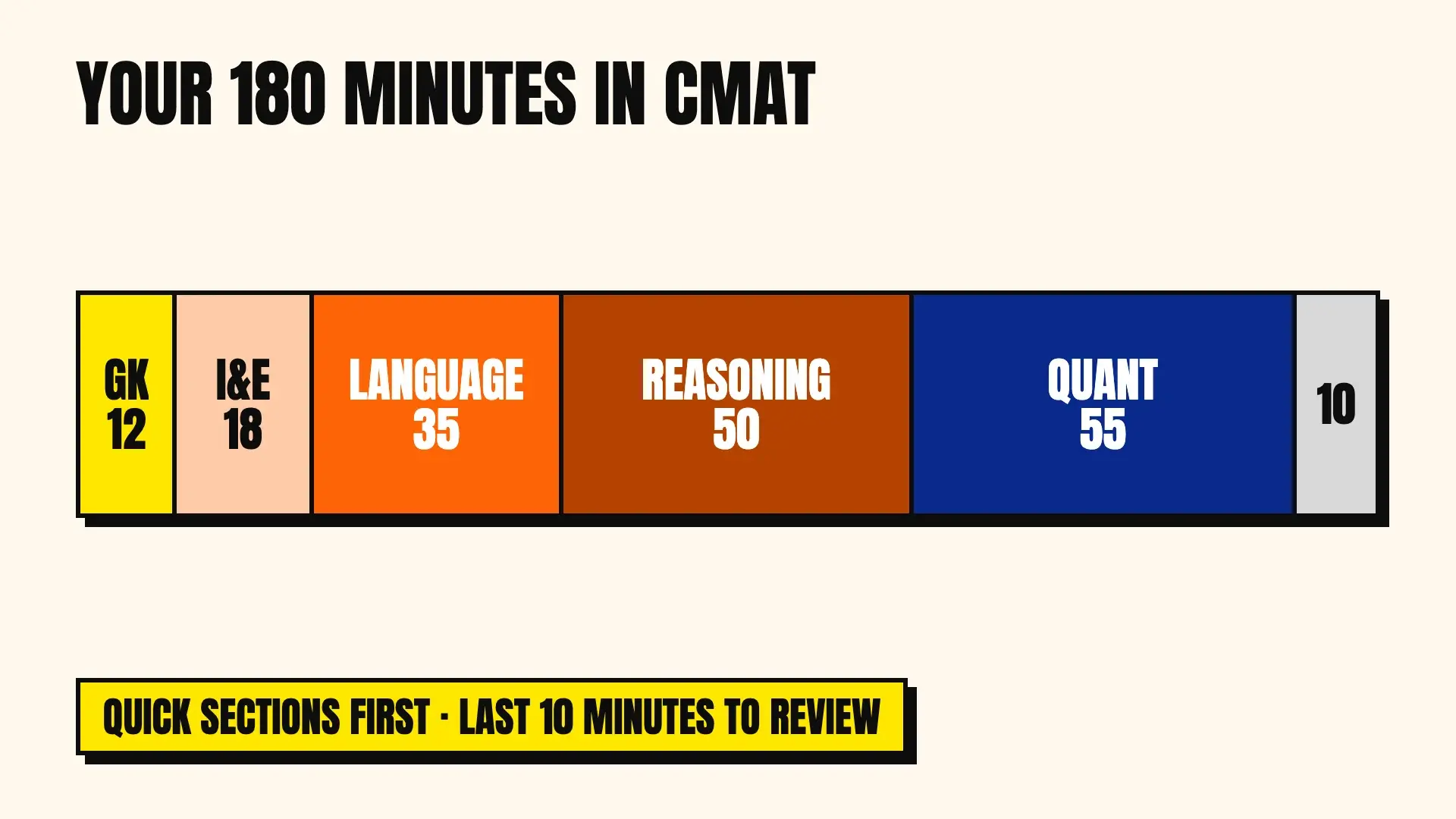
Your 180-minute plan for CMAT
| Order | Section | Minutes |
|---|---|---|
| 1 | General Awareness | 12 |
| 2 | Innovation and Entrepreneurship | 18 |
| 3 | Language Comprehension | 35 |
| 4 | Logical Reasoning | 50 |
| 5 | Quantitative Techniques and DI | 55 |
| 6 | Review of marked questions | 10 |
Starting with GA and I&E gives you quick marks and a calm head for the three thinking sections. Mark doubtful questions as you go and return to them in the last ten minutes.
If quant is your strength, test the reverse order in a mock: Quant, Reasoning, Language, I&E, GA. Keep whichever order scores higher across three mocks.
How long does it take to prepare for CMAT?
| Your situation | Time needed | Focus |
|---|---|---|
| You prepared for CAT or XAT | 4 to 5 weeks after those exams | GA and I&E daily, accuracy drills, 8 to 10 CMAT mocks |
| You start fresh, with good basics | About 60 days at 5 to 7 hours a day | All five sections, with GA and I&E from day one |
| You start fresh as a beginner | 4 to 6 months at 2 to 3 hours a day | Arithmetic, grammar and a daily newspaper first |
CMAT falls after CAT and XAT in the season, so most candidates carry their quant, reasoning and reading from those exams. The two sections they don't carry are GA and I&E. Start those two early, even while you prepare for CAT: 45 minutes a day is enough.
For a full schedule, the 60-day CMAT preparation plan goes phase by phase, and the plan for preparing for all MBA exams together shows how CMAT fits beside the others.
A four-phase study plan for CMAT
| Phase | Goal | Main work | Mocks |
|---|---|---|---|
| 1. Build | Fix basics | Arithmetic, reasoning basics, vocabulary, static GK | A diagnostic mock, then one more |
| 2. Strengthen | Add the rest | Algebra, geometry, DI, I&E notes, current affairs | One a week |
| 3. Convert | Raise accuracy | Mocks, error log, GA revision | One every three days |
| 4. Perform | Peak on exam day | Full mocks at the exam's time, revision, a fixed sleep routine | Two in the last week |
A day for a full-time student:
| Time | Task |
|---|---|
| 7 to 9 am | Quant: one concept and 25 questions |
| 9:30 to 10:30 am | Reasoning: 25 questions |
| 11 am to 12 pm | Language: one RC and 15 verbal questions |
| 2 to 3 pm | I&E notes and 10 questions |
| 5 to 5:45 pm | Newspaper and static GK |
| 8 to 9 pm | Error log and revision |
How many mocks should you take for CMAT?
Take 12 to 14 full mocks of three hours each, plus the last two CMAT papers under a timer. Sit them at the same hour as the exam.
After each mock, note:
| Item | Note it for each mock |
|---|---|
| Score out of 400 | |
| Attempts in each section | |
| Wrong answers | Each costs 1 mark |
| Blind guesses you made | Target: none |
| Time in each section | |
| GA and I&E score | |
| Silly mistakes | |
| Next three actions |
A mock takes three hours and its analysis two to three more. Keep the next day light. Add each I&E fact you missed to your notes sheet and each GA fact to a running list.
Top colleges you can target with 99+ percentile in CMAT
| Rank | College | City | Approximate cutoff percentile |
|---|---|---|---|
| 1 | JBIMS | Mumbai | 99.9+ |
| 2 | SIMSREE | Mumbai | 99.7+ |
| 3 | PUMBA | Pune | 99+ |
| 4 | K J Somaiya | Mumbai | 95 to 98 |
| 5 | WeSchool (Welingkar) | Mumbai | 90 to 93 |
| 6 | NIBM | Pune | 90 to 92 |
| 7 | BIMTECH | Greater Noida | 90 to 92 |
| 8 | NIA | Pune | 90 to 92 |
| 9 | N L Dalmia | Mumbai | 90 to 92 |
| 10 | SIES, Jaipuria or XIME | Several cities | 80 to 85 |
Approximate percentiles for all-India seats, as listed in Crack CMAT in 60 Days. Acceptance and cutoffs change every year.
How CMAT colleges select candidates
There are two routes.
The Maharashtra CAP route. JBIMS, SIMSREE and PUMBA fill their all-India seats through the Centralised Admission Process run by the State CET Cell. The merit list uses your entrance score alone. Your class 10, class 12 and graduation marks carry no weight at this stage, and there is no group discussion or interview for CAP seats. If your academics are weak and your CMAT score is strong, this is your best route. The MBA CET CAP process guide explains the rounds, the option form and the freeze, float and slide choices.
The private college route. K J Somaiya, WeSchool, NIBM, BIMTECH and other PGDM colleges shortlist on your CMAT percentile and then hold a group discussion and a personal interview. You apply to each one separately.
Whichever route you take, register for the CAP and for each private college before its own deadline. A high score with a missed form gets you nothing.
Eight mistakes that keep you below 99
| # | Mistake | Fix |
|---|---|---|
| 1 | Treating CMAT as a speed paper | Aim for 90 percent accuracy |
| 2 | Guessing blind | Cut one option first |
| 3 | Ignoring Innovation and Entrepreneurship | Six pages of notes can bring 60 marks |
| 4 | Reading only current affairs | Static GK is most of the GA section |
| 5 | Leaving GA for the last week | 45 minutes a day from the start |
| 6 | Skipping the CAP form | Track the State CET Cell dates |
| 7 | Taking no full mocks | 12 to 14 three-hour mocks |
| 8 | Weak vocabulary | 20 words a day |
Frequently asked questions
How many marks are required for 99 percentile in CMAT?
About 258 to 265 marks out of 400 earned a 99 percentile in the latest CMAT. The year before, it took about 270. Aim for 280 or more in mocks, since the figure rises when the paper is easier.
How many questions should I attempt in CMAT for 99 percentile?
Around 76 attempts with 68 right and 8 wrong gives 264 marks, which matched the 99th percentile in the latest paper. You can leave about 24 questions, most of them in General Awareness, if your accuracy stays near 90 percent.
Is 300 a good score in CMAT?
Yes. A score of 300 has been at or above the 99.5 percentile in the last two papers. It clears PUMBA's usual range and brings SIMSREE close. JBIMS needs more still for its all-India seats.
Is there negative marking in CMAT?
Yes. Each correct answer earns 4 marks and each wrong answer costs 1 mark. A blank scores nothing. With four options, a guess is worth taking once you have cut at least one option.
How do I prepare for Innovation and Entrepreneurship in CMAT?
Make one sheet of notes covering startup terms, funding stages, business models, intellectual property basics, and government schemes and founders. Revise it weekly and practise 10 questions a day. The section has 20 questions and rewards plain recall.
How do I prepare for General Awareness in CMAT?
Read a newspaper daily and study static GK alongside it, since static questions outnumber current affairs. In the exam, attempt the questions you are sure of and skip the rest. Forty-five minutes a day from the start of your preparation is enough.
Is CMAT easier than CAT?
The quant, reasoning and language questions are easier than CAT's, and you get more time for each. The difficulty comes from two extra sections, General Awareness and Innovation and Entrepreneurship, and from the high accuracy the top colleges demand.
Can I get JBIMS through CMAT?
Yes. JBIMS admits candidates to its all-India seats through the Maharashtra CAP, which accepts CMAT scores. The all-India cutoff has been about 99.9 percentile or higher, so you need marks well above the 99 percentile figure.
Does CMAT have sectional cutoffs?
NTA reports a score for each section and a total. The Maharashtra CAP ranks candidates on the overall percentile. Some private colleges look at sectional scores, so check the admission criteria of each college you apply to.
How many mocks should I take for CMAT?
Twelve to fourteen full three-hour mocks are enough, along with the last two CMAT papers. Analyse each for two to three hours, and count your blind guesses and wrong answers in each one.
Sources
- Pattern, marking scheme and schedule: cmat.nta.nic.in (official)
- Score vs percentile estimates: MBAUniverse and Cracku
- CAP admission process: State CET Cell, Maharashtra (official)
- Attempt tables, paper analysis, time plan, colleges and the four-phase plan: Crack CMAT in 60 Days by The 99 Percentiler
Related reading: CMAT preparation in 60 days · MBA CET CAP process · How to crack 99+ percentile in MBA CET · How to crack 99+ percentile in CAT · How to crack 99+ percentile in MBA entrance exams · Free MBA exam calendar
The CMAT playbook has the topic chapters, the GA and I&E notes, the 60-day calendar and a mock tracker you can print.