You've been preparing for CAT for months. CMAT is next, and when you open its syllabus you find two sections you've never studied: General Awareness and Innovation & Entrepreneurship. Forty questions, 160 marks, and no CAT book covers them.
That's the opportunity. Most CMAT takers already have decent Quant, reasoning and English from CAT or other exams. The students who pull ahead are the ones who treat General Awareness and Innovation & Entrepreneurship as a real 40 percent of the paper and give them a daily slot. Those two sections need memory more than problem-solving, so they reward a steady 45 minutes a day.
Quick answer: To prepare for CMAT in 60 days, spend about 45 minutes daily on General Awareness and Innovation & Entrepreneurship, and the rest on Quant, Reasoning and Language. Take 12 to 14 full 3-hour mocks. On exam day, do GA and I&E first in about 30 minutes, then Language, Reasoning and Quant. Aim for 70 to 80 attempts at high accuracy.
The CMAT pattern
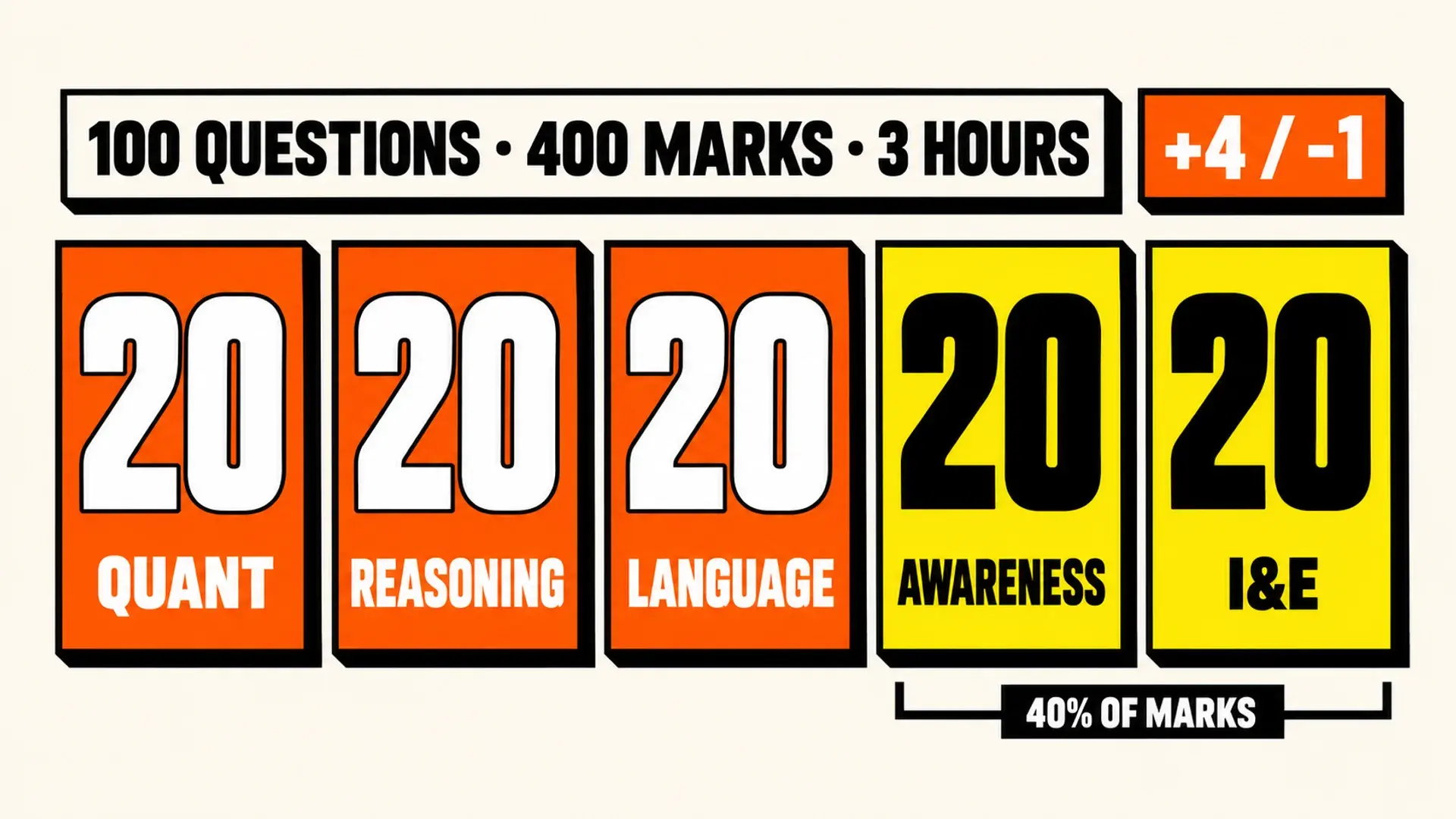
| Section | Questions | Marks |
|---|---|---|
| Quantitative Techniques and Data Interpretation | 20 | 80 |
| Logical Reasoning | 20 | 80 |
| Language Comprehension | 20 | 80 |
| General Awareness | 20 | 80 |
| Innovation & Entrepreneurship | 20 | 80 |
| Total | 100 | 400 |
180 minutes, computer-based, no sectional time limits, four options per question. +4 for a correct answer, −1 for a wrong one. NTA usually holds CMAT in late January or early February and publishes the dates on cmat.nta.nic.in.
The guessing maths in CMAT
CMAT's marking makes guessing more favourable than most students assume. With four options, +4 for a right answer and −1 for a wrong one:
| Situation | Expected marks per guess |
|---|---|
| Blind guess (4 options) | +0.25 |
| One option cut | About +0.67 |
| Two options cut | +1.5 |
Worked out: a blind guess is right one time in four (+4 × 0.25 = +1) and wrong three times in four (−1 × 0.75 = −0.75), which nets +0.25.
So your rule: solve everything you can first. Then, in the last minutes, guess every question where you can cut at least one option. Pure blind guesses also have a small positive expected value, but each one adds risk to your score, so keep them for the final minute.
What score do you need?
| Percentile | CMAT 2026 score (out of 400) |
|---|---|
| 99.5 | About 277 |
| 99 | About 262 |
| 98 | About 249 |
| 95 | About 225 |
| 90 | About 203 |
| 80 | About 172 |
Sources: Crack CMAT in 60 Days; Cracku CMAT score vs percentile. Estimates; CMAT 2025 needed about 275 to 285 for the 99th percentile, so the number moves with the paper.
Good attempts in CMAT 2026 were about 70 to 75 questions in total: roughly 16 to 17 in Quant, 15 to 16 in Reasoning, 14 to 16 in Language, 10 to 11 in GA and 11 to 12 in I&E (IMS India and Cracku analyses). For a safe 99, aim for about 280 in mocks.
Section-wise strategy
Quantitative Techniques and Data Interpretation
CMAT Quant is easier than CAT Quant. In CMAT 2026, arithmetic made up about 7 to 9 questions, DI 3 to 5, algebra 3 to 4, geometry 2 to 3 and number system 1 to 2. Focus on accuracy: percentages, profit and loss, ratio, mixtures, interest, time and work, speed and distance, and simple DI tables, bars and pie charts.
Logical Reasoning
Mostly traditional reasoning: coding-decoding, blood relations, direction sense, series, seating, syllogisms, ranking, statements and assumptions, clocks and calendars. Fast marks if you practise 25 questions a day.
Language Comprehension
In CMAT 2026, about 2 reading passages and 18 grammar and vocabulary questions. That makes it a fast section: error spotting, sentence improvement, fill in the blanks, one-word substitution, idioms and para jumbles. Learn 20 words a day.
General Awareness
GA in recent CMAT papers has leaned towards static GK, by one estimate about 60 to 70 percent (Crack CMAT in 60 Days). Cover:
- Static GK: headquarters of bodies, books and authors, firsts in India, constitutional articles
- Economy and business: RBI, SEBI, the Budget, major mergers and CEOs
- Current affairs from the last 8 to 10 months
- Awards and sports
Attempt a GA question only if you know it or can cut an option. Twenty minutes of news and 15 static facts a day adds up over 60 days.
Innovation & Entrepreneurship: the section most people skim
I&E is 80 marks of mostly factual questions, and a short, well-made set of notes covers most of it. Build a six-page I&E sheet with these topics:
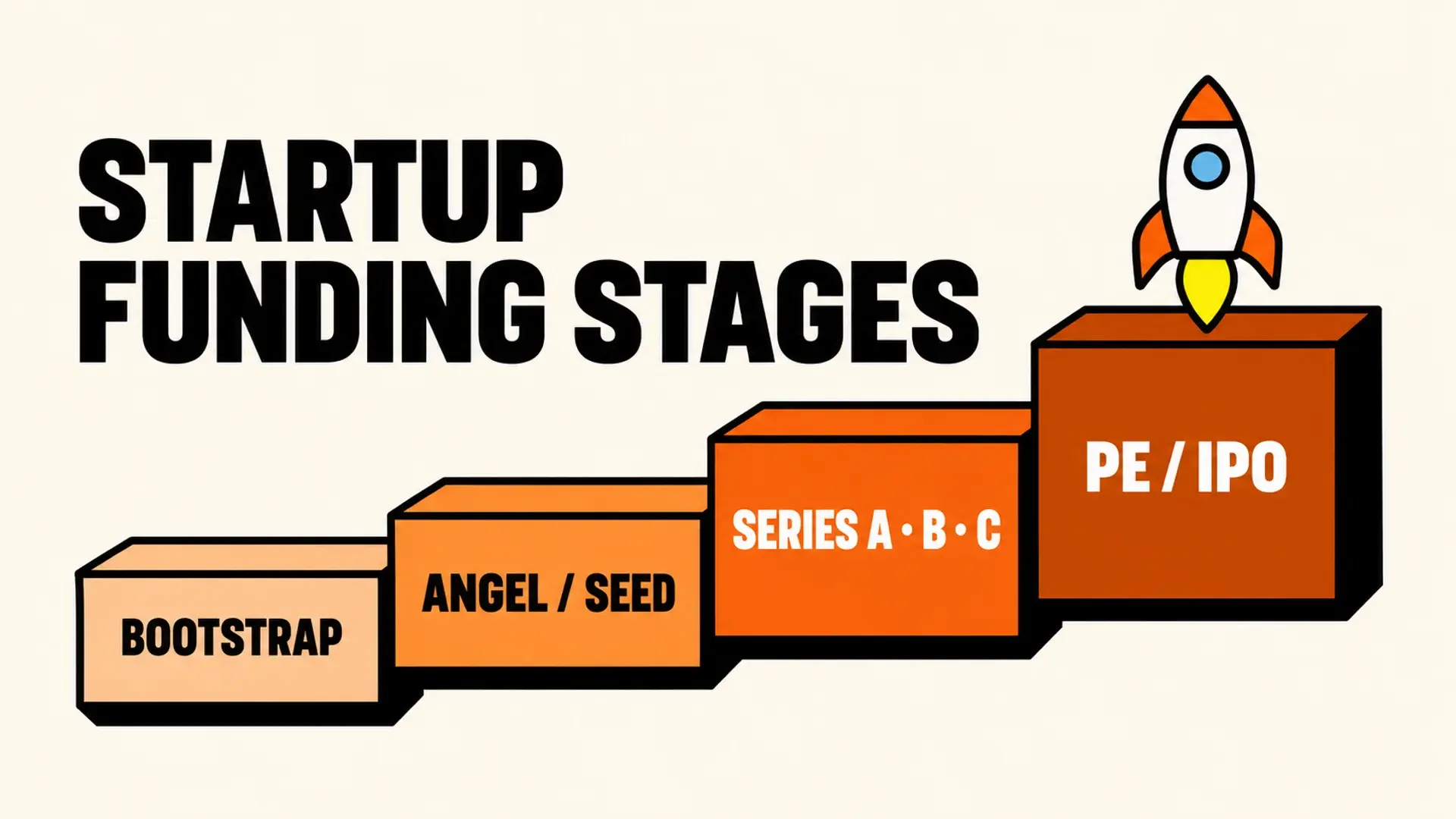
Funding stages
| Stage | Source of money |
|---|---|
| Bootstrapping | Founders' savings, friends and family |
| Angel or seed | Individual investors, early product and first users |
| Series A, B, C | Venture capital to scale up |
| Private equity or IPO | Large investors or listing on the stock market |
Incubator vs accelerator
| Incubator | Accelerator |
|---|---|
| For an early idea | For an existing startup |
| Months to years | Fixed programme, usually 3 to 6 months |
| Space and mentoring | Funding for equity, ends with a demo day |
Types of innovation: incremental (small steady improvements), disruptive (cheaper and simpler, eventually takes over the market, a term from Clayton Christensen), radical (new technology creating a new market), and reverse (built for emerging markets, then sold in richer ones).
Indian IP laws
| Law | Year |
|---|---|
| Copyright Act | 1957 |
| Patents Act | 1970 |
| Trade Marks Act | 1999 |
| Geographical Indications of Goods Act | 1999 |
Startup definition (DPIIT): an entity up to 10 years from incorporation, with annual turnover not above ₹100 crore in any financial year.
Thinkers and books
| Thinker | Known for |
|---|---|
| Joseph Schumpeter | Creative destruction |
| Clayton Christensen | The Innovator's Dilemma |
| Eric Ries | The Lean Startup |
| Peter Drucker | Innovation and Entrepreneurship |
| W. Chan Kim and Renée Mauborgne | Blue Ocean Strategy |
Also learn the nine blocks of the Business Model Canvas (Alexander Osterwalder) and current government startup schemes. CMAT 2026 I&E included terms, funding, business models, IP and short caselets.
Your exam-day time plan
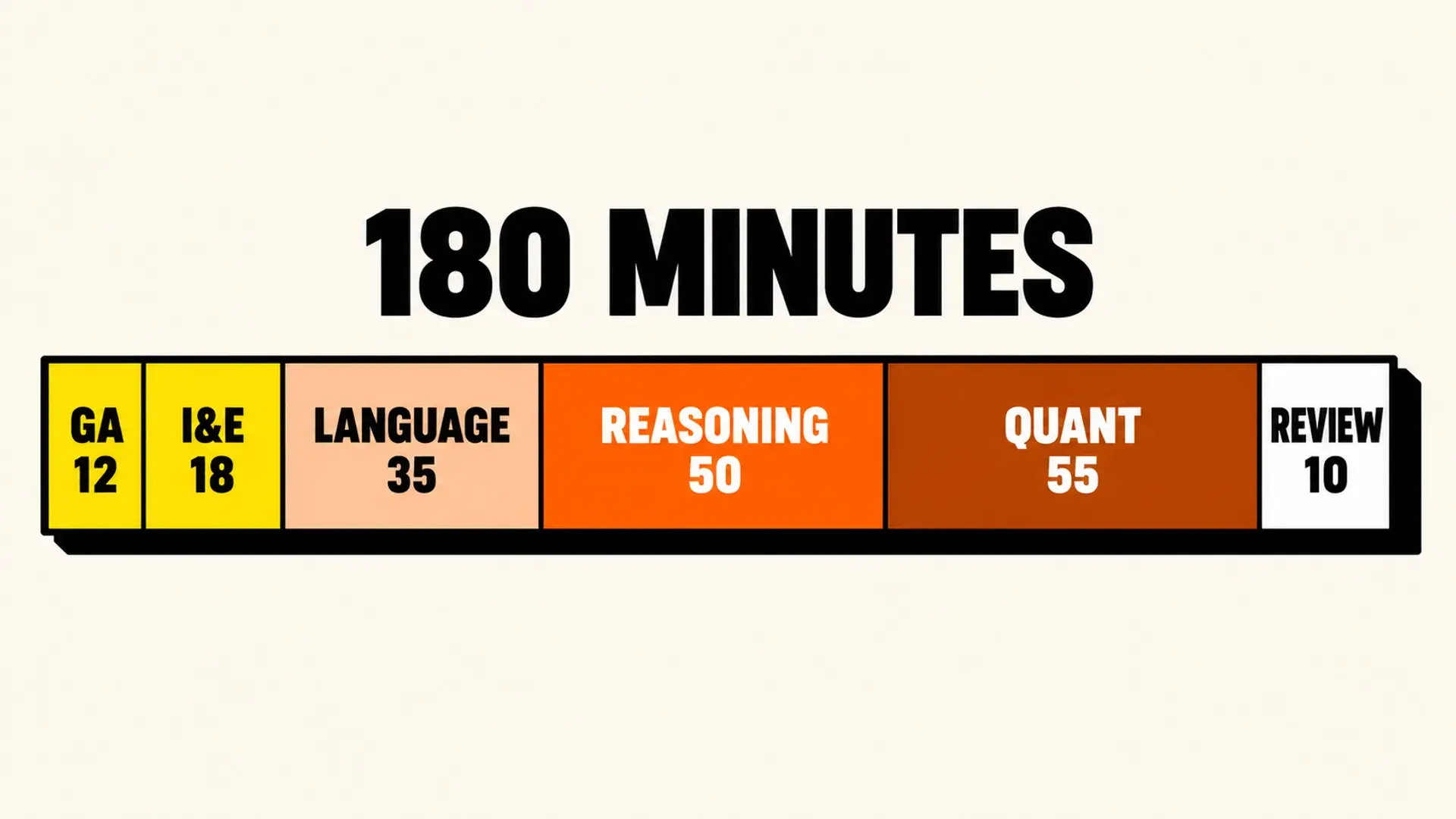
| Order | Section | Time |
|---|---|---|
| 1 | General Awareness | 12 minutes |
| 2 | Innovation & Entrepreneurship | 18 minutes |
| 3 | Language Comprehension | 35 minutes |
| 4 | Logical Reasoning | 50 minutes |
| 5 | Quant and DI | 55 minutes |
| Review marked questions | 10 minutes |
Source: Crack CMAT in 60 Days.
GA and I&E first gives you quick marks and a calm start, because you either know those answers or you don't. Test this order in mocks. If Quant is your strength, starting with it can work too.
The 60-day plan
| Phase | Days | Focus | Mocks |
|---|---|---|---|
| Build | 1 to 15 | Diagnostic mock, arithmetic, LR basics, vocabulary, static GK, first I&E notes | 3 |
| Strengthen | 16 to 30 | Algebra, geometry, DI, full I&E sheet, current affairs | 3 |
| Convert | 31 to 45 | Mock every 3 days, error log, GA revision, past CMAT papers | 4 + 2 past papers |
| Perform | 46 to 60 | Full mocks at exam time, revision, sleep routine | 4 |
Source: Crack CMAT in 60 Days.
If you're coming from CAT or XAT, your Quant, Reasoning and reading are already built. Start around Day 27 of this plan and add 45 minutes of GA and I&E every day.
Daily timetable for a full-time student (about 7 hours): Quant concept and 25 questions in the morning, 25 reasoning questions, one RC and 15 verbal questions before lunch, I&E notes and 10 questions after lunch, newspaper and static GK in the evening, and the error log at night.
For a working student (about 3.5 hours): Quant and Reasoning before work, GK and 10 words at lunch, Language and I&E at night, and a 3-hour mock every weekend.
Common CMAT mistakes
- Treating CMAT like a speed test. It rewards accuracy. Aim for 90 percent or better.
- Ignoring I&E. Six pages of notes can be worth 40 or more marks.
- Reading only current affairs for GA. Static GK carries most of the section.
- Skipping full mocks. Three hours is long. Build stamina with 12 to 14 mocks.
- Forgetting the admission step. For JBIMS, SIMSREE and PUMBA's all-India seats, a CMAT score goes through Maharashtra's CAP process. Watch the CET Cell's CAP notices after your result.
Frequently asked questions
Is 60 days enough for CMAT preparation?
Yes, especially if you have prepared for CAT or another MBA exam. Quant, Reasoning and Language overlap with other exams. Use the 60 days to add General Awareness and Innovation & Entrepreneurship and take 12 to 14 full mocks.
How do I prepare for Innovation & Entrepreneurship in CMAT?
Make a short set of notes on funding stages, incubators and accelerators, types of innovation, Indian IP laws, the DPIIT startup definition, key thinkers and books, the Business Model Canvas and government startup schemes. Revise it daily and solve 10 I&E questions a day.
What is a good score in CMAT?
In CMAT 2026, about 262 out of 400 matched the 99th percentile and about 225 matched the 95th. These numbers change with the paper, so aim for around 280 in mocks for a safe 99.
Does CMAT have negative marking?
Yes. CMAT gives +4 for a correct answer and −1 for a wrong one. Because a wrong answer costs only a quarter of a right one, a guess after cutting even one option has a clearly positive expected value.
Which colleges accept CMAT?
CMAT is accepted by many AICTE-approved institutes. In Maharashtra, JBIMS, SIMSREE and PUMBA admit all-India candidates through the CAP process using scores such as CMAT. Other colleges include K J Somaiya, WeSchool, NIBM, BIMTECH and NIA. Check each college's current admission notice.
Sources
- CMAT pattern and marking: cmat.nta.nic.in (official)
- CMAT 2026 score vs percentile: Crack CMAT in 60 Days; Cracku
- CMAT 2026 good attempts: IMS India and Cracku CMAT 2026 analyses
- Section plans, I&E notes, GA approach, time plan and 60-day plan: Crack CMAT in 60 Days by The 99 Percentiler
- DPIIT startup definition: Startup India, DPIIT notification (official)
Related reading: MBA CET CAP process explained · MBA CET time strategy · Prepare for all MBA exams together · Free MBA exam calendar 2026–27 · How to crack 99+ percentile in CMAT
The CMAT playbook has the full I&E sheet, a static GK list and the 60-day calendar.