

Your MBA CET result is out: 99.6 percentile. Your phone fills with congratulations, and then the questions start. Which colleges do you list? In what order? What happens if you get your third choice in Round 1? What on earth is "float"?
Maharashtra fills its MBA and MMS seats through the Centralised Admission Process, called CAP, run by the State CET Cell. CAP decides whether your percentile turns into JBIMS, SIMSREE, PUMBA or a college you didn't want. The process is fair and mechanical, and once you understand how it allots seats, you can avoid the mistakes that cost students their best possible college.
Quick answer: In MBA CAP, you register on the State CET Cell portal, upload and verify documents, and get placed on a merit list by your entrance score. You then fill an option form listing colleges in order of preference. After each allotment round, you choose to freeze the seat (stop), float (keep it but look for a better college) or slide (look for a better course in the same college).
Who allots MBA seats in Maharashtra?
The State Common Entrance Test Cell, Maharashtra, runs CAP for MBA and MMS programmes. The process covers government, aided and private institutes across the state, including JBIMS, SIMSREE and PUMBA. Seats are allotted on merit, which for CAP means your entrance score and nothing else. Your 10th, 12th and graduation marks don't change your CAP rank, and CAP seats have no group discussion or interview.
Two groups of candidates compete for different seats:
| Group | Which score counts | Seats |
|---|---|---|
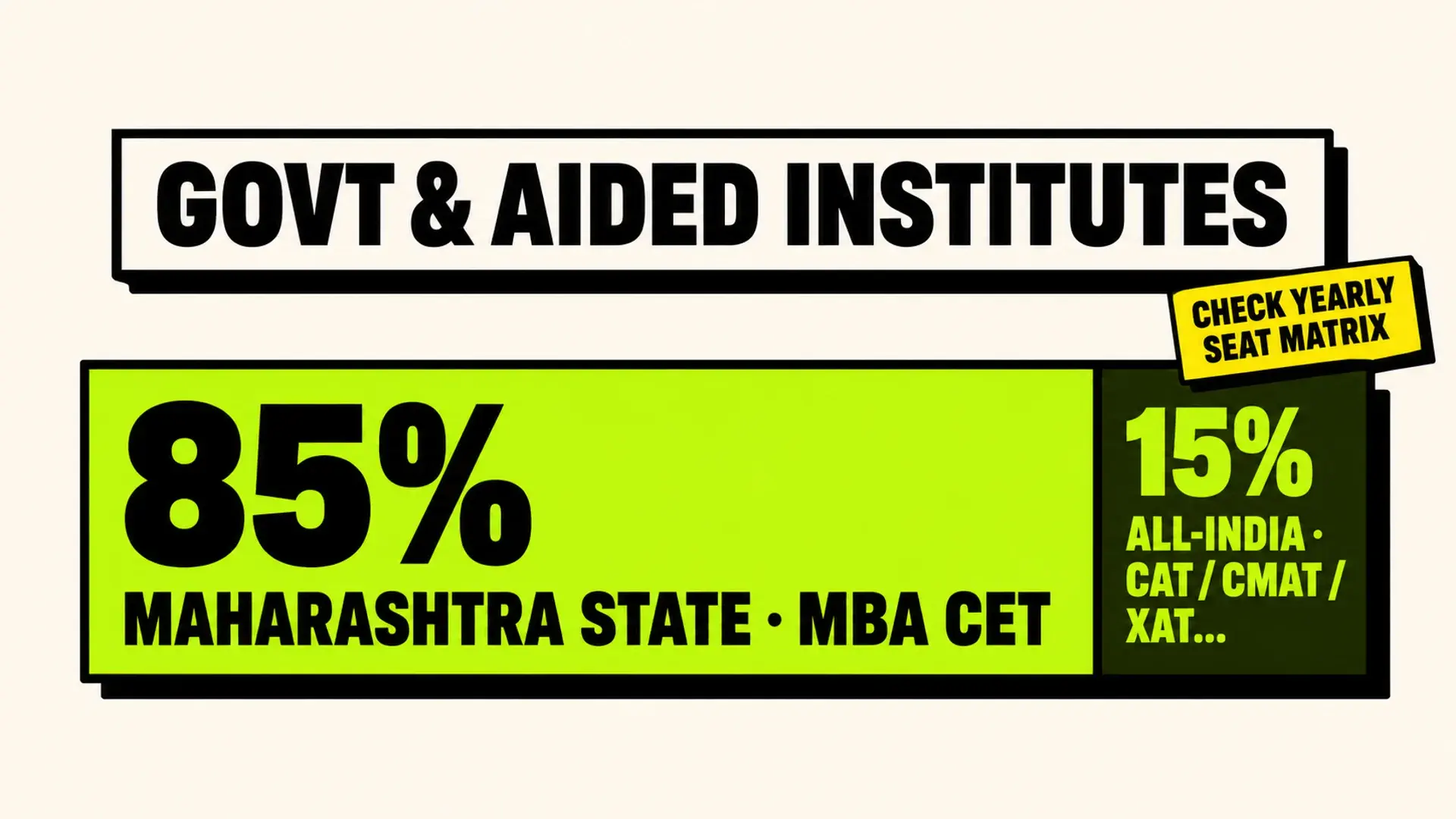
| Maharashtra State candidates | MAH MBA/MMS CET | Most seats (85 percent at government and aided institutes) |
| All-India candidates | CAT, CMAT, XAT, MAT, ATMA or MAH CET | A separate all-India share (15 percent at government and aided institutes) |
Source: CET Cell information brochures, as summarised by Hitbullseye and Collegedunia. Seat shares differ at private unaided institutes; check the seat matrix the CET Cell publishes each year.
The CAP process step by step
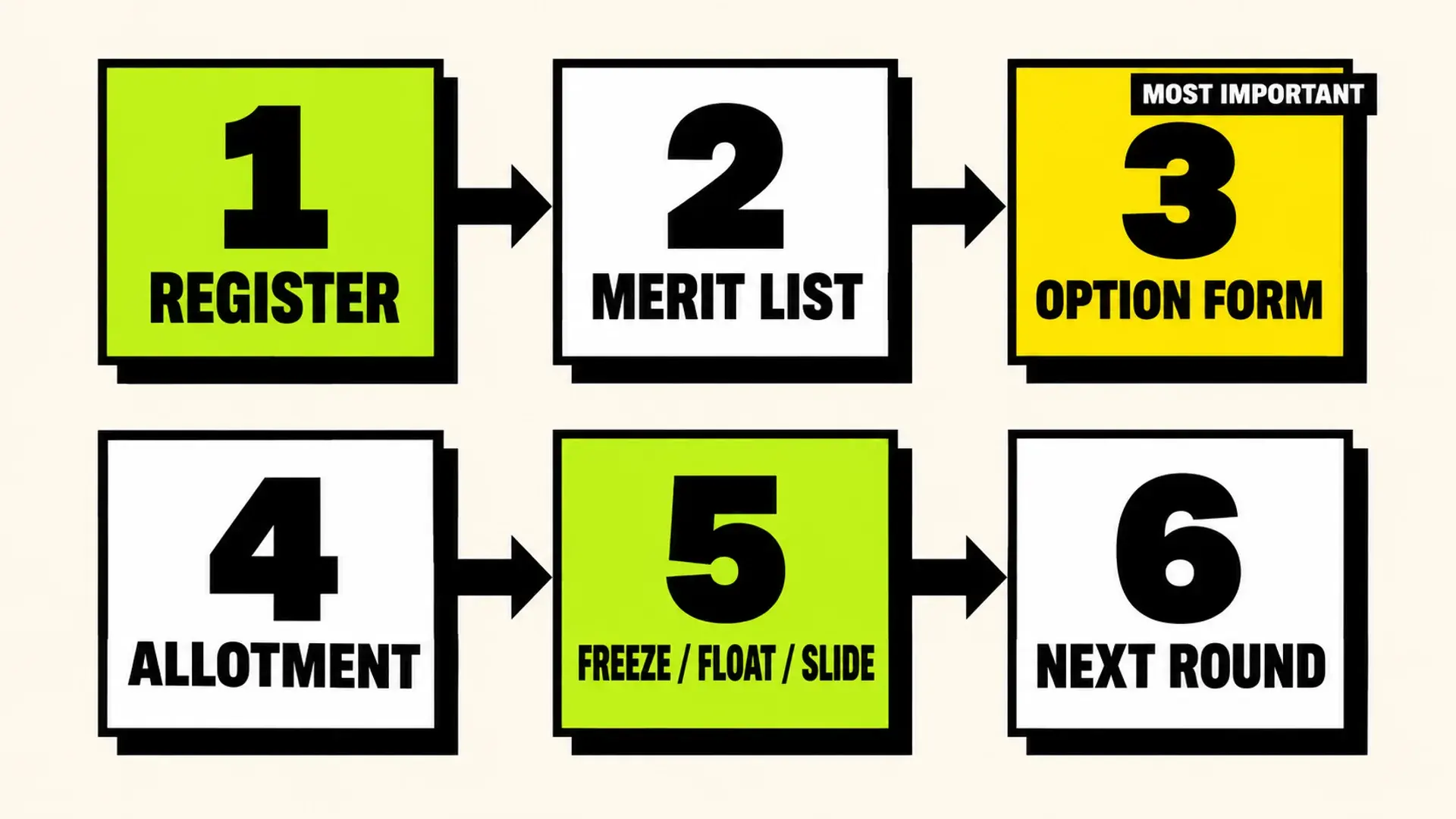
Step 1: CAP registration and documents
Register on the CET Cell's CAP portal after the result, and upload your documents. Typical documents include:
- MBA CET (or CAT, CMAT and so on) score card
- 10th, 12th and graduation mark sheets
- Domicile certificate, if you're claiming Maharashtra State candidature
- Category certificate and non-creamy layer certificate, if applicable
- EWS or other reservation certificates, if applicable
- Photo ID
Your documents are then verified, either online (e-scrutiny) or at a facilitation centre, depending on the year's rules. Mistakes here can cost you your category or your candidature type, so check every upload.
Step 2: Provisional and final merit lists
The CET Cell publishes a provisional merit list. If your name, score or category is wrong, raise a grievance in the window it gives you. Then the final merit list comes out. Your merit number decides your turn in the allotment.
Step 3: The option form
For each CAP round, you fill an option form: a list of institutes and programmes in your order of preference. This is the single most important decision in CAP.
Step 4: Seat allotment
The system goes down the merit list. For each candidate, it looks at their options from the top and gives them the highest-listed option that still has a seat in their category. You see your provisional allotment on the portal.
Step 5: Accept the seat and choose freeze, float or slide
If you get a seat, you accept it (usually by paying an acceptance fee and reporting as instructed) and choose what happens next.
Step 6: Later rounds
There are usually three CAP rounds, and sometimes an additional round for vacant seats. After CAP, institutes may fill leftover and institute-level seats themselves.
Freeze, float and slide: what each one means
| Choice | What happens | Use it when |
|---|---|---|
| Freeze | You keep this seat and leave CAP. No further rounds. | You got the college you want most, or one you'd happily settle for |
| Float | You keep this seat, and in later rounds you move up to a higher-preference college if a seat opens | You'd prefer a college listed above this one |
| Slide | You keep this seat, and you can move to a higher-preference programme in the same institute only | You like the institute but want a different programme there |
Neither float nor slide can give you a worse seat. The worst outcome is that you keep the seat you already have.
One rule to know: in past CAP rounds, candidates allotted their first-preference option have been treated as frozen, with no further rounds (Careers360 answers on CAP rules). Read the current year's information brochure to confirm how the CET Cell handles this.

How to fill your option form
Because the system gives you the highest option still available, you lose nothing by listing a college you're unlikely to get above one you're likely to get. You lose a lot by listing them in the wrong order.
- List colleges in your true order of preference. Dream colleges first, then targets, then safe options.
- Don't list a college you wouldn't join. If it's allotted and it's your first preference, you may be locked in.
- Look at last year's closing percentiles for each college and your category, round by round. Cutoffs at the top move in decimals: 99.5 and 99.9 can mean different colleges.
- Order by what you value, not by name alone. Fees, placements, location and specialisation all matter. SIMSREE, for example, charges about ₹1.4 lakh in total fees for a reported average package around ₹15 lakh a year (Crack MBA CET in 60 Days; figures change every year).
- Recheck the form before each round. You may be able to edit preferences for later rounds.
A worked example
Priya scores 99.7 percentile in MBA CET. Her honest preference order: JBIMS, SIMSREE, PUMBA, a well-known private college as a safe option.
- Round 1: She's allotted SIMSREE, her second preference. She chooses float, because she'd still prefer JBIMS.
- Round 2: A JBIMS seat in her category doesn't reach her merit number. She keeps SIMSREE and stays on float.
- Round 3: Still no JBIMS seat. She ends CAP with SIMSREE, the seat she already held.
Floating cost Priya nothing. If she had frozen SIMSREE in Round 1, she would have had no chance at JBIMS. If she had listed the private college above SIMSREE, the system would have allotted that college instead and she might never have seen SIMSREE at all.
Common CAP mistakes
- Missing a deadline. CAP rounds move fast. Check the CET Cell site every day while CAP is running.
- Wrong order on the option form. The system follows your list in the exact order you enter it.
- Listing colleges you won't join. An unwanted allotment can lock you in.
- Freezing too early. If you'd prefer a college above your allotment, float.
- Not paying the acceptance fee or reporting on time. You can lose the allotted seat.
- Ignoring document details. A missing certificate can change your candidature type or category.
Frequently asked questions
What is CAP in MBA admissions in Maharashtra?
CAP is the Centralised Admission Process run by the State CET Cell, Maharashtra. It allots MBA and MMS seats in participating institutes based on your entrance score and your option form, round by round.
What is the difference between freeze and float in MBA CAP?
Freeze means you keep your allotted seat and leave CAP. Float means you keep your seat but stay in later rounds, where you can move up to a higher-preference college if a seat opens. Floating can't give you a worse seat.
Does JBIMS have a GD or interview for CAP seats?
No. CAP seats at JBIMS and other participating institutes are allotted on your entrance score and option form, with no group discussion or interview. Some programmes or institute-level seats may have their own process.
Can I get into JBIMS through CAT or CMAT?
Yes, through the all-India seats in CAP. All-India candidates can use scores from exams such as CAT, CMAT, XAT, MAT, ATMA or MAH CET. Maharashtra State candidates use their MAH MBA CET score.
How many CAP rounds are there for MBA in Maharashtra?
There are usually three CAP rounds, sometimes followed by an additional round for vacant seats. After that, institutes may fill remaining seats at the institute level. Check the current year's schedule on the CET Cell website.
Sources
- CAP process, candidate types and rounds: State CET Cell, Maharashtra, cetcell.mahacet.org (official information brochure)
- Freeze, float and slide definitions: Collegedunia and Careers360 CAP guides
- Seat shares at government and aided institutes: Hitbullseye and Collegedunia CAP seat matrix summaries
- First-preference rule in past rounds: Careers360 answers on CAP allotment
- Fees and package figures, CAP steps: Crack MBA CET in 60 Days by The 99 Percentiler
- The example student in this article is illustrative, not a real case
Related reading: MBA CET time strategy · CMAT in 60 days · Which MBA exams should you take? · Free MBA exam calendar 2026–27 · How to crack 99+ percentile in MBA CET
The MBA CET playbook includes a CAP tracker and a college list sorted by fees and packages.